
Retailers cannot afford to base pricing decisions on occasional visits to competitors’ websites and stores. Prices and promotions change across stores and marketplaces, while manual checks, mismatched products, and slow approvals consume time and can erode margins. Software for competitor price analysis tracks and examines the prices set by rivals, thereby assisting dedicated teams in monitoring market shifts and making key decisions based on up-to-date, comparable data. The best competitive pricing software turns those observations into an actionable pricing process.
TL;DR
- Yieldigo: AI-powered pricing and promotion optimization for grocery and FMCG retailers balancing competitive position, elasticity, and profit.
- Competera: Retail AI pricing platform that combines competitive data with demand-led optimization.
- Pricefx: Configurable enterprise price management, analytics, and optimization workflows.
- Revionics: Retail-focused AI optimization for everyday prices, promotions, and markdowns.
- Omnia Retail: Price intelligence and rule-driven dynamic pricing for digital retailers.
- Prisync: Accessible e-commerce competitor tracking with repricing options.
- Price2Spy: Detailed price monitoring, historical reports, alerts, and configurable repricing.
- Wiser Solutions: Cross-channel market visibility and enterprise price intelligence.
- Minderest: Competitive price and assortment intelligence for complex catalogs.
- Dealavo: E-commerce monitoring, marketplace intelligence, and AI-assisted repricing.
- Intelligence Node: AI-supported product matching and retail market analytics.
- Skuuudle: Managed product matching, competitive benchmarking, and tailored data collection.
What is competitor pricing software?
Competitor pricing software is a tool that automatically collects, matches, analyzes, and compares competitors’ prices so retailers can make informed pricing decisions. It gathers data from relevant stores and marketplaces, identifies differences in regular and promotional prices, and reveals how a retailer’s market position changes over time. Product matching matters: a price comparison is useful only when the products, sizes, and offers are genuinely comparable.
The best systems incorporate demand forecasting, price recommendation generation, and price elasticity analysis. These tools can assist your team in making critical decisions, such as whether to align prices with competitors, protect margins on products with high price sensitivity, or pursue a premium pricing strategy. For many stores and retail chains selling fast-moving consumer goods (FMCG), business performance often depends not just on individual stock-keeping units (SKUs), but rather on the interrelationships between products and the overall composition of the consumer’s shopping basket. This broader view connects competitive intelligence with price optimization.
How We Evaluated the Best Competitor Pricing Solutions for 2026
The number of tracked websites says little about the quality of a pricing decision. Reliable competitor pricing software must deliver accurate product matches, timely observations, usable analytical tools, and workflows that fit the retailer’s existing operations. A system that monitors thousands of prices but regularly compares different pack sizes can produce misleading recommendations.
In this article, we compare 12 platforms based on six key practical criteria, drawing on vendor documentation, user reviews from the G2 platform (all data is current as of November 2026), and publicly available information regarding pricing plans. Specialized price-tracking tools, comprehensive business optimization solutions, and automated dynamic pricing systems are designed to address distinct objectives; therefore, their features, capabilities, and limitations must be evaluated within that specific context. Product ratings on G2 reflect user opinions and do not serve as verified indicators of forecast accuracy or return on investment (ROI).
Evaluation Criteria
- Data accuracy and product matching. Exact and equivalent SKU identification; barcodes and other identifiers; pack-size normalization; currencies, promotions, and consistent collection. Incorrect matches can make a price gap appear where none exists.
- Coverage and freshness. Number and relevance of websites, marketplaces, and regions; refresh frequency; availability information; and historical records. Updates must arrive soon enough to support the retailer’s actual decision cycle.
- AI and optimization. Separation of simple competitor-based repricing from recommendations using sales history, elasticity, scenario simulations, and margin constraints. Matching the lowest observed price is not a profitability strategy by itself.
- Automation and workflows. Alerts, configurable rules, approval stages, exceptions, and execution. Automation should reduce routine work without removing commercial oversight.
- Integration and scalability. Compatibility with ERP, POS, PIM, e-commerce, and BI systems, plus support for large assortments, locations, price zones, and omnichannel operations.
- Pricing and feedback. Published subscription details versus negotiated contracts, onboarding and integration costs, and the volume, recency, and relevance of G2 or Capterra reviews.
12 Best Competitor Pricing Software Tools in 2026
The platforms below span three broad approaches: competitor monitoring, rule-based repricing, and demand-led optimization. A team running an online store may value alerts and fast execution, whereas a supermarket chain may need elasticity, category relationships, and pricing approvals across locations.
We recommend starting with the comparison table, which will help you quickly identify the primary use case for each product and the volume of available user reviews. Next, examine the individual product profiles provided below, paying close attention to their practical benefits, pricing transparency, alignment with your business needs, and any potential limitations. A high rating on the G2 platform does not necessarily mean that a product is the ideal choice for your specific business; you may have entirely different communication channels, unique budgetary constraints, or highly specific requirements regarding the quality of the data you receive.
Competitor Pricing Software Comparison Table
| Software | Best For | G2 Rating (Reviews) |
| Yieldigo | AI-powered grocery & FMCG pricing optimization | 4.6 / 5 |
| Competera | AI-driven retail price optimization | 4.9 / 5 |
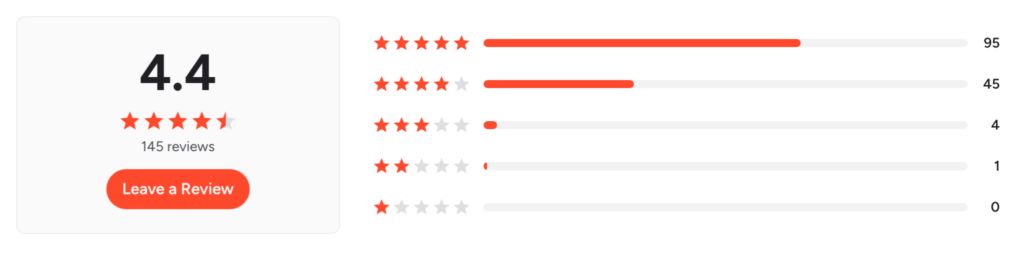
| Pricefx | Enterprise pricing management | 4.4 / 5 |
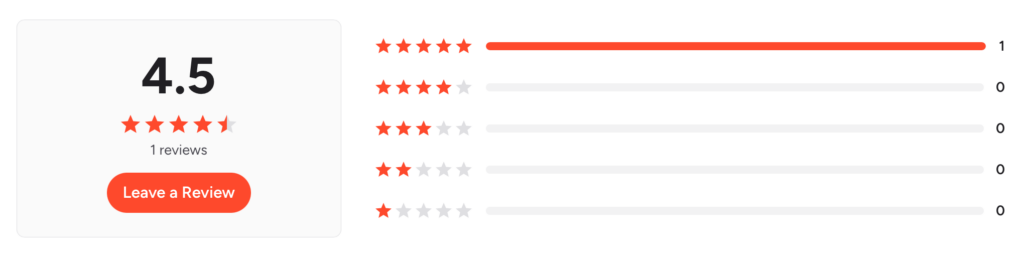
| Revionics | Retail price and promotion optimization | 4.5 / 5 |
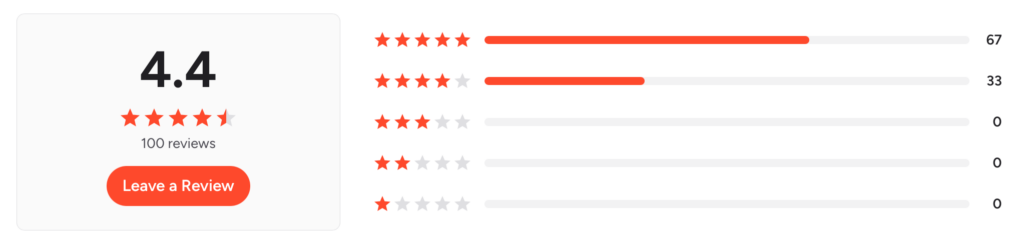
| Omnia Retail | Automated competitive repricing | 4.4 / 5 |
| Prisync | E-commerce price tracking | 4.7 / 5 |
| Price2Spy | Competitor price monitoring | 4.8 / 5 |
| Wiser Solutions | Enterprise price intelligence | 4.3 / 5 |
| Minderest | Price and assortment intelligence | 4.7 / 5 |
| Dealavo | E-commerce competitive intelligence | 4.3 / 5 |
| Intelligence Node | AI-driven retail market intelligence | 4.5 / 5 |
| Skuuudle | Product matching and benchmarking | 4.8 / 5 |
Yieldigo – Best for AI-Powered Grocery & FMCG Pricing Optimization
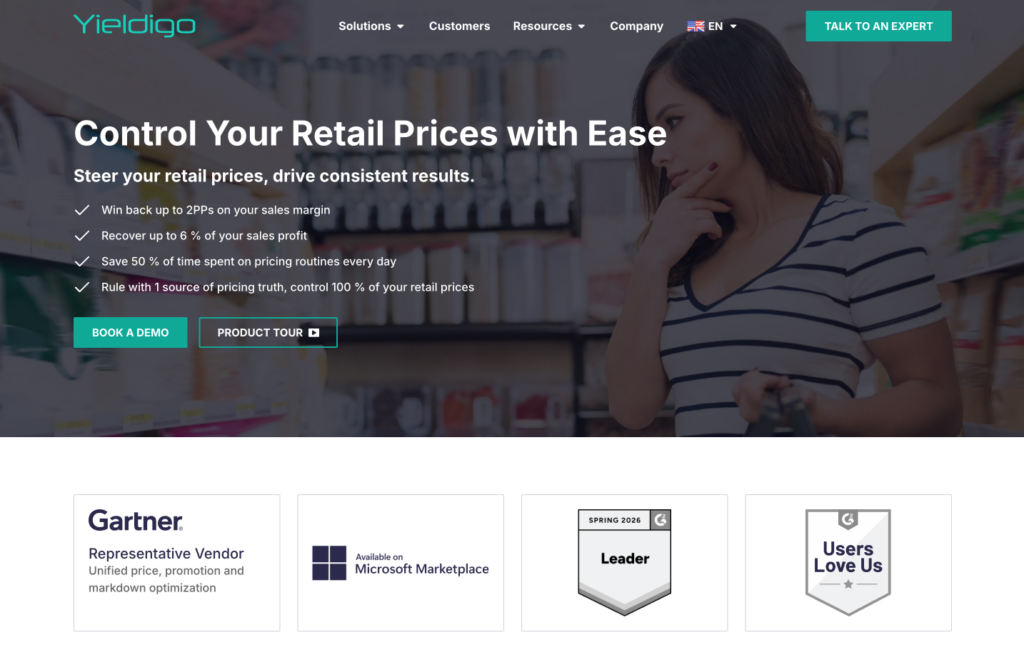
What Is Yieldigo?
Yieldigo is an AI-powered retail pricing and optimization platform built for grocery chains, supermarkets, and FMCG retailers with large assortments. It helps teams set prices in line with margin objectives, competitive positioning, and customers’ perception of value. Rather than requiring every product to follow the lowest competitor price, Yieldigo gives pricing managers ways to apply different strategies across their assortments.
This approach is distinguished by its integration of machine learning, price elasticity analysis, scenario modeling, historical sales data, and defined business rules. In this context, competitive intelligence becomes just one of many factors used to make broad pricing decisions, decisions that also account for product category performance, business constraints, and specific interdependencies between products. For retailers, adopting AI-driven pricing software leads to a shift in focus: instead of simply mirroring competitors’ prices, a company can evaluate how a change in the price of an item will specifically impact sales volume and profit.
Best For
Yieldigo is particularly relevant to supermarkets and grocery or FMCG groups managing thousands of SKUs, multiple categories, and several stores or price zones. Teams need to react to competitor movements on important products while protecting margins elsewhere and maintaining a coherent price image.
Typical users include pricing managers, category managers, commercial directors, and analysts moving beyond fragmented spreadsheets. The platforms support specific structural processes that incorporate principles and rules established by retailers. This is particularly useful in cases where pricing decisions require an analysis across a wide range of products and retail locations.
Key Capabilities of Yieldigo
- AI-powered price optimization. Recommends prices using demand patterns and commercial targets rather than competitor prices alone.
- Price elasticity analysis. Estimates how customer demand may respond to a proposed price change.
- Competitor-aware strategies. Uses relevant market comparisons within configurable margin and positioning rules.
- Scenario simulation. Lets teams assess possible outcomes before implementing a pricing strategy.
- Category-level optimization. Consider related products and categories instead of treating every SKU independently.
- Pricing workflows. Supports structured price reviews, business rules, and automation for recurring decisions.
Strategic Strengths of Yieldigo
Yieldigo’s main advantage is its combination of AI-supported recommendations with commercial control. A supermarket can defend prices on key value items while evaluating margin opportunities elsewhere, taking into account how shoppers perceive an entire category. Its price management and promotion management capabilities are particularly relevant when everyday and promotional decisions must follow the same strategy.
Considerations When Choosing Yieldigo
Conducting comprehensive optimization requires convenient access to data, including sales history, product hierarchies, and pricing information. Retailers need to pay special attention to system integration, staff training, and data preparation. A small online merchant looking only for competitor website alerts may find this broader retail price optimization software more extensive than necessary.
Pricing: Custom enterprise quote based on assortment scope, modules, and implementation needs.
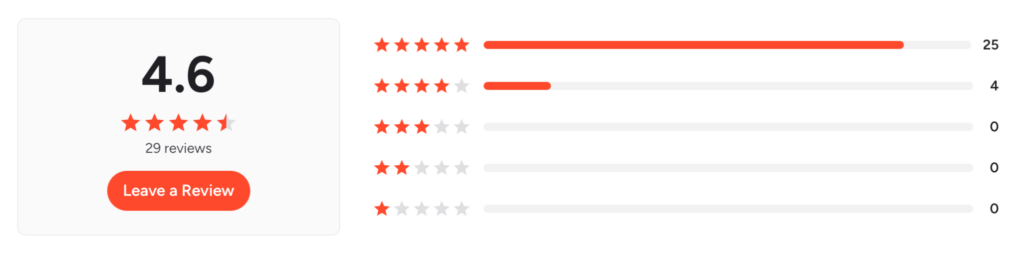
G2 rating: 4.6 / 5 from 28 reviews
Competera – Best for AI-Driven Retail Price Optimization
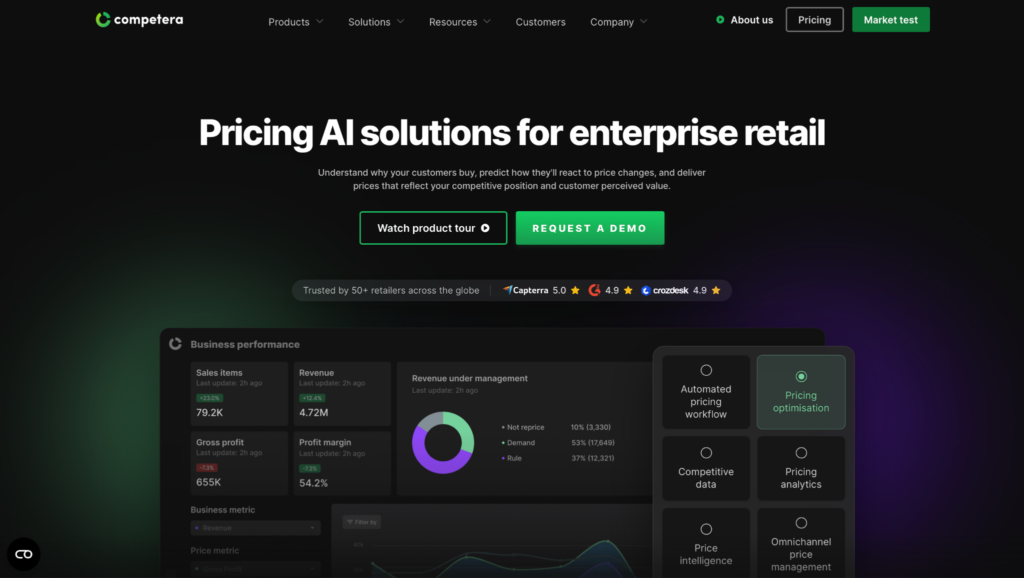
What Is Competera?
Competera is an AI-powered retail pricing platform designed to help retailers make informed pricing decisions using competitive intelligence, demand modeling, and advanced analytics. The software integrates competitor price monitoring with pricing rules and optimization tools, thereby enabling companies to assess the market situation in relation to their own commercial performance metrics.
Best For
Competera is best suited for mid-sized and enterprise retailers managing extensive product catalogs, multiple sales channels, and complex pricing requirements. It is particularly useful for pricing managers, category managers, and commercial teams that need to balance competitive positioning with revenue and margin objectives. Retailers with reliable historical sales data and established pricing processes are better positioned to benefit from its advanced optimization capabilities. For a deeper comparison of this segment, see Competera alternatives.
Key Capabilities of Competera
- AI-powered price optimization. Supports pricing recommendations based on demand patterns, historical transactions, and commercial objectives.
- Competitor price intelligence. Incorporates external market pricing information into retail pricing decisions.
- Price elasticity analysis. Helps retailers understand how changes in price may influence customer demand.
- Scenario modeling. Allows teams to evaluate potential pricing outcomes before implementing changes.
- Inventory-aware pricing. Can incorporate inventory-related signals into pricing strategies.
- Configurable pricing rules. Supports business-defined constraints and pricing policies across products and channels.
Strategic Strengths of Competera
Competera’s main strength is its ability to connect competitive market information with demand-oriented pricing optimization. Retailers, for their part, can evaluate whether it is truly necessary, from a commercial standpoint, to respond to a drop in competitors’ prices; ultimately, however, they end up setting the same price, that is, the lowest one.
Considerations When Choosing Competera
Competera’s advanced functionality requires reliable commercial data and a clearly defined pricing strategy. Retailers must first assess the quality of their historical sales data, their internal capacity to process AI-generated pricing recommendations, and the requirements for integrating such recommendations into their operations.
Pricing: Product editions and scope-based quotations; request current terms from Competera.
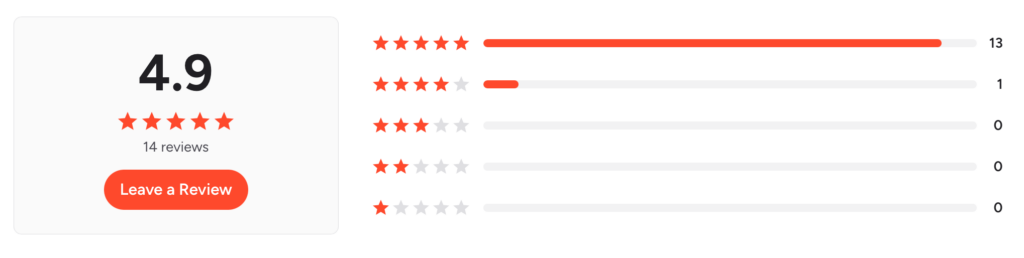
G2 rating: 4.9 / 5 from 14 reviews
Pricefx – Best for Enterprise Pricing Management

What Is Pricefx?
Pricefx is an enterprise pricing software platform that helps businesses manage pricing strategies, analytics, optimization, and execution through configurable workflows. This solution is designed to support organizations that have complex pricing structures, numerous sales departments, and extensive product portfolios.
Best For
Pricefx is best suited for large enterprises and organizations with complex pricing operations across products, regions, and business units. This platform is highly relevant for addressing issues related to pricing, as well as for establishing a structured framework for more precise price control. Its capabilities can also support businesses operating in both B2B and B2C environments.
Key Capabilities of Pricefx
- Enterprise price management. Centralizes pricing processes, policies, and price lists across business units.
- Price optimization. Supports analytical approaches to evaluating and improving pricing decisions.
- Pricing analytics. Provides tools for examining pricing performance and commercial outcomes.
- Approval workflows. Helps organizations manage pricing changes through structured review processes.
- Business rule configuration. Allows teams to establish pricing constraints and commercial policies.
- Enterprise integrations. Connects pricing operations with relevant corporate systems and data sources.
Strategic Strengths of Pricefx
Pricefx’s primary advantage is its flexibility in managing complicated enterprise pricing processes. The platform can serve to coordinate new policies, even in complex or non-standard scenarios, ensuring consistency and long-term stability.
Considerations When Choosing Pricefx
Pricefx is not primarily designed as a plug-and-play competitor price scraper. Whether you are looking to gather external market data, compete more effectively, or simply gain insight into specific information, this solution helps you navigate and integrate these elements into your existing operational workflows.
Pricing: Custom enterprise licensing and implementation quote.
G2 rating: 4.4 / 5 from 145 reviews
Revionics – Best for Retail Price and Promotion Optimization
What Is Revionics?
Revionics, an Aptos company, is an AI-powered retail pricing platform focused on optimizing everyday prices, promotions, and markdowns. The software supports the entire lifecycle of a product, from its initial introduction to its ongoing management within your business processes.
Best For
Revionics is an ideal solution for a wide range of products, helping you identify the right items to promote while ensuring that pricing is strategically aligned across your entire assortment. It is particularly relevant to pricing teams, category managers, and merchandising departments responsible for balancing everyday price competitiveness with promotional effectiveness and markdown performance.
Key Capabilities of Revionics
- AI-powered price optimization. Supports data-driven recommendations for regular retail prices.
- Promotion optimization. Helps retailers evaluate promotional pricing decisions.
- Markdown optimization. Supports pricing decisions for clearance and product lifecycle management.
- Demand-based analytics. Uses commercial data to assess potential pricing outcomes.
- Retail pricing strategies. Supports coordinated pricing approaches across products and stores.
- Pricing decision support. Provides analytical capabilities for reviewing proposed price changes.
Strategic Strengths of Revionics
Revionics’ main strength is its focus on several interconnected retail pricing activities. Instead of treating everyday prices, promotions, and markdowns as entirely separate processes, retailers can evaluate these decisions within a broader commercial strategy.
Considerations When Choosing Revionics
Revionics provides the tools necessary to manage transactions and execute promotional campaigns, enabling more effective optimization strategies. It allows you to implement pricing policies that govern your operational processes.
Pricing: Enterprise quote on request.
G2 rating: 4.5 / 5 from 1 review
Omnia Retail – Best for Automated Competitive Repricing

What Is Omnia Retail?
Omnia Retail is a retail pricing software provider offering competitor price monitoring and automated dynamic pricing solutions. With the feature, you can monitor competitor pricing and implement dynamic pricing models based on pre-defined rules.
Best For
Omnia Retail is best suited for e-commerce businesses and digitally active retailers managing large product catalogs and frequent competitor price changes. To learn more, you can manually track market data and subsequently implement automated, consistent rules for price adjustments across your online sales channels. It is possible to establish clear rules for the creative process, respond consistently to changes, and maintain rigorous oversight at every stage of a competition.
Key Capabilities of Omnia Retail
- Competitor price monitoring. Tracks relevant competitor prices and market movements.
- Dynamic pricing. Supports automated price adjustments based on predefined strategies.
- Rule-based repricing. Allows retailers to establish competitive positioning rules.
- Price intelligence. Provides market pricing information to support commercial decisions.
- Margin safeguards. Supports pricing strategies that account for commercial constraints.
- Pricing automation. Reduces repetitive work associated with monitoring and updating prices.
Strategic Strengths of Omnia Retail
Omnia Retail’s main advantage is the connection between competitive monitoring and automated price execution. Retailers can establish clear pricing rules and respond more consistently to market changes without manually reviewing every competitor price movement.
Considerations When Choosing Omnia Retail
Retailers should carefully evaluate competitor data accuracy, product matching quality, and the safeguards available for automated pricing decisions. Rule-based repricing does not necessarily provide the same demand forecasting or profitability optimization capabilities as advanced AI pricing platforms. Buyers should therefore clarify the extent of demand modeling included in their chosen plan.
Pricing: SMB plans advertised from €399/month; enterprise arrangements are quoted separately.
G2 rating: 4.4 / 5 from 100 reviews
Prisync – Best for E-commerce Competitor Price Tracking
What Is Prisync?
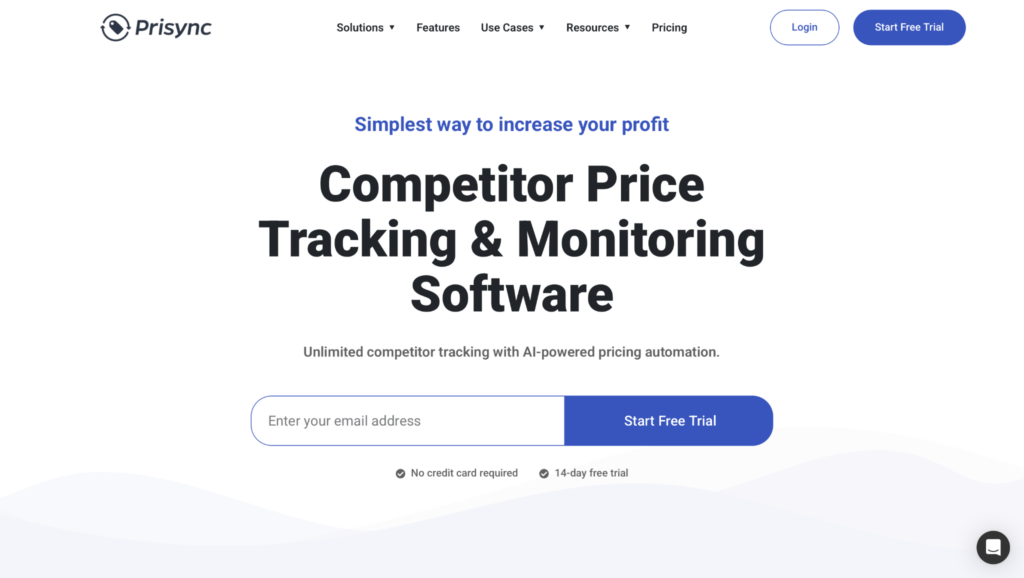
Prisync is a competitor price tracking and dynamic pricing platform designed primarily for e-commerce businesses. It helps online retailers monitor competitor prices, product availability, and historical pricing movements through a centralized dashboard. Retailers researching alternatives can compare other Prisync competitors.
Best For
Prisync is best suited for small and medium-sized e-commerce businesses that need consistent competitor price monitoring and straightforward repricing capabilities. We offer effective online solutions featuring well-structured product catalogs, designed to help you compete when selling identical or non-standard products.
Key Capabilities of Prisync
- Competitor price tracking. Monitors product prices across selected online competitors.
- Product availability monitoring. Tracks stock availability alongside competitor pricing information.
- Historical price analysis. Provides visibility into previous competitor price movements.
- Dynamic repricing. Supports automated pricing responses based on competitive conditions.
- Centralized dashboard. Organizes competitor information for easier analysis.
- Pricing alerts. Helps merchants identify relevant changes in competitor offers.
Strategic Strengths of Prisync
Prisync’s main advantage is its relatively straightforward approach to competitive price monitoring. Online promotion enables your business to access the most up-to-date information and facilitates the development of new infrastructure.
Considerations When Choosing Prisync
Businesses should verify product tracking limits, matching accuracy, competitor coverage, and the availability of advanced features within each subscription tier. Additional services, integrated via API, are not standalone professional products; rather, they allow you to expand your existing toolkit.
Pricing: Published plans start at $99/month, with higher tiers and optional services.
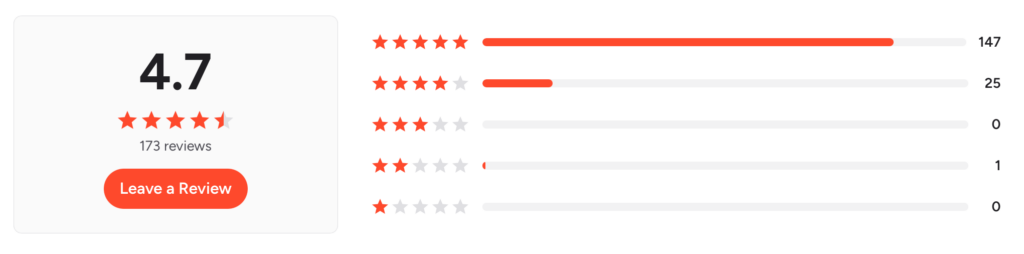
G2 rating: 4.7 / 5 from 173 reviews
Price2Spy – Best for Competitor Price Monitoring
What Is Price2Spy?
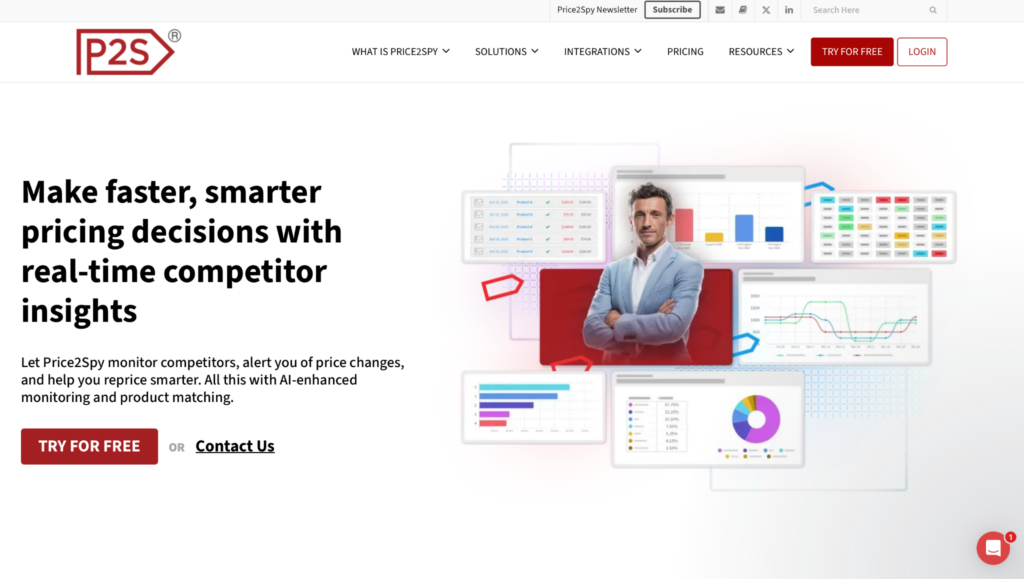
Price2Spy is a competitor price monitoring platform designed to help retailers and brands track online pricing movements, product availability, and historical market trends. This software specializes in managing price-based competition, tracking historical pricing trends, and monitoring prize-related data. It is particularly relevant for businesses that need detailed visibility into how competitor offers change across websites and locations. Teams looking for other monitoring approaches can review Price2Spy alternatives.
Best For
Price2Spy is best suited for e-commerce retailers, brands, and pricing analysts that require detailed competitor monitoring and reporting. To effectively manage your pricing strategy, it is essential to track a large number of competing products and analyze ongoing offers across various online marketplaces.
Key Capabilities of Price2Spy
- Competitor price monitoring. Tracks prices across selected competitor websites.
- Historical price tracking. Records pricing changes for trend analysis.
- Price change alerts. Notifies teams about relevant competitor movements.
- Reporting and analytics. Provides detailed pricing reports and historical charts.
- Availability monitoring. Tracks product availability alongside pricing information.
- Configurable repricing. Supports pricing adjustments based on established rules.
Strategic Strengths of Price2Spy
Price2Spy’s main strength is its detailed approach to competitor monitoring and historical reporting. Pricing teams can examine individual product movements, identify recurring promotional patterns, and investigate unusual market changes.
Considerations When Choosing Price2Spy
Buyers should evaluate the number of URLs they need to monitor, required refresh frequency, and coverage of their priority competitor websites. The cost and available functionality often depend on the intensity of the monitoring and the accessibility of the data.
Pricing: Tiered packages based on monitored URLs and features; the vendor requests a tailored quote.
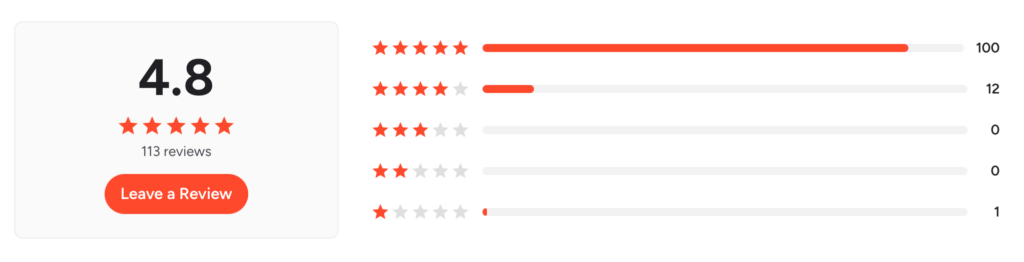
G2 rating: 4.8 / 5 from 113 reviews
Wiser Solutions – Best for Enterprise Price Intelligence
What Is Wiser Solutions?
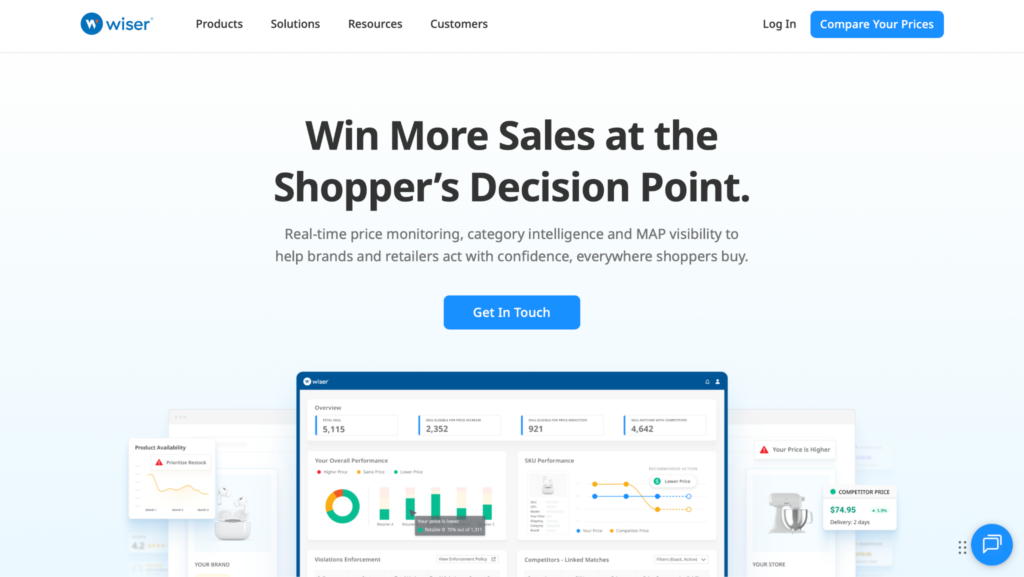
Wiser Solutions provides retail price intelligence and market intelligence software that helps brands and retailers monitor competitive conditions across multiple channels. This platform allows you to track competitors’ prices and product availability, providing actionable signals for your business. Wiser can support broader competitive intelligence requirements for organizations managing complex retail environments.
Best For
Wiser Solutions is best suited for enterprise retailers and consumer brands that need comprehensive competitive market visibility across different sales channels. The platform offers insights for analysts, managers, and category specialists, focusing on monitoring competitor activity and specific product listings. It enables firms to analyze competitive gaps and compare similar products, generating key signals that support ongoing analytical work.
Key Capabilities of Wiser Solutions
- Competitor price intelligence. Provides visibility into external retail pricing.
- Promotion monitoring. Helps businesses observe competitor promotional activity.
- Product availability tracking. Supports analysis of stock-related market signals.
- Cross-channel market intelligence. Collects competitive information across relevant retail channels.
- Competitive benchmarking. Helps businesses evaluate their positioning against market competitors.
- Retail analytics. Supports analysis of pricing and other commercial market information.
Strategic Strengths of Wiser Solutions
Wiser Solutions’ main advantage is its broad approach to retail market intelligence. Businesses can examine competitive conditions beyond isolated product prices and incorporate additional market signals into their commercial analysis.
Considerations When Choosing Wiser Solutions
Organizations should clearly define whether they require basic SKU-level price monitoring, category-wide competitive intelligence, or additional retail execution services.
Pricing: G2 lists several plan tiers; confirm applicable modules and commercial terms with Wiser.
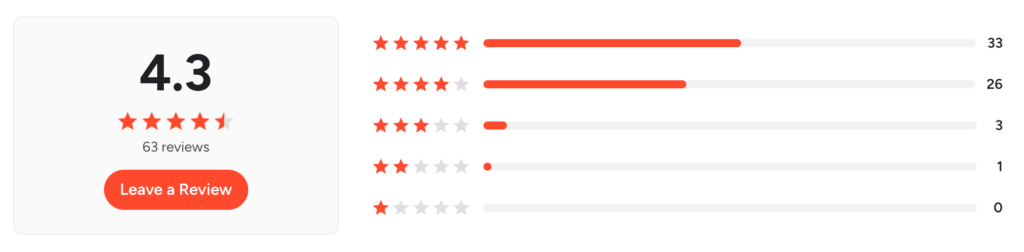
G2 rating: 4.3 / 5 from 63 reviews
Minderest – Best for Price and Assortment Intelligence
What Is Minderest?
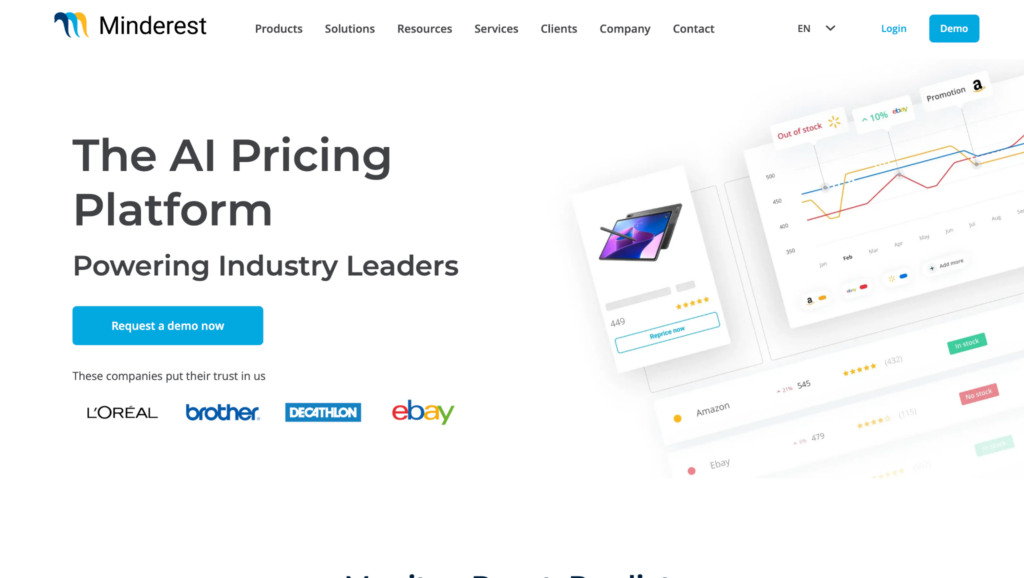
Minderest is a competitive price and assortment intelligence platform designed to help retailers and brands monitor competitor catalogs, pricing movements, promotions, and product availability. These technologies allow for the matching of identical or similar items—a crucial capability, given that competitive listings may often lack standardized identifiers. To gain a key perspective on category management and new analytics, you need to monitor recent market variations, as these also influence product competition. This allows pricing and category teams to analyze competitive positioning across extensive assortments.
Best For
Minderest is best suited for retailers and brands managing large product catalogs across multiple markets or regions. It is particularly relevant to category managers and pricing analysts who need to understand both pricing differences and changes in competitor assortments.
Key Capabilities of Minderest
- Competitor price monitoring. Tracks pricing information across selected competitors.
- Product matching. Identifies identical and comparable products across different catalogs.
- Assortment intelligence. Monitors competitor product ranges and assortment changes.
- Promotion tracking. Provides visibility into competitor promotional activity.
- Availability monitoring. Tracks product availability across relevant channels.
- Competitive benchmarking. Supports comparisons of pricing and assortment positioning.
Strategic Strengths of Minderest
Minderest’s primary strength is its combination of price monitoring and assortment intelligence. Retailers can evaluate not only how their prices compare with competitors but also how their product offerings differ. Its matching capabilities are particularly valuable for organizations working with complicated catalogs, inconsistent product descriptions, and large numbers of comparable items.
Considerations When Choosing Minderest
Retailers should test product matching accuracy using representative items, especially private-label products, unusual pack sizes, and products without standardized identifiers.
If you have implemented a system, you will need to provide information on geographic coverage, ensuring that you generate reports on the specific parameters you submit.
Pricing: Quote-based; no standard subscription rate is displayed on G2.
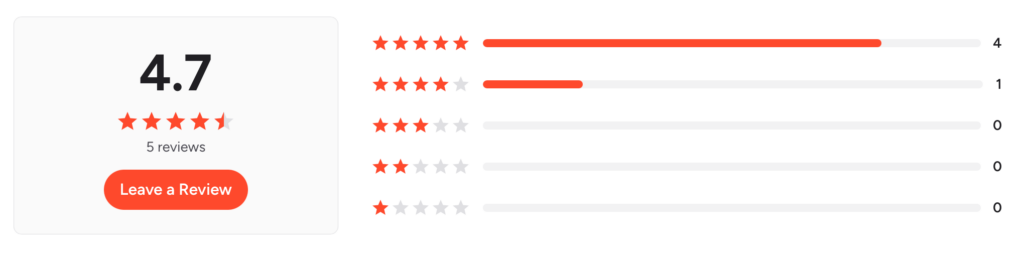
G2 rating: 4.7 / 5 from 5 reviews
Dealavo – Best for E-commerce Competitive Intelligence
What Is Dealavo?
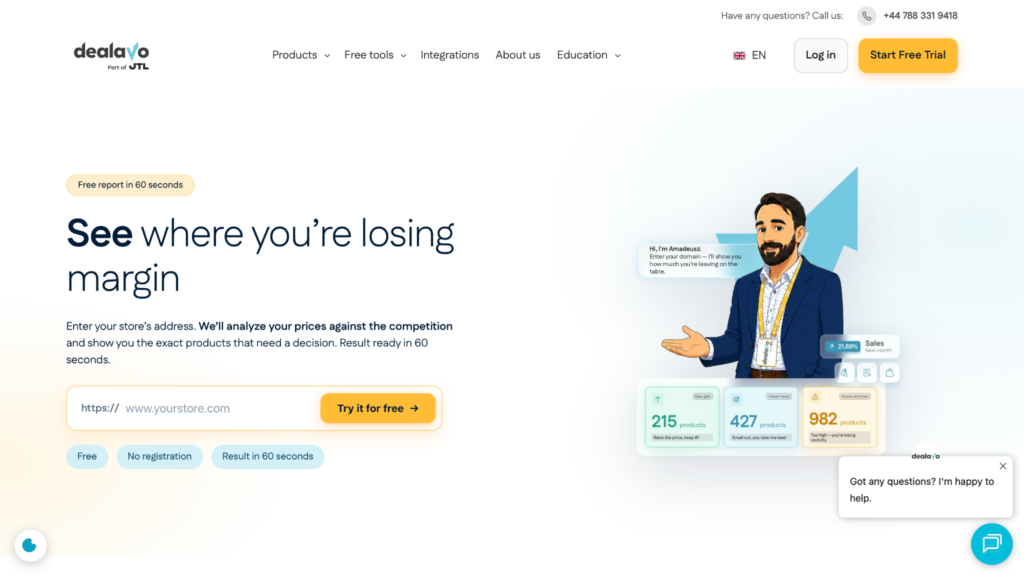
Dealavo is a competitor price monitoring and competitive intelligence platform designed for e-commerce retailers and brands. It helps businesses observe competitor prices, promotional activities, product availability, and marketplace conditions. The platform also offers AI-assisted repricing capabilities, allowing merchants to connect competitive market information with pricing decisions. Its focus on online retail makes it particularly relevant to businesses operating across websites, marketplaces, and comparison shopping platforms.
Best For
Dealavo is best suited for online retailers and consumer brands that need to monitor competitor activity across multiple digital sales channels. To derive additional value from e-commerce in various regions, you must actively manage your pricing in response to competitive pressures.
Key Capabilities of Dealavo
- Competitor price monitoring. Tracks pricing movements across relevant online sellers.
- Marketplace intelligence. Provides visibility into pricing conditions across digital marketplaces.
- Promotion monitoring. Helps identify competitor discounts and promotional offers.
- Product availability tracking. Monitors availability information alongside prices.
- AI-assisted repricing. Supports pricing decisions informed by competitive market data.
- Competitive analytics. Helps businesses analyze market changes and pricing differences.
Strategic Strengths of Dealavo
Dealavo’s main advantage is its focus on competitive intelligence within the e-commerce environment. Retailers can track price changes across various online marketplaces and use the resulting data to develop more flexible pricing strategies. The combination of price monitoring and adjustment features makes this solution ideal for retailers who are not satisfied with merely passively gathering information on competitors’ prices.
Considerations When Choosing Dealavo
Businesses should evaluate marketplace coverage in their target countries, product matching quality, and the reliability of competitor pricing information. Retailers considering a shift to automated price adjustments must ensure that the proposed price changes truly align with their established margin limits and business policies.
Pricing: Quote-based, depending on the monitoring and repricing scope.
G2 rating: 4.3 / 5 from 16 reviews
Intelligence Node – Best for AI-Driven Retail Market Intelligence
What Is Intelligence Node?
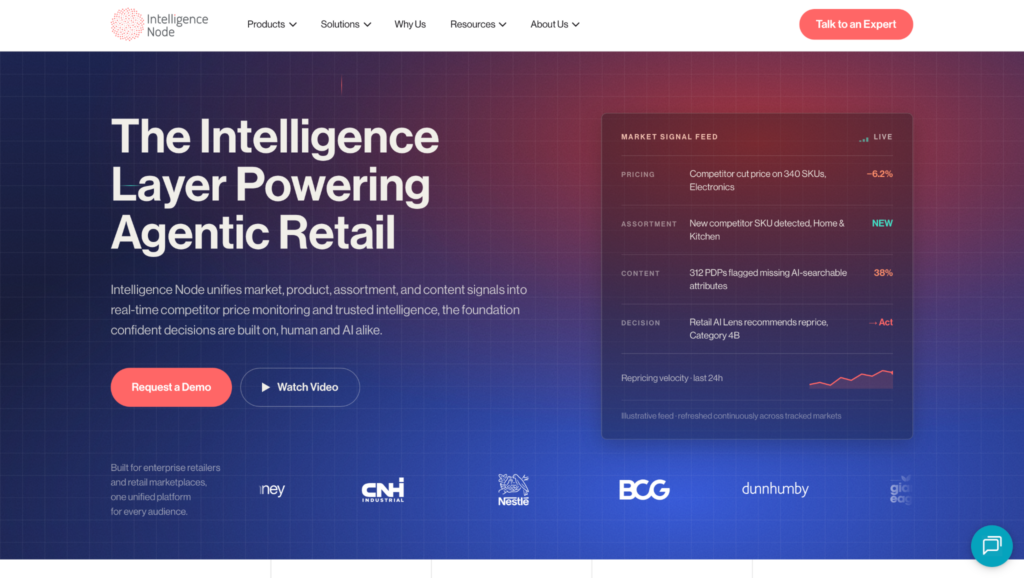
Intelligence Node is an AI-supported retail market intelligence platform that helps businesses analyze competitor prices, product assortments, and marketplace conditions. The technology behind this platform is designed to match identical, similar, and variant products offered by various retail sellers. By consolidating comparable product listings, the platform enables a more detailed analysis of your competitors’ pricing and provides a broader overview of the retail market landscape.
Best For
Intelligence Node is best suited for enterprise retailers and consumer brands managing large or complicated digital product catalogs. This is truly very important, especially for pricing departments, market analysts, and merchandising teams that need to accurately match products across various online stores.
Key Capabilities of Intelligence Node
- AI-powered product matching. Identifies exact, variant, and similar product listings across sellers.
- Competitive price intelligence. Supports comparisons of competitor pricing information.
- Assortment analysis. Helps businesses examine differences in product ranges.
- Marketplace visibility. Provides competitive information across relevant digital channels.
- Retail market analytics. Supports analysis of pricing and assortment trends.
- API-based data delivery. Enables integration of market intelligence into other business systems.
Strategic Strengths of Intelligence Node
Intelligence Node’s primary advantage is its emphasis on product matching accuracy. Reliable data matching is truly critical for competitive analysis; unadjusted comparisons can easily lead to erroneous conclusions regarding market positioning. A combination of data-merging technologies, data delivery capabilities, and assortment analysis tools proves especially valuable for retailers who manage online product catalogs.
Considerations When Choosing Intelligence Node
Retailers should evaluate how the matching technology handles local pack sizes, private-label products, incomplete descriptions, and products without consistent identifiers.
Buyers also need to decide whether they truly require a full-fledged market analysis platform or if individual modules will suffice.
Pricing: Modular, scope-based quotation.
G2 rating: 4.5 / 5 from 37 reviews
Skuuudle – Best for Product Matching and Competitor Benchmarking
What Is Skuuudle?
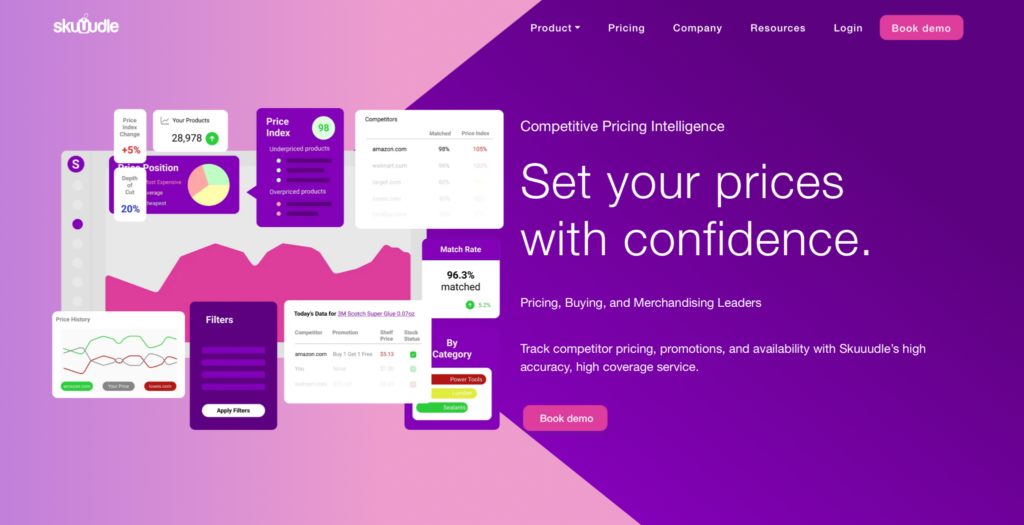
Skuuudle is a competitive intelligence and product matching solution that combines competitor price collection with managed product comparisons and benchmarking. Its service-oriented approach helps retail operations compile comprehensive product catalogs, as well as track prices, availability, discounts, and other essential product information. Data collection and matching processes can be configured around specific business requirements.
Best For
Skuuudle is best suited for retailers and brands that need reliable competitor benchmarking across complex or extensive product assortments. This instrument is quite important for organizations that place significant value on external market data and require specialized solutions for benchmarking or product monitoring.
Key Capabilities of Skuuudle
- Competitor price collection. Gathers pricing information from selected competitor sources.
- Managed product matching. Supports identification of comparable products across different catalogs.
- Competitive benchmarking. Helps businesses evaluate their pricing position against competitors.
- Discount monitoring. Tracks relevant promotional and discount information.
- Product availability tracking. Includes availability information in competitive comparisons.
- Customized data collection. Supports monitoring configurations based on selected products, websites, and update requirements.
Strategic Strengths of Skuuudle
Skuuudle’s main strength is its focus on tailored competitive data collection and product matching. These companies can determine which specific products, monitoring requirements, and competitors are most important to their business operations. This approach is particularly useful when accurate comparisons require more attention than a standardized self-service monitoring tool may provide.
Considerations When Choosing Skuuudle
Businesses should clearly define their required product coverage, competitor websites, refresh intervals, and expected reporting formats. Before signing the contract, it is also advisable to discuss the scope of services related to managing data matching, implementation support, and data quality verification.
Pricing: Tailored quotation based on products, sites, and update frequency.
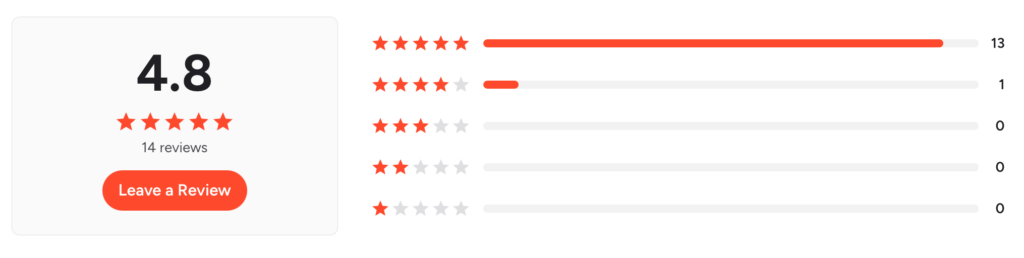
G2 rating: 4.8 / 5 from 14 reviews
Why Trust Our Reviews?
This comparison draws on publicly accessible vendor product descriptions, pricing information, documentation, and customer feedback, with a focus on practical retail use cases. We considered what each platform is actually built to do: capture competitor prices, automate e-commerce repricing, optimize pricing decisions, or connect data to retail systems.
In this article, we did not explicitly mention that these tools for analyzing competitor pricing are functionally interchangeable. Factors such as the depth of analysis, product comparison capabilities, workflow management features, total cost, and integration requirements can, in fact, be far more significant than a simple list of functions. On the G2 platform, ratings are presented alongside the number of reviews submitted by users who have tested the platforms; a high rating based on the opinions of only a few users is generally considered less compelling than an equally high rating backed by a substantial number of reviews.
Disclosure: Yieldigo publishes this guide and is one of the platforms reviewed. Competitor profiles are based on publicly available information or vendor-sponsored performance benchmarks. Features, pricing, and user ratings can change; confirm important claims through a current demonstration, written proposal, and product documentation.
What Are the Benefits of Using Competitor Pricing Software?
Competitor pricing software replaces disconnected website checks and spreadsheets with a more consistent view of the market. Instead of spending time searching for changes, pricing teams can work from matched products, historical observations, and alerts. When these inputs feed a clear competitive pricing policy, the potential benefits include more reliable market visibility, less repetitive work, and better control over margin decisions.
Results may vary depending on the type of system used. Monitoring tools, for instance, can enhance transparency. Software designed for automated price checking enables you to execute transactions as quickly as possible, based on pre-established rules. Furthermore, it is worth noting that advanced optimization systems can assess how a change in price might affect demand and, consequently, profit. Implementing such systems requires not only data on competitors’ prices but also other relevant information, not to mention clearly defined pricing objectives.
According to a 2025 Ipsos survey, 68% of surveyed online shoppers across six markets always or often compare prices of identical or similar products before making a purchase, highlighting the importance of competitive price visibility for retailers.
Market Visibility
Automated competitor price tracking helps retailers spot price changes, promotions, availability shifts, and longer-term market patterns. Historical records distinguish a brief discount from a sustained change in positioning, while alerts allow teams to investigate relevant developments without checking every website manually.
Profitability and Margin Protection
Analyzing competitor pricing has become significantly more valuable when supplemented with data on minimum acceptable margins, specific business objectives, and estimates of demand elasticity. A retailer might choose to match competitor prices for widely available, everyday goods while maintaining higher margins on less popular items. As a result, not every price reduction by a competitor will automatically trigger a corresponding price cut.
Less Manual Pricing Work
Price collection, spreadsheet updates, comparisons, and routine alerts can all be automated. Pricing managers can then spend more time reviewing exceptions, evaluating category strategies, and checking whether recommended prices support their business goals. The gain is most significant when the software connects cleanly with existing systems.
Faster Pricing Decisions
By leveraging real-time data alongside pre-established rules, your team can drastically reduce the time between identifying a competitor’s move and implementing a response. However, rapid response strategies require built-in safeguards, such as threshold limits for exceptional scenarios, strict minimum margin controls, and clearly defined roles for decision-makers, along with established approval workflows. It is crucial for retailers to remember that while adjustments must be made promptly, this does not mean that every single price should be subject to change at the snap of a finger.
Stronger Category Strategies
Customers judge a retailer through selected highly visible products and the value of an entire basket. Advanced systems can prioritize key value items while preserving sensible price relationships between brands, pack sizes, and private-label options. Category-level decisions can protect overall basket profitability better than independent SKU-by-SKU price matching.
What Are the Key Features of Competitor Pricing Software?
Modern competitor pricing software ranges from automated collection of market prices to recommendations that account for demand and commercial constraints. Some platforms concentrate on accurate price feeds; others include pricing automation, predictive modeling, and execution. A comprehensive retail pricing software platform may cover several of these tasks, but the label alone does not guarantee any particular feature.
Priorities when selecting functional capabilities must always align with a retailer’s specific business model. For instance, an online electronics retailer might prioritize precise price comparisons and market-change alerts, whereas a supermarket chain would likely require tools for assessing demand elasticity, analyzing product interdependencies, and managing operational workflows. The sections below outline features that are well worth testing during a software vendor’s product demonstration.
Automated Monitoring and Historical Alerts
Competitor price monitoring collects regular and promotional prices, availability, and relevant offer details from selected websites and marketplaces. The strongest setup matches the required refresh frequency and retains enough history to identify recurring promotions or unusual competitor behavior. Alerts help teams separate isolated changes from market-wide movements.
Product Matching and Competitive Benchmarking
Matching links identical or genuinely comparable items despite differences in titles, identifiers, pack sizes, and listing formats. Benchmarking then measures the retailer’s position against the correct competitor offers. Ask vendors to show how their systems handle multipacks, private labels, temporary promotions, and items without universal barcodes.
Dynamic Pricing and Automated Repricing
Dynamic pricing systems utilize predefined rules to adjust prices based on market conditions. A retailer might, for example, aim to keep prices within a specific range relative to competitors while ensuring a minimum acceptable profit margin. Rule-based automated repricing software should also allow for the creation of exceptions and include approval workflows for price changes. It is crucial to distinguish between the application of specific rules and the evaluation of broader pricing strategies designed to optimize both demand and profitability.
AI-Powered Price Optimization
Retail price optimization software can combine historical sales, demand elasticity, competitor data, costs, and business objectives to model alternative prices. AI-supported recommendations and scenario simulations help managers test the expected implications of a pricing change before execution. Teams should ask what data the model needs and how it explains its recommendations. For a wider explanation, see predictive pricing analytics.
Reporting, Integrations, and Scalability
Data models and various export functions are only truly valuable if they enable a retailer to move beyond mere observation toward taking concrete, actionable steps. Evaluate the software’s API and its capacity to integrate with ERP, POS, and PIM systems, as well as e-commerce platforms and business intelligence (BI) tools. Furthermore, it is essential to verify how effectively the system handles large product catalogs, distinct pricing zones, and operations across multiple geographic regions. As the business scales, the system must be capable of maintaining control over approval processes.
Competitor Pricing Software Feature Comparison Table
| Feature | Primary purpose | Most relevant to |
| Competitor price monitoring | Track external market prices | Retail and e-commerce teams |
| Product matching | Identify comparable products | Large or complex catalogs |
| Historical price tracking | Interpret competitor movements | Pricing analysts |
| Automated repricing | Execute rule-based price changes | E-commerce retailers |
| AI price optimization | Support demand-based decisions | Enterprise and grocery retailers |
| Pricing integrations | Connect data, approvals, and execution | Omnichannel businesses |
How to Pick the Right Competitor Pricing Software for Your Business?
Choosing competitor pricing software begins with a business problem, not a checklist of advertised functions. Decide whether the immediate priority is market visibility, faster repricing, margin protection, demand-based optimization, or a combination. A clear brief makes it easier to avoid paying for capabilities that will not be used.
Compare vendors using the data, channels, and pricing scenarios your team actually manages. Include product matching, automation, integration effort, implementation cost, and expected commercial value. Run realistic examples before signing a contract; demonstrations using generic sample data rarely expose the issues that matter in daily retail operations.
Define Measurable Pricing Goals
Start by defining a small set of performance metrics, for example, the time spent verifying data, the speed of response to competitors’ actions, the accuracy of product (SKU) matching, adherence to target margin goals, or performance within specific product categories. It is essential to distinguish between core requirements and additional features, such as reporting tools or AI-driven capabilities. The solution you implement should help resolve a specific, measurable “bottleneck” in your pricing processes.
Match the Tool to Your Retail Model
An e-commerce merchant may need marketplace coverage and rapid updates, while a grocery chain must balance price perception, elasticity, promotions, and category relationships across stores. Large omnichannel retailers may need local price zones and synchronized execution. Match the product’s core design to assortment complexity, sales channels, and how often prices actually change.
Test Data Quality and Monitoring Coverage
Provide solution vendors with a representative sample of complex products, including various private-label (CTM) items. Evaluate the accuracy of product matching, data update latency, the extent of coverage for key competitors, and the availability of historical data. A well-structured trial period will allow you to see how the system handles errors and determine the overall success rate of its product matching.
Assess Automation, AI, and Integrations
Ask whether the system applies preset rules, predicts the impact of price changes, or offers elasticity-based optimization. Review how managers can override recommendations and maintain margin constraints. At the same time, assess ERP, POS, PIM, e-commerce, and reporting connections, along with data preparation, user training, and ongoing vendor support. The pricing automation process must fit the retailer’s existing responsibilities.
Compare Total Cost and Run Real Scenarios
Be sure to calculate the total cost of ownership, which includes subscription fees, costs for monitoring additional competitors, expenses related to tracking a specific number of SKUs or URLs, as well as setup, integration, and support costs. Then, weigh these costs against the actual time saved and the potential for increasing margins or revenue. During the system demonstration, simulate various scenarios, such as competitors lowering their prices, breaches of minimum margin thresholds, products failing to meet specific criteria, or large-scale category shifts that require coordination. This approach will enable you to evaluate much more than just the monthly subscription fee.
Conclusion: Choosing the Best Competitor Pricing Software in 2026
Competitor pricing software covers several distinct technologies. Price trackers establish market visibility, repricing engines execute predefined responses, and AI optimization platforms model how prices interact with demand and profitability. The best choice depends on a retailer’s objectives, operational complexity, existing data, and need for automation. The importance of competitive pricing is particularly evident in grocery retail. According to Flipp’s 2025 State of Grocery Report, 68% of surveyed US grocery shoppers often or sometimes compare prices across stores, reinforcing the need for retailers to maintain a competitive price position.
Yieldigo is an option for grocery and FMCG retailers that want to connect competitive signals with elasticity, category-level strategy, and profit objectives. Its broader approach differs from monitoring products focused mainly on collecting website prices or triggering e-commerce repricing. Retailers assessing related needs can also explore grocery pricing systems and wider pricing intelligence approaches.
Shortlist platforms against real pricing challenges, verify integrations and current commercial terms, and judge expected value over the full contract period. If your business manages a complex grocery or FMCG assortment, explore Yieldigo to see how data-driven pricing recommendations could support competitive positioning and profitable decisions.
Frequently Asked Questions
What is competitor pricing software?
It is software that collects and compares competitor prices, often matching equivalent products and tracking changes over time. Some products add alerts, automated repricing, or demand-based optimization.
Which competitor pricing software is best for retail businesses?
The answer depends on the retail format. Grocery chains requiring elasticity and category control may consider Yieldigo, Competera, or Revionics. Digital retailers focused on monitoring and repricing may prefer Prisync, Price2Spy, or Omnia Retail.
What is the best competitor pricing software for e-commerce?
Prisync, Price2Spy, Omnia Retail, and Dealavo are practical candidates for online stores. Compare product matching, marketplace coverage, refresh frequency, and automated repricing rules before choosing.
How does competitor pricing software work?
It collects pricing data from selected sources, matches offers with the retailer’s products, and displays differences or trends. Depending on the product, it can trigger alerts, propose price changes, or send approved prices to connected systems.
How much does competitor pricing software cost?
Costs depend on products or URLs tracked, competitors, data frequency, features, and integration scope. Prisync publishes entry plans from $99/month and Omnia Retail advertises SMB plans from €399/month; many enterprise vendors quote individually.
Is there free competitor pricing software?
Some vendors offer trials or limited free tools, but sustained multi-competitor monitoring at scale usually involves a paid subscription or contract. Check whether a free version includes sufficient matching, alerts, and historical data.
What is the difference between competitor price monitoring and price optimization?
Monitoring tells a retailer what competitors charge. Optimization evaluates what the retailer should charge using demand, margins, business objectives, and sometimes competitive data. They solve related but different questions.
How often does competitor pricing software update prices?
Refresh frequency varies by vendor, plan, website, and data source. Some services support frequent intraday checks; others use scheduled daily collection. Ask for a written refresh commitment covering your priority competitors.
Can competitor pricing software track Amazon and other marketplaces?
Many e-commerce platforms support major marketplaces, but coverage differs by country, product category, seller, and offer type. Confirm the exact marketplaces and fields that your business needs.
What is the best pricing software?
There is no universal winner. A small merchant may need competitive monitoring and simple repricing; a large retailer may need governed price management or demand-based optimization. Define the decision before selecting a software category.
How to compare competitors’ pricing?
Select relevant competitors, match identical products and pack sizes, account for promotions and availability, and compare changes over time. Use multiple unit pricing concepts when offers contain different quantities, so unit-price comparisons remain meaningful.
How to find competitors’ pricing?
Start with publicly listed prices on relevant websites, marketplaces, and stores. For large assortments, automated monitoring software can collect observations regularly, normalize comparable offers, and flag changes without relying on manual checks.