
Retail pricing has become one of the most critical levers for profitability in modern commerce. Static pricing strategies no longer work in environments shaped by real-time demand, competition, and changing consumer behavior. Retail pricing software helps businesses automate, optimize, and scale their pricing strategies using data, AI, and predictive analytics.
Overview
Top retail pricing software solutions in 2026 include:
- Yieldigo – AI-driven retail pricing and promotion optimization for top retailers
- RELEX Solutions – pricing aligned with demand forecasting and supply chain
- Revionics – price optimization with strong AI and retail analytics
- Competera – competitive pricing and price perception optimization
- Prisync – competitor monitoring and dynamic pricing for e-commerce
What Is Retail Pricing Software?
Retail pricing software is a category of tools designed to help retailers set, manage, and optimize product prices using data instead of manual rules or spreadsheets. These platforms analyze multiple data sources to recommend or automatically apply optimal prices, helping businesses balance revenue, margins, and competitiveness in real time.
Demand data. Retail pricing software analyzes historical and real-time demand patterns to understand how products sell under different conditions. This allows retailers to predict how price changes will impact sales volume and avoid underpricing or overpricing.
Competitor prices. These tools continuously monitor competitor pricing across channels and locations. By incorporating this data, retailers can stay competitive while avoiding unnecessary price wars that erode margins.
Customer behavior. Pricing platforms evaluate how customers respond to price changes, promotions, and product positioning. This helps retailers identify which products are price-sensitive and which can sustain higher margins.
Product elasticity. Elasticity modeling measures how demand changes when prices increase or decrease. Retailers can use this insight to set prices that maximize either revenue or profit, depending on their strategy.
Best Retail Pricing Software in 2026
Choosing the right pricing software is no longer just about automation, it’s about selecting a platform that aligns with your business model, assortment complexity, and strategic goals. In 2026, the most effective solutions go beyond price updates and provide deep analytical capabilities, predictive insights, and cross-functional optimization across pricing, promotions, and demand.
Below are the leading retail pricing software solutions, each with its own strengths. However, platforms like Yieldigo stand out by offering a more advanced, AI-driven approach that connects pricing decisions with real customer behavior, basket dynamics, and overall business performance.
1. Yieldigo – Best for AI-driven pricing in retail
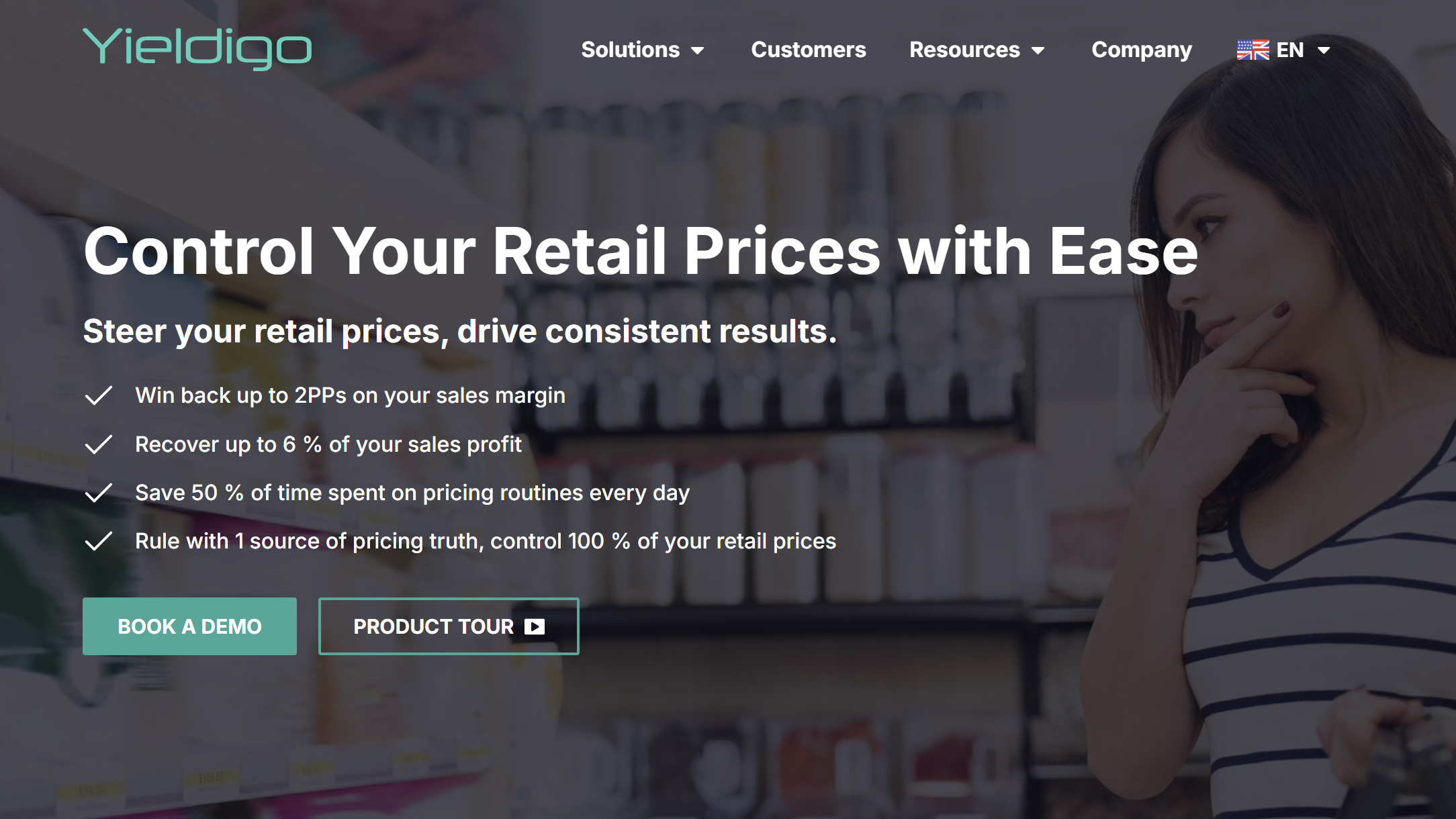
Yieldigo is an AI-powered pricing and promotion optimization platform designed specifically for grocery and FMCG retailers. It combines pricing, promotions, and markdown optimization into one unified system, allowing retailers to manage complex assortments and high-frequency price changes with precision.
Best For:
AI-driven retail pricing and promotion optimization for large grocery and FMCG retailers with thousands of SKUs, frequent promotions, and highly dynamic pricing environments.
Key Features:
- AI-driven price optimization. Yieldigo uses advanced machine learning algorithms to calculate optimal prices based on demand patterns, business goals, and customer behavior. It continuously learns from new data, ensuring pricing decisions remain accurate and adaptive. This allows retailers to move away from static rules and toward fully data-driven pricing.
- Promotion planning and simulation. The platform enables retailers to design and test promotional campaigns, including multibuy promotion, before execution. By simulating different scenarios, teams can understand the true impact of discounts on revenue, margins, and demand. This reduces risk and ensures promotions deliver incremental value.
- Demand forecasting and elasticity modeling. Yieldigo predicts how demand will respond to price changes using elasticity modeling. This helps retailers identify the optimal balance between price and volume. As a result, they can avoid both over-discounting and missed sales opportunities.
- Cross-product and basket analysis. Unlike traditional tools, Yieldigo evaluates how pricing decisions affect entire baskets, not just individual products. It identifies relationships between products and measures how discounts influence overall purchasing behavior. This is critical for maximizing total revenue rather than optimizing SKUs in isolation.
- Markdown optimization. The platform optimizes markdown strategies to reduce waste and improve sell-through, especially for perishable goods. It ensures discounts are applied at the right time and depth. This helps retailers protect margins while clearing inventory efficiently.
2. RELEX Solutions – Best for pricing & supply chain alignment
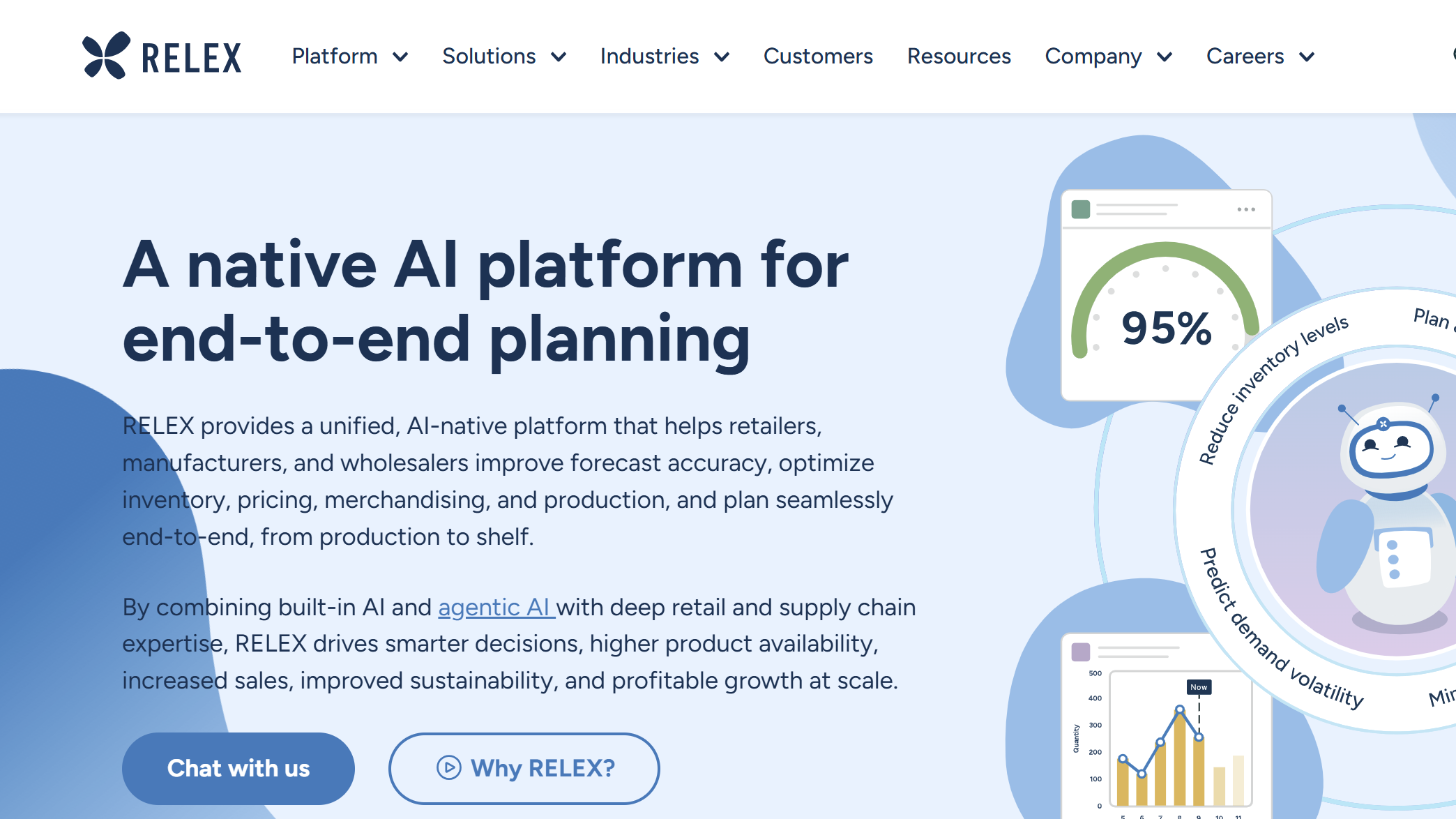
RELEX Solutions is a retail optimization platform that connects pricing decisions with demand forecasting and inventory planning.
Best For:
Retailers who need pricing strategies tightly aligned with stock levels and supply chain operations.
Key Features:
- Demand-driven pricing. RELEX uses demand signals to guide pricing decisions, ensuring prices reflect actual market conditions. This helps retailers avoid mismatches between pricing and customer demand.
- Forecasting and replenishment. The platform integrates pricing with forecasting and replenishment processes. This ensures that promotions and price changes are supported by sufficient inventory.
- Promotion planning. RELEX enables retailers to plan promotions with demand and supply constraints in mind. This reduces the risk of stockouts during high-demand periods.
- Inventory optimization. The system optimizes stock levels across locations, ensuring efficient distribution and availability. This is particularly valuable for large retail networks.
Strength:
RELEX ensures that pricing strategies are operationally feasible, reducing stockouts, overstock, and inefficiencies.
3. Revionics – Best for enterprise price optimization
Revionics provides advanced price optimization and analytics tailored for large-scale retail environments.
Best For:
Enterprise retailers with complex pricing structures and large assortments.
Key Features:
- AI price optimization. Revionics uses AI models to determine optimal pricing strategies across categories and locations. This enables consistent and scalable pricing decisions.
- Price elasticity modeling. The platform measures how demand reacts to price changes, helping retailers fine-tune pricing strategies. This improves both revenue and margin outcomes.
- Promotion analytics. Revionics analyzes the effectiveness of promotions and discounts. This helps retailers understand which campaigns drive real value.
- Category-level pricing. Pricing decisions can be optimized at category level, ensuring strategic alignment across product groups. This is important for large assortments.
Strength:
Strong focus on scientific pricing models and scalability for enterprise retailers.
4. Competera – Best for competitive pricing strategies
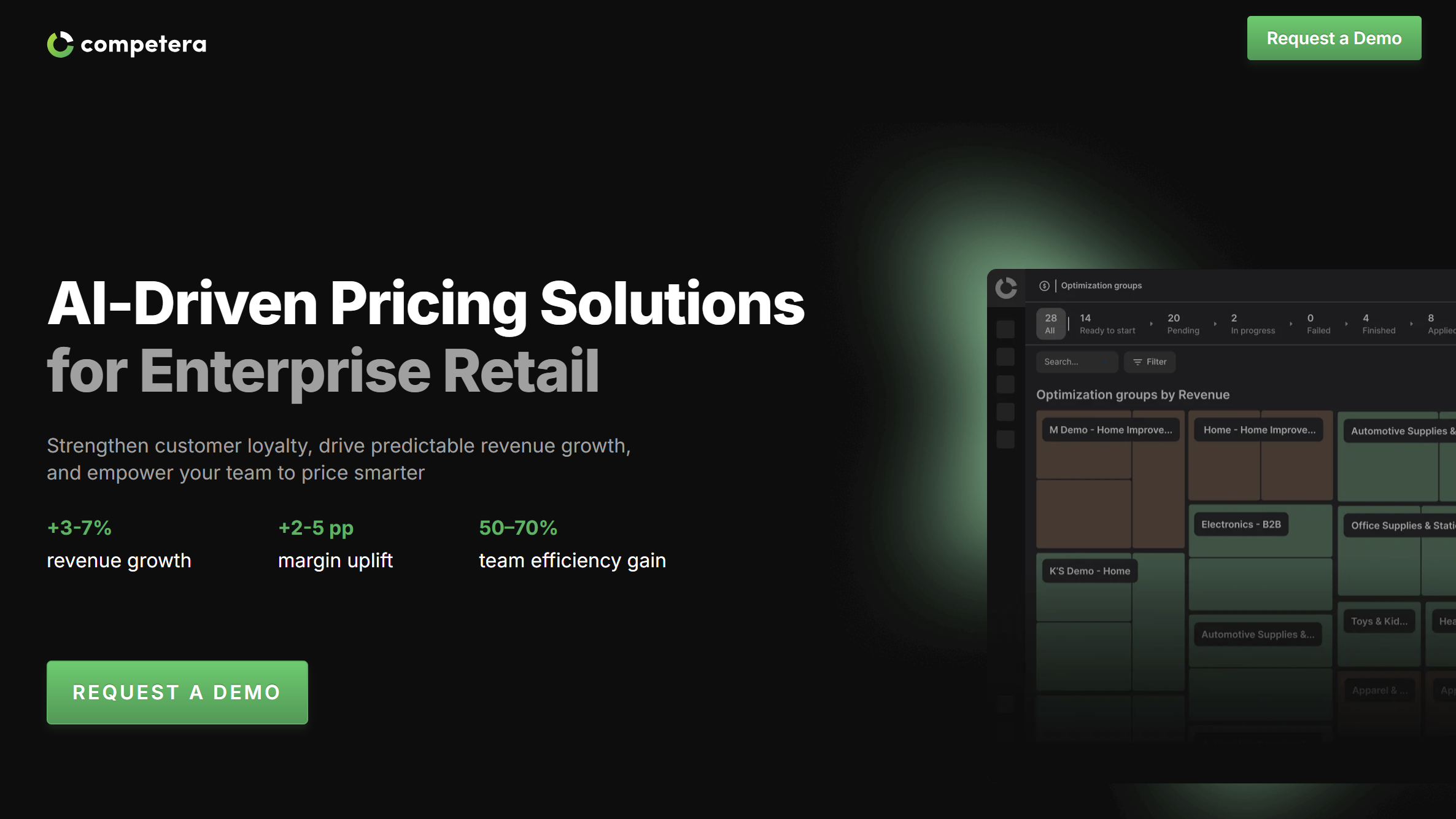
Competera focuses on competitive pricing and price perception, helping retailers maintain a strong position in the market.
Best For:
Retailers operating in highly competitive markets where price positioning is critical.
Key Features:
- Competitor price tracking. Competera continuously monitors competitor prices across channels. This enables fast reactions to market changes.
- Price perception analytics. The platform evaluates how customers perceive pricing compared to competitors. This helps retailers maintain a strong price image.
- Dynamic pricing recommendations. Competera provides real-time pricing suggestions based on competitive data and internal metrics. This ensures balanced decision-making.
Strength:
Helps retailers stay competitive without unnecessary margin sacrifice.
5. Prisync – Best for e-commerce dynamic pricing
Prisync is a dynamic pricing and competitor tracking tool designed for e-commerce businesses.
Best For:
Online retailers and smaller businesses looking for simple, effective pricing automation.
Key Features:
- Competitor monitoring. Prisync tracks competitor prices in real time across online channels. This helps retailers stay competitive in fast-moving markets.
- Automated repricing. The platform automatically adjusts prices based on predefined rules. This reduces manual effort and ensures quick reactions.
- Pricing rules. Retailers can define custom pricing strategies using flexible rules. This provides control while still benefiting from automation.
Strength:
Simple implementation and strong focus on real-time competition tracking.
Why Retail Pricing Software Matters in 2026
Retail in 2026 is defined by constant change and increasing complexity. Prices no longer shift only in response to competitors, they are influenced by supply chain disruptions, fluctuating costs, changing demand patterns, yield management, and the growing challenges of managing omnichannel environments. In this landscape, pricing has become a dynamic process that requires continuous adjustment rather than periodic updates.
Manual pricing approaches simply cannot keep up with this level of volatility. Retailers relying on spreadsheets or static rules often struggle to react in time, which leads to common issues such as margin erosion from excessive discounting, missed revenue opportunities due to underpricing, inconsistent pricing across channels, and ineffective promotions that fail to deliver real impact.
Pricing software addresses these challenges by enabling real-time, data-driven decision-making. By analyzing multiple data sources simultaneously and automating pricing adjustments, these tools help retailers stay competitive while protecting margins. As a result, pricing becomes not just an operational task, but a strategic capability that directly drives profitability and long-term growth.
Key Retail Pricing Software Features to Look For
When evaluating retail pricing software, it’s important to focus on capabilities that go beyond basic automation. The most effective platforms combine data analysis, predictive modeling, and strategic decision support to help retailers optimize pricing in a fast-changing environment.
Rather than looking for a single feature, retailers should prioritize tools that provide a holistic approach to pricing, combining forecasting, competitive intelligence, and scenario planning. This ensures pricing decisions are not only accurate, but also aligned with broader business goals such as profitability, growth, and customer retention.
Price Optimization Algorithms
These algorithms use AI or predefined rules to calculate optimal prices based on business objectives such as maximizing revenue or margins. Through pricing automation, recommendations can continuously adjust as new data becomes available, ensuring pricing remains relevant and competitive. This removes guesswork and replaces manual decisions with data-driven precision.
Demand Forecasting
Demand forecasting predicts how changes in price will influence sales volume. By understanding demand sensitivity, retailers can avoid overpricing that reduces sales or underpricing that sacrifices margin. Accurate forecasting is critical for making confident pricing decisions, especially in volatile markets.
Competitor Price Monitoring
This feature tracks competitor prices in real time across different channels. It allows retailers to react quickly to market changes and maintain an effective competitive pricing strategy without unnecessary price drops. By combining competitor data with internal metrics, retailers can make smarter, more balanced pricing decisions.
Promotion & Markdown Optimization
Promotion and markdown optimization helps retailers understand the true impact of discounts on revenue and profitability. Instead of relying on intuition, these tools evaluate which promotions generate incremental sales and help retailers build a more effective markdown strategy. This leads to more effective campaigns and reduced margin loss.
Scenario Simulation
Scenario simulation enables retailers to test different pricing strategies before implementing them. By modeling potential outcomes, businesses can assess risks and choose the most effective approach. This reduces uncertainty and allows for more strategic, forward-looking pricing decisions.
How to Choose the Right Pricing Software
Choosing the right pricing software depends heavily on your business model, operational complexity, and strategic priorities. Not all tools are built for the same type of retailer, a grocery chain with thousands of SKUs and daily price changes has very different needs compared to an e-commerce business or a large enterprise with global operations.
Instead of focusing only on features, retailers should evaluate how well a platform supports their core pricing challenges, whether it’s managing promotions, aligning pricing with inventory, or competing in real time. The right solution should not only optimize prices, but also improve overall business performance.
For grocery & FMCG retailers
Focus on basket-level optimization, promotion planning, and the ability to scale across thousands of SKUs. These environments require tools that can handle high-frequency changes and complex product relationships.
For omnichannel retailers
Focus on integration with supply chain systems and accurate demand forecasting. Pricing decisions must align with inventory availability across online and offline channels.
For enterprise-level pricing
Focus on advanced analytics, scalability, and the ability to manage complex pricing structures across regions and categories. These organizations require robust, data-driven systems.
For e-commerce businesses
Focus on competitor tracking, automation, and fast implementation. Speed and responsiveness are critical in highly competitive online markets.
Conclusion
Retail pricing in 2026 is no longer a manual or purely operational task, it has become a core driver of profitability and competitive advantage. As market conditions grow more volatile and customer expectations continue to evolve, retailers need tools that allow them to react quickly, make informed decisions, and optimize pricing at scale. Relying on outdated methods inevitably leads to missed opportunities, margin loss, and inconsistent performance across channels.
Modern pricing software enables retailers to move from reactive pricing to proactive, data-driven strategy. Solutions like Yieldigo go even further by connecting pricing with promotions, demand, and basket behavior, unlocking a more holistic approach to revenue optimization. For retailers looking to stay competitive and maximize long-term growth, investing in the right pricing technology is no longer optional, it’s essential.