
Pricing has become one of the most data-intensive and strategically important functions in modern retail. In 2026, businesses operate in an environment shaped by constantly changing customer demand, volatile supply chains, inflation, and aggressive competitive pricing. According to McKinsey, a 1% increase in price typically translates into an average 8.7% increase in operating profits, assuming sales volume remains constant. Relying on historical sales reports or manual pricing decisions is no longer enough to stay competitive. Instead, retailers are increasingly turning to predictive pricing analytics to anticipate market changes and make smarter pricing decisions before opportunities are lost.
Predictive pricing analytics combines historical data, artificial intelligence (AI), machine learning, and demand forecasting to estimate how customers are likely to respond to different price scenarios. Rather than simply explaining what happened in the past, it helps businesses forecast future demand, optimize prices, improve profit margins, and respond proactively to changing market conditions. In this guide, you’ll learn how predictive pricing analytics works, its key benefits, common use cases, implementation best practices, and how to choose the right software for your business.
Table of Contents
- What Is Predictive Pricing Analytics?
- Core Components of Predictive Pricing Analytics
- How Predictive Pricing Analytics Works
- Key Benefits of Predictive Pricing Analytics
- Predictive Pricing Analytics vs. Traditional Pricing Analytics
- How to Implement Predictive Pricing Analytics
- Pros and Cons of Predictive Pricing Analytics
- Real-World Use Cases Across Industries
- Common Challenges (and How to Overcome Them)
- How to Choose Predictive Pricing Analytics Software
- Future Trends in Predictive Pricing Analytics
- FAQ
What Is Predictive Pricing Analytics?
Predictive pricing analytics is the use of historical pricing data, demand forecasting, artificial intelligence (AI), and machine learning to predict how pricing decisions will affect future customer behavior, sales, and profitability. Instead of analyzing only past performance, predictive pricing analytics helps businesses anticipate future market conditions and recommend optimal pricing strategies.
Traditional pricing decisions often rely on historical reports and manual analysis, which makes it difficult to react quickly to changing market conditions. Predictive pricing analytics takes a forward-looking approach by continuously analyzing multiple variables, such as customer demand, competitor pricing, inventory levels, promotions, and seasonal trends, to estimate the most profitable pricing actions before they are implemented.
It’s also important to distinguish predictive pricing analytics from other types of analytics commonly used in pricing:
| Analytics Type | Primary Question | Example |
| Descriptive Analytics | What happened? | Sales decreased by 8% after last month’s promotion. |
| Diagnostic Analytics | Why did it happen? | A competitor launched a larger discount, reducing demand. |
| Predictive Analytics | What is likely to happen next? | Demand is expected to increase by 12% if the price is reduced by 5%. |
| Prescriptive Analytics | What should we do? | Increase the price by 3% while launching a targeted promotion to maximize profit. |
As pricing becomes increasingly dynamic, retailers are turning to predictive analytics for pricing strategies that are proactive rather than reactive. Instead of responding after profits decline or inventory accumulates, businesses can forecast customer demand, evaluate multiple pricing scenarios, and make informed decisions that balance revenue growth with long-term profitability.
Core Components of Predictive Pricing Analytics
Predictive pricing analytics relies on several interconnected components that transform raw business data into actionable pricing recommendations. Together, these elements enable retailers to forecast demand, estimate customer responses, and optimize prices with greater confidence.
Historical Pricing Data
Historical pricing data provides the foundation for predictive models. It includes previous product prices, sales volumes, promotional campaigns, discounts, seasonal performance, and margin history. By identifying patterns in past pricing decisions, businesses can understand which strategies consistently produced the best financial outcomes.
Historical data also helps establish pricing baselines that machine learning models use to recognize long-term trends and distinguish normal fluctuations from unusual market behavior.
Demand Forecasting
Demand forecasting estimates future customer demand by analyzing historical sales, seasonal trends, economic indicators, weather conditions, holidays, and other external variables. Accurate demand forecasts allow retailers to anticipate changes before they occur rather than reacting after sales have already shifted.
When combined with predictive pricing analytics, demand forecasting enables businesses to identify the optimal timing for price adjustments, promotional campaigns, and inventory planning.
Customer Behavior Analysis
Not all customers respond to price changes in the same way. Predictive pricing analytics evaluates purchasing behavior, buying frequency, product preferences, basket composition, and customer segments to estimate how different groups are likely to react to various pricing strategies.
This deeper understanding allows retailers to create pricing strategies that maximize both customer satisfaction and profitability instead of relying on one-size-fits-all pricing decisions.
Predictive pricing analytics also supports multibuy management by identifying when volume discounts, bundle offers, or “buy more, save more” promotions are most likely to drive incremental sales. Instead of applying the same offer to every product, retailers can use customer and demand insights to create promotions that increase basket value while maintaining healthy margins.
Competitor Pricing Monitoring
Pricing decisions rarely happen in isolation. Modern predictive pricing systems continuously monitor competitor prices across online marketplaces, retailer websites, and other sales channels to identify significant market changes.
Rather than simply matching competitors’ prices, predictive models evaluate how competitive movements may influence demand, market share, and profitability before recommending the most effective pricing response.
Machine Learning Models
Machine learning is the engine that powers predictive pricing analytics. Machine learning pricing models process massive volumes of historical and real-time data to identify complex relationships that would be impossible to detect manually.
As new sales data becomes available, machine learning models continuously improve their predictions. This allows pricing recommendations to become increasingly accurate over time, helping retailers adapt to changing customer behavior, evolving market conditions, and competitive dynamics without constant manual intervention.
How Predictive Pricing Analytics Works: A Step-by-Step Process
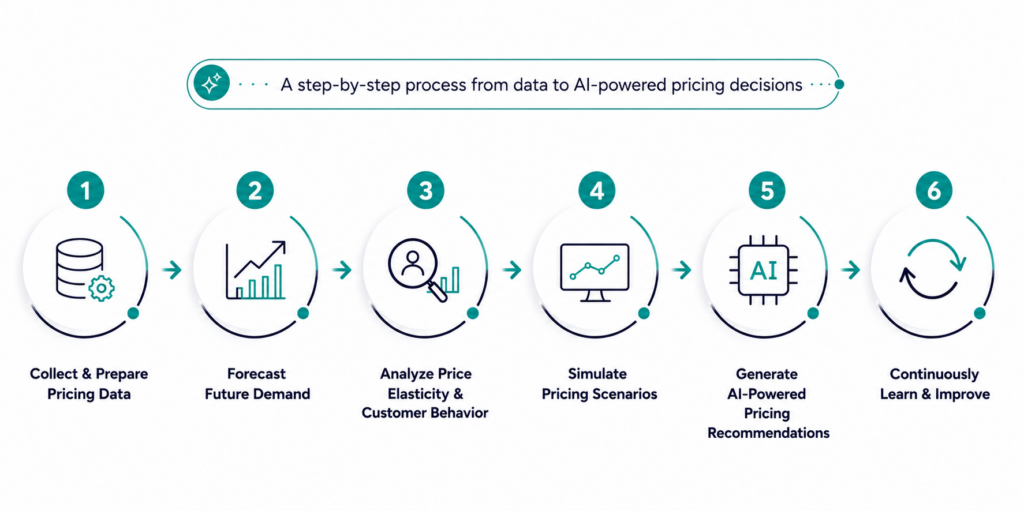
Predictive pricing analytics follows a structured workflow that transforms large volumes of business data into actionable pricing recommendations. While specific methodologies vary between software providers, most AI-powered pricing platforms use a similar sequence of data collection, forecasting, modeling, and continuous optimization. Below is a simplified overview of the predictive pricing process.
Step 1. Collect and Prepare Pricing Data
Every predictive pricing model starts with data. Businesses gather information from multiple internal and external sources, including historical sales, product prices, promotions, inventory levels, customer transactions, competitor prices, and market trends.
Before analysis begins, this data must be cleaned, standardized, and validated. Incomplete or inaccurate data can significantly reduce prediction accuracy, making data quality one of the most important foundations of predictive pricing analytics.
Step 2. Forecast Future Demand
Once reliable data has been collected, predictive models estimate future demand using statistical forecasting techniques and machine learning algorithms.
Instead of relying solely on historical sales, modern forecasting models consider numerous variables, including seasonality, holidays, weather conditions, local events, economic indicators, competitor activity, and changing consumer preferences. This allows businesses to anticipate demand fluctuations before they happen and prepare pricing strategies accordingly.
Step 3. Analyze Price Elasticity and Customer Behavior
The next step is understanding how customers respond to different price changes.
Predictive pricing analytics evaluates price elasticity, measuring how demand increases or decreases when prices change. Some products are highly price-sensitive, while others maintain stable demand even after price increases.
At the same time, AI models analyze purchasing behavior across customer segments, shopping baskets, and buying patterns. These insights help retailers determine which products should be priced aggressively to attract customers and which can maintain higher margins without negatively affecting sales.
Step 4. Simulate Pricing Scenarios
Rather than recommending a single price immediately, predictive pricing software typically evaluates multiple pricing scenarios. For example, retailers can compare questions such as:
- What happens if the price decreases by 5%?
- How will margins change after a promotional campaign?
- Will competitor discounts reduce demand?
- Which pricing strategy generates the highest overall category profit?
By simulating these scenarios before implementation, businesses can minimize risk and make pricing decisions based on projected outcomes rather than assumptions.
Step 5. Generate AI-Powered Pricing Recommendations
After evaluating all relevant variables, the predictive model recommends pricing actions that align with predefined business objectives. Depending on the organization’s priorities, recommendations may focus on:
- maximizing revenue,
- increasing profit margins,
- improving inventory turnover,
- supporting promotional campaigns,
- protecting market share,
- or balancing multiple objectives simultaneously.
Instead of replacing pricing managers, predictive pricing analytics provides data-driven recommendations that support faster and more informed decision-making.
Step 6. Continuously Learn and Improve
Predictive pricing analytics is not a one-time analysis. Modern AI systems continuously monitor sales performance, customer responses, competitor activity, and changing market conditions.
Every pricing decision generates new data that is fed back into machine learning models. Over time, prediction accuracy improves as algorithms learn from successful and unsuccessful pricing strategies, enabling businesses to adapt more quickly to changing market dynamics.
Key Benefits of Predictive Pricing Analytics
Organizations that adopt predictive pricing analytics gain far more than automated pricing recommendations. By combining AI pricing analytics with demand forecasting, businesses can make faster decisions, improve profitability, and respond more effectively to changing market conditions. Below are some of the most significant advantages.
Better Demand Forecasting
Predictive pricing analytics enables businesses to estimate future demand with greater accuracy by analyzing historical sales patterns alongside external market factors. Rather than reacting after demand changes occur, retailers can anticipate seasonal peaks, promotional effects, and customer purchasing behavior in advance. This leads to more effective pricing strategies, improved inventory planning, and fewer stock shortages or overstocks.
Improved Price Optimization
One of the primary goals of price optimization analytics is identifying prices that maximize long-term profitability rather than simply increasing sales volume. By evaluating price elasticity, customer willingness to pay, competitor activity, and margin targets simultaneously, predictive models support price optimization by recommending prices that balance revenue growth with sustainable profit margins.
Faster Decision-Making
Traditional pricing analysis often requires manual spreadsheet work, multiple approvals, and lengthy reporting cycles. Predictive pricing software automates much of this process by continuously analyzing data and generating recommendations in real time. As a result, pricing teams can respond much faster to changing market conditions and spend more time on strategic decision-making instead of manual calculations.
More Accurate Competitive Pricing
Monitoring competitor prices manually becomes increasingly difficult as product assortments grow and prices change more frequently. Predictive pricing analytics continuously tracks market movements and evaluates how competitor pricing is likely to influence customer demand. Instead of automatically matching every competitor discount, businesses can choose pricing strategies that protect both competitiveness and profitability.
Higher Profit Margins
Frequent discounting may increase sales volume, but it doesn’t always improve profitability. Predictive pricing analytics identifies opportunities to increase prices where customer demand remains strong while recommending targeted promotions only when they are expected to generate incremental revenue. This helps retailers reduce unnecessary discounting and improve gross margins across entire product categories.
Better Customer Experience
Customers increasingly expect prices that are both competitive and consistent. Predictive pricing analytics helps businesses deliver fair pricing by considering customer behavior, purchasing patterns, and market conditions. More accurate pricing decisions reduce sudden price fluctuations, improve customer trust, and create a better overall shopping experience while maintaining business profitability.
Predictive Pricing Analytics vs. Traditional Pricing Analytics
Although both traditional and predictive pricing analytics aim to support better pricing decisions, they differ significantly in how they analyze data and generate insights. Traditional pricing analytics focuses on understanding past performance, while predictive pricing analytics uses AI and machine learning to forecast future outcomes and recommend proactive pricing actions. The table below highlights the key differences between these two approaches.
| Feature | Traditional Pricing Analytics | Predictive Pricing Analytics |
| Uses historical data | Yes | Yes |
| Forecasts future demand | No | Yes |
| Machine learning | Limited | Extensive |
| Competitor monitoring | Mostly manual | Continuous and automated |
| Real-time recommendations | No | Yes |
| Automation | Limited | High |
| Scenario simulation | Rarely | Built-in |
| Scalability | Moderate | Designed for enterprise-scale pricing |
Traditional pricing analytics is valuable for understanding historical trends and evaluating previous pricing performance. However, it often requires manual interpretation and does not provide guidance on future pricing decisions.
Predictive pricing analytics builds on this historical foundation by continuously learning from new data, forecasting demand, and recommending optimal pricing strategies before market conditions change. This proactive approach enables retailers to react faster, improve profitability, and reduce pricing risks.
How to Implement Predictive Pricing Analytics: Best Practices
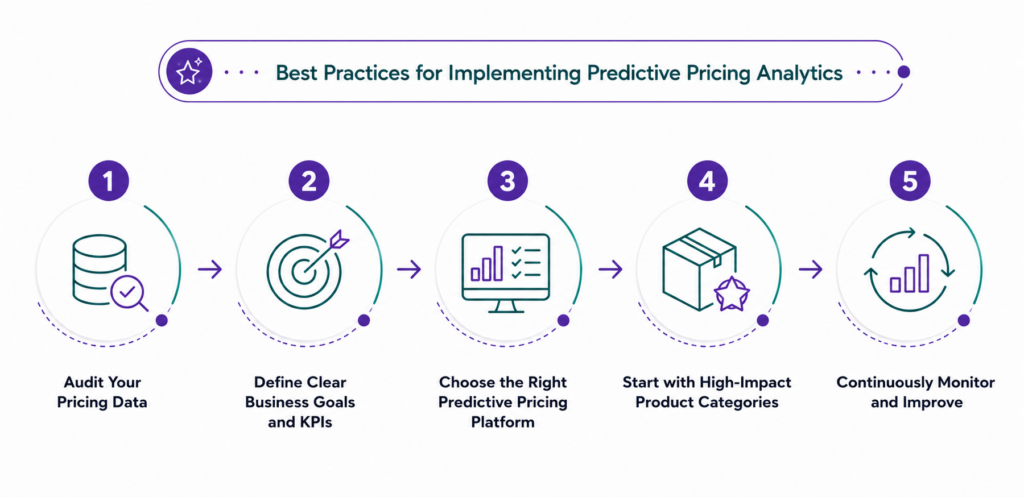
Implementing predictive pricing analytics involves more than purchasing new software. Successful adoption requires high-quality data, clear business objectives, cross-functional collaboration, and continuous model improvement.
The following best practices can help organizations build an effective predictive pricing strategy.
Step 1. Audit Your Pricing Data
Before implementing predictive pricing analytics, businesses should evaluate the quality of their existing data. Historical prices, sales transactions, promotions, inventory levels, customer information, and competitor pricing data should all be reviewed for completeness and accuracy. Even the most advanced AI models cannot produce reliable recommendations if the underlying data is inconsistent or outdated.
Step 2. Define Clear Business Goals and KPIs
Predictive pricing should support measurable business objectives rather than operate as a standalone technology initiative. Organizations should establish key performance indicators (KPIs) such as:
- gross margin improvement,
- revenue growth,
- sell-through rate,
- inventory turnover,
- promotion effectiveness,
- pricing accuracy,
- customer retention.
Clear goals help ensure that pricing recommendations align with broader commercial strategies.
Step 3. Choose the Right Predictive Pricing Platform
Not every pricing solution offers the same capabilities. The essentials are AI-powered forecasting, price elasticity modeling, competitor price monitoring, and scenario simulation. The full evaluation checklist is covered later in this guide. Selecting a solution that aligns with current needs while remaining scalable for future growth is essential for long-term success.
Step 4. Start with High-Impact Product Categories
Rather than transforming every pricing decision simultaneously, many organizations begin with a pilot project. High-volume, high-margin, or highly competitive product categories typically provide the fastest return on investment. Early successes also help build internal confidence before expanding predictive pricing across the entire assortment.
Step 5. Continuously Monitor and Improve
Predictive pricing is an ongoing process rather than a one-time implementation. Businesses should regularly evaluate forecasting accuracy, monitor pricing performance, retrain machine learning models, and adjust strategies as customer behavior and market conditions evolve. Establishing a centralized price management process helps organizations maintain pricing consistency while applying AI-driven recommendations across multiple product categories and sales channels. Continuous optimization ensures that predictive pricing remains accurate and delivers long-term business value.
Pros and Cons of Predictive Pricing Analytics
Like any advanced business technology, predictive pricing analytics offers significant advantages while also introducing new implementation challenges. Understanding both sides helps organizations develop realistic expectations and plan successful deployments.
| Pros | Cons |
| Improves pricing accuracy: AI evaluates significantly more variables than manual analysis. | Requires high-quality data: inaccurate or incomplete data reduces forecasting accuracy. |
| Supports faster decision-making: automated recommendations reduce manual analysis. | Implementation can be complex: integrating multiple business systems may require significant resources. |
| Increases profitability: optimized prices improve margins while maintaining competitiveness. | Requires organizational change: pricing teams must learn to work alongside AI-driven recommendations. |
| Enhances demand forecasting: businesses anticipate market changes before they occur. | Initial investment: advanced predictive pricing platforms may require substantial upfront costs. |
| Scales across thousands of products: suitable for large retailers managing complex assortments. | Models require continuous monitoring: algorithms must be updated as markets and customer behavior evolve. |
Despite these challenges, the long-term business benefits typically outweigh the initial implementation effort. As AI technologies continue to mature, predictive pricing analytics is becoming increasingly accessible for organizations of all sizes.
Real-World Use Cases of Predictive Pricing Analytics Across Industries
Predictive analytics in retail is no longer limited to large enterprises. Today, organizations across multiple industries use predictive models to forecast demand, optimize pricing strategies, improve profitability, and respond more effectively to changing market conditions.
While implementation varies by sector, the underlying objective remains the same: making smarter pricing decisions based on future market behavior rather than historical performance alone.
- Retail. Retailers use predictive pricing analytics to optimize prices across thousands of SKUs while balancing revenue, inventory levels, and customer demand. Common applications include demand forecasting, markdown optimization, promotion planning, competitive pricing, and assortment optimization. Applying predictive analytics to SKU pricing also lets retail teams price item by item instead of relying on blanket category rules. Retail pricing analytics platforms help teams react faster to changing consumer behavior while maintaining healthy profit margins.
- Grocery.Grocery retailers operate in one of the most dynamic pricing environments due to perishability, frequent promotions, and high product turnover.Predictive pricing analytics supports fresh product pricing, waste reduction, price elasticity analysis, promotion management, and inventory planning, enabling retailers to plan campaigns that align with expected customer demand. These insights help reduce food waste while maximizing both sales and profitability.
- eCommerce. Online retailers face intense competition where prices can change multiple times throughout the day. Predictive pricing analytics enables dynamic pricing, marketplace monitoring, personalized offers, customer segmentation, and automated competitor analysis. This allows eCommerce businesses to remain competitive without relying solely on aggressive discounting.
- Manufacturing. Manufacturers use predictive pricing analytics to improve pricing consistency across distribution channels while protecting long-term profitability. Applications include wholesale pricing optimization, contract pricing, channel pricing, demand forecasting, and production planning. Predictive models also help manufacturers anticipate market changes before adjusting prices.
- Consumer Goods (CPG). Consumer packaged goods companies rely on predictive analytics for pricing and promotions, evaluating promotional effectiveness across retailers and optimizing trade investments. AI-powered pricing models support promotion planning, trade spend optimization, category management, and demand forecasting, helping brands maximize return on promotional budgets while strengthening retailer relationships.
- Travel & Hospitality. Hotels, airlines, and travel companies have used predictive pricing techniques for many years to adjust prices according to fluctuating demand. Modern predictive pricing analytics combines booking trends, seasonality, local events, competitor pricing, occupancy forecasts, and customer behavior to recommend prices that maximize revenue throughout the booking cycle.
- Logistics & Freight. Carriers, freight brokers, and 3PL providers use predictive freight pricing analytics to quote shipments based on lane demand, fuel costs, capacity, and seasonality. Forecasting rate movements helps logistics teams win contracts without giving up margin in volatile markets.
Common Predictive Pricing Analytics Challenges and How to Overcome Them

While predictive pricing analytics offers significant business value, successful implementation requires more than advanced algorithms. Organizations must establish strong data foundations, align business objectives, and continuously improve their pricing models to achieve reliable results. Below are some of the most common challenges businesses face and practical ways to overcome them.
Poor Data Quality
Predictive pricing models are only as reliable as the data they analyze. Missing product information, outdated pricing records, inconsistent inventory data, or inaccurate sales history can significantly reduce forecasting accuracy.
To overcome this challenge, businesses should establish strong data governance practices, regularly audit pricing data, and integrate information from all relevant systems into a single, reliable source of truth.
Choosing the Right KPIs
Many organizations focus exclusively on revenue growth when evaluating pricing performance. However, successful pricing strategies should balance multiple business objectives.
In addition to revenue, companies should monitor gross margin, price realization, promotion effectiveness, inventory turnover, customer retention, and forecast accuracy. Selecting the right KPIs ensures predictive pricing supports long-term profitability rather than short-term sales gains.
Cross-Department Collaboration
Pricing decisions affect multiple business functions, including merchandising, category management, marketing, finance, supply chain, and sales. Without clear collaboration, departments may pursue conflicting objectives that reduce pricing effectiveness. Establishing shared KPIs, centralized pricing processes, and cross-functional decision-making helps organizations maximize the value of predictive pricing analytics.
Continuous Model Training
Customer preferences, competitor behavior, and market conditions constantly evolve. As a result, predictive models cannot remain static. Organizations should regularly evaluate forecasting accuracy, retrain machine learning models using new data, and validate pricing recommendations against real business outcomes. Continuous learning enables predictive pricing systems to remain accurate as market conditions change.
Markdown Optimization
Many retailers struggle to determine the right time to mark down products without unnecessarily reducing margins. Markdown optimization uses predictive pricing analytics to recommend the optimal timing and depth of price reductions based on demand forecasts, inventory levels, and customer behavior. This helps businesses clear excess or seasonal inventory more efficiently while protecting long-term profitability.
Start with High-Impact Categories
Trying to cover the entire assortment on day one increases complexity and makes results difficult to measure. Choose a few high-volume or highly competitive categories, define clear success metrics, and use the pilot results to build the case for a wider rollout.
How to Choose Predictive Pricing Analytics Software
Selecting the right predictive pricing platform can significantly influence the success of your pricing strategy. While different vendors offer varying levels of functionality, the best solutions combine AI-driven forecasting, automation, and seamless integration with existing retail systems. Before committing, run a side-by-side pricing software comparison so differences in predictive analytics capabilities are easy to spot. When evaluating predictive pricing software, consider the following capabilities:
- AI-Powered Demand Forecasting. Look for solutions that use machine learning to forecast customer demand based on historical sales, seasonality, promotions, external market conditions, and other influencing factors.
- Price Elasticity Modeling. The platform should measure how sensitive customer demand is to price changes across products, categories, and customer segments. This allows businesses to identify pricing opportunities while minimizing unnecessary revenue loss.
- Scenario Simulation. Advanced pricing software should enable teams to compare multiple pricing scenarios before implementation, helping decision-makers evaluate the potential impact on sales, margins, inventory, and profitability.
- Competitor Price Monitoring. Continuous competitor monitoring provides visibility into market pricing and enables businesses to respond strategically instead of reacting solely to price changes.
- Promotion Analytics. Promotion analytics capabilities help retailers measure campaign effectiveness, estimate incremental sales, identify which promotions truly drive demand, and continuously improve future pricing and promotional decisions.
- ERP and POS Integration. Pricing decisions depend on data from multiple business systems. Seamless integration with ERP, POS, inventory management, and eCommerce platforms ensures pricing recommendations are based on complete and up-to-date information.
- Dashboards and Reporting. Interactive dashboards allow pricing managers to monitor KPIs, compare pricing scenarios, and measure the financial impact of pricing decisions in real time.
- Automation Capabilities. Automation reduces repetitive manual pricing work while ensuring pricing recommendations remain current as market conditions evolve.
- Scalability. As product assortments and data volumes grow, predictive pricing software should continue delivering accurate recommendations across thousands, or even millions, of SKUs without compromising performance.
- Security and Governance. Pricing data represents a valuable business asset. Enterprise-grade security, role-based permissions, audit trails, and compliance with data protection standards are essential for maintaining trust and operational integrity.
- Pricing Transparency and Free Trials. Vendors should openly share how their pricing works, and a free trial or pilot makes it easier to validate forecast accuracy on your own data before signing a contract.
Future Trends in Predictive Pricing Analytics (2026 and Beyond)
Predictive pricing analytics continues to evolve rapidly as artificial intelligence becomes more sophisticated and businesses gain access to larger volumes of real-time data. Over the next few years, pricing technology is expected to become increasingly autonomous, personalized, and integrated across the entire retail value chain. Companies that pair advanced analytics with predictive pricing strategies today will adapt to these shifts fastest.
One of the biggest developments is the growing use of generative AI to support pricing decisions. Rather than simply recommending prices, AI assistants will increasingly explain the reasoning behind pricing recommendations, generate pricing scenarios, and help business users evaluate strategic trade-offs through natural language conversations.
Another emerging trend is the rise of autonomous pricing engines capable of continuously monitoring demand, competitor activity, inventory levels, and customer behavior while automatically recommending, or even executing, pricing adjustments within predefined business rules.
Retailers are also moving toward hyper-personalized pricing, where AI evaluates customer segments, purchasing behavior, loyalty status, and contextual factors to deliver more relevant pricing experiences without compromising fairness or transparency.
At the same time, real-time optimization is becoming a competitive necessity. Instead of updating prices once a week or once a day, businesses increasingly adjust prices dynamically as market conditions evolve throughout the day.
Conclusion
Pricing has evolved far beyond manual spreadsheets and historical reporting. In today’s rapidly changing markets, businesses need pricing strategies that anticipate customer demand, competitive dynamics, and market trends before they impact profitability.
Predictive pricing analytics enables organizations to move from reactive decision-making to proactive, data-driven pricing. By combining artificial intelligence, machine learning, demand forecasting, and scenario modeling, businesses can optimize prices with greater confidence, improve margins, respond faster to market changes, and create better customer experiences.
In retail pricing, predictive analytics has shifted from a competitive edge into standard practice. As AI technologies continue to mature, predictive pricing analytics is becoming an essential capability for retailers, manufacturers, and eCommerce businesses seeking sustainable competitive advantage. Organizations that invest in predictive pricing today will be better positioned to navigate increasingly complex markets while driving long-term growth and profitability.
Frequently Asked Questions
What is predictive pricing analytics?
Predictive pricing analytics uses historical pricing data, machine learning, and AI to forecast how pricing decisions are likely to affect future demand, sales, and profitability. It helps businesses make proactive pricing decisions based on predicted outcomes rather than relying solely on historical reports.
How does predictive pricing analytics work?
Predictive pricing analytics collects data from sales, pricing, inventory, customer behavior, and competitor activity. AI models analyze this information, forecast future demand, simulate pricing scenarios, and recommend prices that best support business objectives such as maximizing revenue or improving margins.
How does predictive pricing differ from dynamic pricing?
Predictive pricing focuses on forecasting future market behavior before making pricing decisions. Dynamic pricing refers to automatically adjusting prices in response to changing market conditions. Many modern pricing platforms combine predictive analytics with dynamic pricing capabilities.
What data is needed for predictive pricing analytics?
Predictive pricing models typically use historical sales, product prices, promotions, inventory levels, competitor prices, customer purchasing behavior, seasonal trends, and external market data to generate accurate pricing recommendations.
What are the benefits of predictive pricing analytics?
Predictive pricing analytics improves demand forecasting, increases pricing accuracy, supports faster decision-making, optimizes profit margins, reduces unnecessary discounting, and enables businesses to respond proactively to changing market conditions.
Can small retailers benefit from predictive pricing?
Yes. While enterprise retailers often use advanced AI pricing platforms, smaller businesses can also benefit from predictive analytics for retail pricing, using lighter tools that improve pricing consistency, demand forecasting, promotion planning, and profitability.
What industries use predictive pricing analytics?
Predictive pricing analytics is widely used across retail, grocery, eCommerce, manufacturing, consumer packaged goods (CPG), travel, hospitality, logistics, and many other industries where pricing directly influences demand and profitability.
How can businesses implement predictive pricing analytics?
Successful implementation begins with high-quality data, clearly defined business objectives, and appropriate pricing software. Most organizations start with a pilot project, measure results, and gradually expand predictive pricing across additional product categories.
How much does predictive pricing analytics software cost?
Predictive analytics pricing depends on data volume, the number of SKUs, and the level of automation required. Most predictive analytics software pricing follows an annual subscription model, often tiered by revenue or product count. Look for vendors that offer pricing transparency and a free trial before committing.
What are the 5 predictive analytics models?
The five commonly recognized predictive analytics models include classification models, regression models, clustering models, time-series forecasting models, and machine learning models such as neural networks that continuously improve prediction accuracy.
What are the 5 C’s of pricing?
The five C’s of pricing generally refer to Customers, Company, Costs, Competition, and Channels. Together, these factors help businesses develop pricing strategies that balance customer value with profitability and market positioning.
What are the 4 types of pricing strategies?
The four common pricing strategies are cost-based pricing, value-based pricing, competition-based pricing, and dynamic pricing. Many modern organizations combine these approaches with predictive pricing analytics to optimize decisions in real time.
What are the 4 types of analytics?
The four primary types of analytics are descriptive analytics (what happened), diagnostic analytics (why it happened), predictive analytics (what is likely to happen), and prescriptive analytics (what action should be taken).