
Private label has become one of the biggest margin opportunities in grocery and FMCG retail. What started as a cheap alternative to national brands now covers every tier of the shelf, from entry-level essentials to premium and specialised ranges. For pricing and category managers, this shift raises a practical question: how do you price own-brand products so they stay clearly cheaper than the brands they compete with, hold the margin the business depends on, and still meet what shoppers expect from them? This guide explains what private label is, why retailers invest in it, the main types you will find on the shelf, and the pricing strategies that separate a private label range that fills space from one that drives category profit.
Table of Contents
- What is a Private Label?
- Private Label vs. White Label: What’s the Difference?
- Examples of Private Labeling
- How Does Private Label Work?
- What are the advantages and disadvantages of private labeling?
- What is a private label pricing?
- How does private label pricing work for retailers?
- How to Build an Effective Private Label Pricing Strategy (step by step)
- Common Private Label Pricing Mistakes to Avoid
- Conclusion
What is a Private Label?
Private labeling is a business model in which products are manufactured by one company but marketed and sold under another company’s brand. In retail, these products typically carry the retailer’s own branding rather than the manufacturer’s identity. The retailer manages product positioning, packaging requirements, assortment decisions, and pricing, while an external supplier handles production according to agreed specifications.
Private labels (PL) are highly prevalent in the retail sector, particularly within the food and fast-moving consumer goods (FMCG) categories. Retailers offer exclusive options in these segments, spanning personal care products, food items, household chemicals, beverages, and home goods. The success of such offerings depends on striking a careful balance between consumer perceptions of product quality, market positioning relative to competitors, and production costs.
Private Label vs. White Label: What’s the Difference?
Private labeling and white labeling both allow businesses to sell products manufactured by external suppliers, but they differ in customization, exclusivity, and brand control. Private labeling typically involves products developed or adapted for a particular retailer, potentially including unique formulations, packaging, specifications, or quality standards. White labeling generally involves standardized products that manufacturers offer to multiple businesses, each selling the product under its own branding. The distinction matters because production arrangements influence costs, differentiation opportunities, and long-term pricing flexibility.
It should also be borne in mind that this may influence how retail sellers set price differentials between competing products. Private-label brands (PLBs) that have been developed independently can always justify their market positioning, provided that consumers perceive clear differences in product features, quality, or the overall consumer experience.
| Comparison Factor | Private Labeling | White Labeling |
| Product development | Customized to retailer requirements | Usually based on existing manufacturer products |
| Brand ownership | Sold under the retailer’s brand | Sold under the purchasing company’s brand |
| Product exclusivity | May involve exclusive specifications or agreements | Similar products may be supplied to multiple businesses |
| Production costs | Potentially higher customization and development costs | Often lower initial development requirements |
| Pricing flexibility | Greater differentiation through unique product attributes | More direct competition with comparable offerings |
| Market positioning | Supports distinctive retailer-owned brand portfolios | Supports faster entry into established product categories |
Examples of Private Labeling
Private labeling appears across numerous retail categories, from everyday groceries to specialized consumer products. Retailers use different approaches depending on customer expectations, category economics, and competitive conditions. The following examples illustrate how private labeling supports distinct commercial objectives.
Grocery and packaged foods
Supermarkets frequently offer retailer-owned pasta, dairy products, cereals, canned goods, and frozen foods. These products provide alternatives to national brands while supporting competitive everyday pricing. Retailers can establish different quality tiers and adjust price gaps according to customer preferences and category profitability. In competitive grocery categories, effective promotion management helps retailers coordinate private label discounts with broader commercial objectives while minimizing unnecessary margin erosion.
Premium food ranges
Retail chains often seek to develop their own premium private-label brands, utilizing unique packaging, specialized ingredients, or carefully selected suppliers. Such products typically target consumers who value quality and uniqueness over the lowest possible price. Pricing strategies for these items should underscore their premium status while remaining reasonable when compared to similar offerings from well-known brands.
Household cleaning products
Private label detergents, surface cleaners, and dishwasher products compete in categories where shoppers often compare functionality and unit prices. Retailers can emphasize reliable performance and attractive value. Competitive benchmarking is particularly important because established national brands frequently use promotions to influence customer choices. For frequently purchased private label products, multiple unit pricing can encourage larger purchases while allowing retailers to experiment with different value propositions and promotional structures.
Personal care products
Own-brand shampoos, skincare and hygiene products let retailers serve shoppers at several price points within one category. What people are willing to pay depends on the product’s attributes, its packaging and how well they believe it works. The challenge is to keep prices accessible without falling short of quality expectations, which matters most when a retailer adds a premium or specialised range.
Pet supplies
Pet food, treats and accessories sold under a retailer’s own name can be set apart by their recipes, pack formats and the needs they address, such as age, breed or diet. Owners tend to be loyal to what they trust, and that trust rests on how good they believe the product is for their animal. Prices for this category therefore need to reflect how often customers come back for the same item, what branded alternatives they could switch to and the value of keeping them as long-term buyers.
These examples demonstrate that private labeling is not limited to low-cost products. Successful retailers use private labels to address specific customer needs, develop recognizable brand identities, and improve assortment economics. Pricing must reflect each category’s competitive environment rather than applying identical rules throughout the portfolio.
How Does Private Label Work?
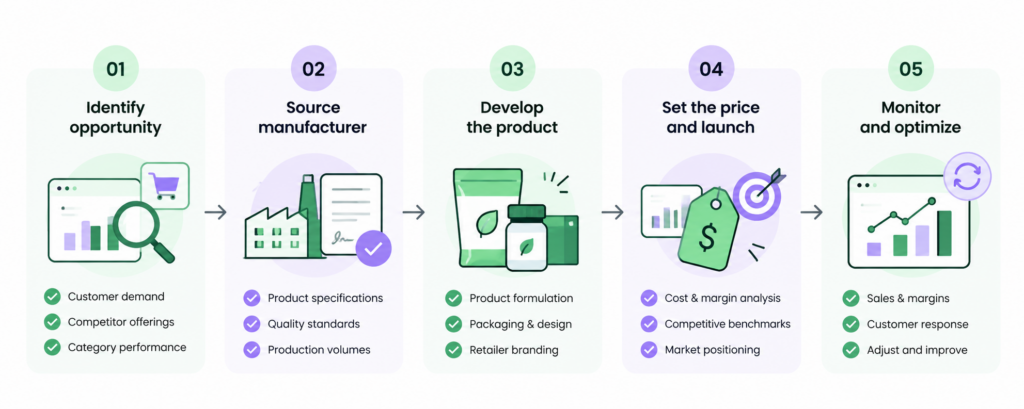
Private labeling follows a structured process that allows retailers to develop exclusive products, establish competitive prices, and manage long-term profitability. From identifying market opportunities to monitoring product performance, each stage requires coordination between suppliers, category managers, and pricing teams.
Identify Market Opportunities
The process begins with analyzing customer demand, competitor offerings, and category performance to identify opportunities for private label products. Retailers evaluate potential differentiation, target audiences, and market gaps to determine which products could strengthen their assortments.
Source Manufacturing Partners
Retailers select manufacturers capable of meeting product specifications, quality standards, production volumes, and delivery requirements. Commercial agreements define responsibilities for manufacturing, packaging, compliance, and supply continuity. Depending on the arrangement, retailers may develop customized products or adapt existing formulations.
Develop the Product and Brand
Once a manufacturing partner is selected, retailers establish product specifications, packaging, branding, and quality positioning. These decisions should reflect customer expectations and the intended market segment. Consistent product development helps create recognizable private labels that differentiate the retailer’s assortment.
Set Pricing and Launch the Product
Retailers evaluate supplier terms, production and logistics costs, and sales volumes to formulate an initial pricing structure. They also compare their products with those of national brands and similar offerings from other retailers to determine the optimal price positioning. Ultimately, pricing must balance affordability, profitability, and perceived value while supporting the retailer’s overall business strategy.
Monitor Performance and Optimize
After launch, retailers continuously monitor sales, margins, customer responses, and competitive developments. Performance data helps identify opportunities to adjust prices, refine product specifications, or improve promotional activities. Collaboration between procurement, pricing, merchandising, and supply chain teams ensures that private label strategies remain responsive to changing market conditions.
What are the advantages and disadvantages of private labeling?
Private labeling offers retailers greater influence over assortment differentiation, brand positioning, and commercial performance. However, these opportunities are accompanied by operational responsibilities and financial risks. Understanding both sides helps retailers establish realistic objectives and select appropriate pricing strategies.
Advantages
- Greater pricing control. Retailers can establish prices according to their own positioning and profitability objectives rather than following manufacturer-led brand strategies. This flexibility supports differentiated value, mainstream, and premium offerings. It also creates opportunities to optimize prices using customer demand and category-level performance data.
- Potentially stronger margins. Private labels can offer attractive margin opportunities when sourcing, manufacturing, and distribution costs are managed effectively. Retailers may capture value that would otherwise support national brand marketing and distribution structures. Actual profitability still depends on sales volumes, operating expenses, and pricing discipline.
- Customer loyalty. Exclusive products give shoppers additional reasons to return to a particular retailer. Positive experiences with consistent quality and value can strengthen trust in the retailer’s overall brand and repeating purchases may contribute to more predictable demand and stronger customer relationships.
- Assortment differentiation. Private labels can help retailers offer products precisely tailored to the preferences of local shoppers, whether these are items currently in high demand or products entirely absent from the market. The specific packaging and product attributes make it significantly more difficult to compare these items with competing offerings. This differentiation allows for clearer positioning; furthermore, management believes it provides considerable flexibility in setting prices.
- Commercial flexibility. Because retailers control the product itself, they can change specifications, switch suppliers and adjust pricing as the market moves. That control also makes it easier to test new categories and price tiers without waiting on a brand owner. When buying and pricing teams make these decisions together, the retailer can react faster to what competitors do.
Disadvantages
- Development responsibilities. Retailers must coordinate product specifications, packaging, quality requirements, and supplier relationships. These activities demand internal resources and specialized expertise. Weak coordination can increase costs, delay launches, or create inconsistencies between intended positioning and delivered products.
- Inventory exposure. Retailers may face minimum order quantities, uncertain demand, and limited flexibility after production commitments. Inaccurate forecasts can generate excess inventory or stock shortages. Both outcomes can reduce profitability and complicate pricing decisions. When private label inventory accumulates or products approach the end of their selling period, markdown optimization can help retailers manage clearance decisions while limiting unnecessary profitability losses.
- Quality and reputation risks. With private label, the retailer’s name is on the pack, so shoppers judge the store by the product. A quality problem with one item can shake confidence in the whole range, and in the retailer itself. Keeping standards consistent means checking suppliers closely, testing products regularly and dealing with complaints quickly and well.
- Marketing investment. Private label products usually need more marketing effort than national brands to get noticed and prove they are worth buying. Shoppers often reach for the brand they know first, especially in categories such as baby care or health, where trust matters most. Retailers therefore have to spend on positioning, packaging and shelf presentation, while making sure those costs do not eat into the margin that made private label attractive in the first place.
- Supplier dependence. Production delays, rising input costs or unreliable deliveries can leave shelves empty and eat into profit. Retailers need backup suppliers and open, honest relationships with the ones they already use. Pricing also has to absorb some of these risks, because passing every cost increase straight to customers is rarely an option. For private label stock that is not moving, a well-planned markdown pricing strategy helps clear inventory without giving away more margin than necessary.
What is a private label pricing?
Private label pricing refers to the process of establishing and managing prices for products sold under a retailer’s own brand. Unlike pricing established national brands, retailers generally have greater control over product positioning and commercial objectives. However, this flexibility also creates additional responsibilities involving customer perception, profitability, and competitive differentiation. Effective price management helps retailers maintain consistent positioning across private label products while balancing customer expectations, competitive pressures, and profitability objectives.
- Cost considerations. Retailers must understand manufacturing expenses, transportation, packaging, storage, and distribution costs before establishing selling prices. These costs determine the financial boundaries within which pricing decisions can operate. Accurate cost information helps protect margins and identify opportunities for operational improvements.
- Competitive positioning. Private label products are frequently compared with similar national brands and competing retailer-owned alternatives. Retailers must identify appropriate benchmarks based on product characteristics, quality, and customer expectations. Maintaining meaningful price differences supports a recognizable value proposition without unnecessarily reducing profitability.
- Customer demand. Pricing decisions should reflect how shoppers respond to different price levels and product attributes. Customer willingness to pay varies according to category, brand familiarity, perceived quality, and purchasing frequency. Understanding these differences helps retailers select prices that support both demand and commercial objectives.
- Brand positioning. Private labels may target budget-conscious customers, mainstream shoppers, or consumers seeking premium quality. Each positioning strategy requires a different relationship between price and perceived value. Consistent pricing across comparable products reinforces customer understanding of the retailer’s brand portfolio.
- Profitability optimization. Good pricing looks beyond the margin on a single product. Retailers should weigh the profit of the whole category, what else ends up in the basket, which products customers switch between and how volumes are likely to shift when a price changes. Seen this way, the right price is the one that improves overall performance, not just the line it sits on.
Why the right Private Label Pricing Matters for Retailers
Private label is where a retailer has the most control over price and the most to gain or lose from it. Unlike national brands, there is no manufacturer setting a recommended price or funding promotions, so every pricing decision sits with the retailer. Priced too high, an own-brand product loses the clear advantage over brands that gives shoppers a reason to try it. Priced too low, it gives away margin the retailer could have kept, and can even make customers doubt the quality. The right price also shapes how the whole category performs: it influences whether shoppers trade down from brands or trade up within the own-brand range, what else ends up in the basket and how often they come back. Get it right and private label becomes one of the most reliable sources of profit and loyalty a retailer has. Get it wrong and it quietly drains both.
How does private label pricing work for retailers?
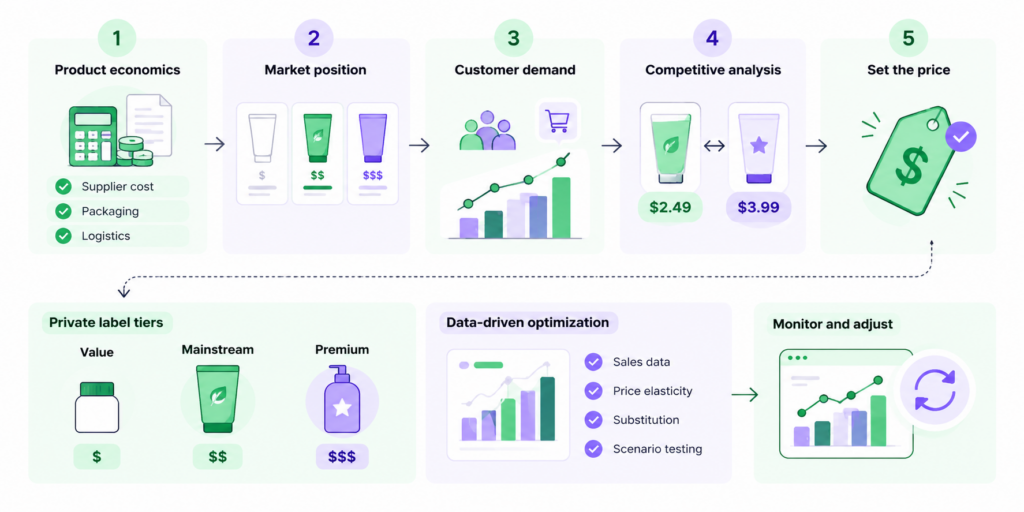
Setting the right price for a private label product means weighing several things at once: what it costs to make and sell, where it sits against national brands, what shoppers expect to pay and how much margin the business needs. Most retailers work through these factors in a set order so that prices stay competitive, margins hold and the own-brand range tells a consistent story. Fixed markup rules can only take this so far. Price optimization tools go further by analysing costs, competitor prices and customer demand together, so the recommended price reflects all three rather than a single rule of thumb. Whether a retailer works with such tools or not, the process usually follows the same steps
- Analyze Product Costs. Retailers begin by evaluating supplier prices, packaging, transportation, warehousing, and other relevant expenses. Understanding the complete cost structure helps establish financial targets and minimum acceptable margins. However, costs should serve as a starting point rather than the sole basis for pricing decisions.
- Define Market Positioning. Products sold under a retailer’s own private label are typically categorized into several segments: budget, mass-market, and premium. Budget-tier products focus on affordability for the consumer; the mass-market segment offers a balance between price and quality; and premium-tier products feature specific attributes intended to justify their higher price point. This segmentation allows for a clear differentiation in pricing across a retailer’s entire product assortment.
- Evaluate Customer Demand and Competition. Retailers analyze customer willingness to pay, competitor prices, and comparable national brands to establish appropriate price gaps. Historical sales data and price elasticity analysis help predict how customers may respond to different price levels. These insights support competitive positioning without unnecessarily sacrificing profitability. Using predictive pricing analytics, retailers can estimate potential demand responses and evaluate how different price points may influence sales volumes and profitability.
- Optimize and Monitor Pricing Performance. Modern private label pricing relies on transaction data, demand forecasting, and scenario testing to evaluate potential price adjustments. Retailers must consider product substitution, category-level profitability, and changing market conditions. Continuous monitoring allows pricing teams to refine decisions as costs, competitor prices, and consumer preferences evolve.
How to Build an Effective Private Label Pricing Strategy (step by step)
Building an effective private label pricing strategy requires a structured process that connects commercial objectives with customer behavior, competitive positioning, and profitability. Retailers must understand how individual products contribute to broader category performance while ensuring that prices communicate a consistent value proposition. The following five steps provide a practical framework for developing, implementing, and continuously improving private label pricing decisions.
Five Steps to Develop a Private Label Pricing Strategy
Step 1 – Define Pricing Objectives
The first step is establishing clear commercial objectives for each private label category. Retailers should determine whether their priority is increasing profit margins, improving market penetration, strengthening customer loyalty, or reinforcing price perception. Different objectives may require different approaches, even within the same assortment.
For example, frequently purchased grocery essentials may play an important role in communicating affordability, while premium private labels may prioritize differentiation and contribution margins. Retailers should define measurable targets such as gross margin, sales volume, category contribution, or customer retention. Retailers managing frequent campaigns may benefit from promotion management software that connects promotional planning with broader pricing, margin, and category performance objectives.
Step 2 – Analyze the Competitive Landscape
Competitive analysis helps retailers understand how their private label products compare with available alternatives. Relevant benchmarks include national brands, competing retailer-owned products, and comparable offerings across different retail channels. Product comparisons should consider quality, package size, functionality, and positioning rather than relying exclusively on shelf prices.
Retailers should calculate price gaps between private labels and their closest competitors. These gaps reveal whether products communicate the intended value proposition and whether pricing relationships remain consistent across categories.
Competitive monitoring must also account for promotional activity and changing market conditions. Temporary national brand discounts can narrow or reverse established price gaps, potentially affecting customer choices. Regular benchmarking enables retailers to identify positioning risks, evaluate competitive responses, and make informed adjustments without automatically matching every competitor price change. Modern pricing intelligence software helps retailers collect and analyze competitor pricing information, making it easier to identify market changes and maintain appropriate private label price gaps.
Step 3 – Establish a Price Positioning Framework
A consistent positioning framework defines how different private label tiers should relate to national brands and one another. Retailers commonly distinguish between value, mainstream, and premium ranges, assigning each tier a clear customer proposition and commercial role.
Value products typically emphasize affordability, while mainstream ranges balance quality and price. Premium private labels may justify higher prices through distinctive ingredients, features, packaging, or product experiences. Retailers should set appropriate pricing boundaries while allowing flexibility for category-specific differences.
Step 4 – Use Customer and Sales Data
Customer and transaction data provide essential insights into how shoppers respond to private label prices. Retailers should analyze historical sales, purchasing frequency, basket composition, promotional performance, and demand patterns. These insights help identify which products influence price perception and which contribute disproportionately to profitability.
Price elasticity analysis can estimate how changes in selling prices may affect demand. Retailers should also examine substitution between private labels and national brands, particularly when products serve similar customer needs.
Combining these insights with competitive information enables more informed pricing decisions. Rather than assuming that lower prices always increase category performance, retailers can evaluate whether additional volume compensates for reduced margins. Data-driven analysis supports more precise pricing decisions across large assortments. Accurate retail demand forecasting helps retailers anticipate purchasing patterns, evaluate expected sales volumes, and make more informed private label pricing decisions.
Step 5 – Test, Monitor, and Refine Prices
Private label pricing strategies require continuous evaluation after implementation. Retailers should establish performance indicators covering sales volumes, gross margins, category profitability, price gaps, and customer purchasing behavior. Monitoring these metrics helps determine whether pricing decisions achieve their intended objectives.
Prices should not be set once and left alone. Whenever supplier costs rise, a competitor moves or shoppers start behaving differently, the decision deserves another look. AI-based optimisation tools make this easier by picking up patterns across thousands of products and price points that no team could spot by hand. Reviewed and adjusted this way, pricing stops being an admin task done at launch and becomes a commercial lever the retailer can pull as conditions change.
Common Private Label Pricing Mistakes to Avoid
Even retailers with a clear private label strategy can lose margin or market share through a handful of avoidable pricing habits. Most of them come down to the same root cause: treating price as a number set once at launch rather than a decision that depends on costs, competitors and demand, all of which keep changing. The three mistakes below are the ones that show up most often, along with what to do instead.
Relying Too Heavily on Cost-Based Pricing
Cost-plus pricing provides a straightforward starting point, but relying on it exclusively can lead to missed commercial opportunities. A fixed markup does not adequately reflect customer willingness to pay, competitive positioning, or price elasticity. Retailers may price highly differentiated products unnecessarily low or establish prices that customers consider excessive. Combining cost information with market and demand analysis creates a more balanced approach.
Ignoring Price Gaps and Category Interactions
Significant discrepancies in price gaps can severely weaken the position of private-label (store-brand) products and lead to complete confusion among your customers. Furthermore, it is important to remember that retailers may inadvertently compare products with different characteristics, which can result in highly inaccurate conclusions. Another risk to consider is “cannibalization”, where growth in private-label sales comes solely at the expense of other, more profitable items. Conducting a thorough analysis of similar products, as well as the contribution of other categories and substitutes to overall performance, can help retailers avoid decisions that might improve the metrics of individual products while simultaneously reducing total profitability.
Failing to Adapt to Changing Market Conditions
Static pricing rules and infrequent reviews can become ineffective when competitors adjust prices, supplier costs fluctuate, or consumer demand changes. Retailers that lack reliable elasticity data and consistent performance monitoring may respond too slowly to emerging opportunities or risks. Regular analysis, scenario testing, and clearly defined review processes help maintain competitive positioning. Effective pricing strategies should evolve with market conditions rather than depend on assumptions established during the initial product launch. Implementing dynamic pricing software can support more responsive pricing decisions by helping retailers adapt to competitor movements, demand fluctuations, and changing market conditions.
Conclusion
Private label pricing is a strategic tool for balancing customer value, competitive differentiation, and retail profitability. Successful retailers align pricing decisions with broader category management objectives, ensuring that private labels strengthen the overall assortment rather than simply compete on lower prices. Choosing appropriate pricing analytics software can further support this approach by providing insights into demand patterns, pricing performance, and opportunities for continuous improvement.
Pricing decisions get better when they rest on data rather than habit. Tracking the gap between own-brand and branded prices, benchmarking against competitors and watching how sales respond over time shows retailers exactly how a price change plays out in shopper behaviour and category profit. And because costs, competitors and customer habits keep moving, the strategy built on that data has to keep moving with them.
AI-based price optimisation gives pricing teams the means to do this at scale: it maps how products in a category affect each other, tests alternative price scenarios before they reach the shelf and shows the trade-off between volume and margin for each option. Retailers who want to put their private label pricing on a firmer footing can see how Yieldigo supports data-driven pricing across grocery and FMCG assortments.
Frequently Asked Questions
What is a private label?
A private label is a product manufactured by one company and sold under another company’s brand, typically a retailer’s own brand. The retailer controls branding, positioning, and pricing, while an external manufacturer usually handles production. Private labels are common in grocery, household goods, personal care, and other retail categories.
What’s the difference between retail and private label?
Retail refers to the business of selling products directly to consumers, regardless of who owns the brands. Private label refers specifically to products sold under a retailer’s own brand, usually manufactured by third parties. A retailer can sell both national brands and private label products within the same assortment.
How is a private label different from a brand?
A private label is itself a brand, but it is owned or controlled by a retailer rather than an independent national brand manufacturer. Private labels are generally exclusive to the retailer or retail group that owns them. National brands, by contrast, are typically distributed through multiple retailers and sales channels.
What are the four types of private labels?
A common classification identifies four types: economy private labels, standard or mainstream private labels, premium private labels, and value-added or specialty private labels. Economy products emphasize affordability, mainstream products balance quality and value, premium products target higher quality expectations, and specialty ranges address particular customer needs or preferences.
How do you price a private label product?
Retailers typically begin by analyzing product costs, target margins, competitor prices, and customer willingness to pay. They then establish an appropriate price position relative to comparable national brands and competing private labels. Price elasticity analysis and scenario testing can help refine the final price.
What is a good profit margin for private label products?
There is no universal profit margin that applies to every private label product. Appropriate margins depend on the category, sourcing costs, competition, product positioning, and retailer objectives. Retailers should evaluate both product-level gross margins and the contribution of private labels to overall category profitability.
What is a private label price gap?
A private label price gap measures the price difference between a private label product and a comparable national brand or competing product. It is often expressed as a percentage relative to the benchmark product’s price. Retailers use price gap analysis to maintain consistent positioning and understand how pricing differences influence consumer behavior.
What are the main types of private label pricing strategies?
Common approaches include cost-based, competitor-based, and value-based pricing. Retailers may also apply everyday low pricing or promotional pricing depending on their category objectives. Many effective strategies combine these methods with price elasticity analysis and profitability optimization.
How can retailers optimize private label pricing?
Retailers can optimize private label pricing by combining cost information, competitive benchmarks, transaction data, and customer demand analysis. They should evaluate price gaps, product substitutability, and category-level profitability before making adjustments. Continuous performance monitoring and pricing scenario simulations can support more consistent decisions.
What Are the Different Types of Private Labels?
Not all own-brand products play the same role. Some exist purely to offer the lowest price on the shelf, others are built to sit right next to a national brand and win on value, and a growing number aim higher than the brands themselves. Most private label ranges fall into four main types: generic, copycat, premium and value innovator. Each targets a different shopper, carries a different margin profile and calls for its own pricing approach, so it helps to look at them one by one.