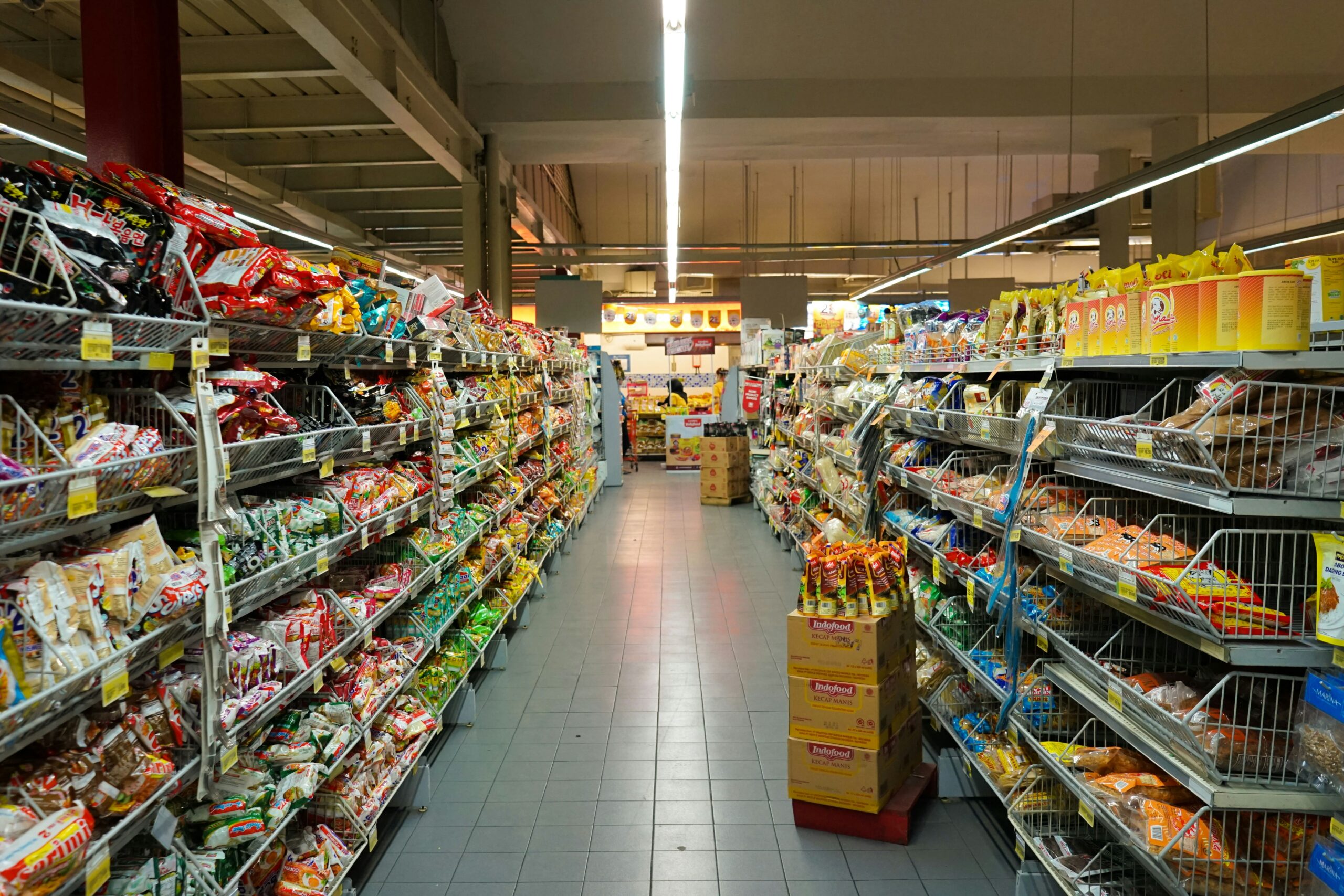
In retail, customers don’t judge a store’s prices by looking at every product on the shelf. Instead, they often focus on a few familiar items they buy regularly, such as milk, bread, eggs, or everyday household essentials. These products, known as Key Value Items (KVIs), play a major role in shaping how customers perceive a retailer’s overall pricing. If these items are priced competitively, shoppers are more likely to see the store as affordable and trustworthy. But if their prices seem too high, even a store with great deals on other products may struggle to win customers’ confidence.
That’s why having the right KVI pricing strategy matters. Retailers need to identify which products influence customers’ price perceptions, understand how competitors price them, and find the right balance between staying competitive and protecting profit margins. Simply lowering prices isn’t always the answer. With the right approach, retailers can use KVI pricing to attract more customers, strengthen price perception, and make smarter pricing decisions across their product range. In this guide, we’ll explore what KVIs are, how to identify them, how they differ from non-KVI products, and the practical steps you can take to build and optimize an effective KVI pricing strategy.
Table of Contents
- What Is Key Value Item (KVI) Pricing?
- How does Key value item pricing (KVI) works
- Why Are Key Value Items (KVIs) Important in Retail Pricing?
- How to Identify Key Value Items in Retail
- Key Value Item Pricing vs. Non-KVI Pricing
- Key Value Item Examples by Retail Vertical
- Understanding KVIs and KVCs in Retail
- How to Build an Effective KVI Pricing Strategy: A Step-by-Step Guide
- KVI Pricing at Scale vs. Smaller Product Portfolios
- How to manage KVI pricing effectively: best practices
- Common KVI Pricing Mistakes and How to Avoid Them
- How to Measure and Optimize KVI Pricing Performance
- Conclusion
- Frequently Asked Questions
What Is Key Value Item Pricing (KVI) ?
Key Value Item (KVI) pricing is a retail pricing strategy that focuses on products with a particularly strong influence on customers’ perception of a retailer’s overall price competitiveness. These products often serve as reference points when shoppers compare stores and decide where to shop.
Consumers often gauge the overall price level of a store by looking at the cost of a few specific, frequently purchased everyday items, such as milk, eggs, or bananas, which serve as price benchmarks. Shoppers tend to have a strong recall for the prices of these essential goods, which they buy often, while the costs of other products remain outside their immediate focus.
It is important to note that such “Key Value Items” (KVIs) are not necessarily the best-selling products; rather, their strategic value lies in the fact that they shape the customer’s perception of a store’s pricing policy. By identifying these items and managing them effectively, retailers can strengthen their market position, for instance, by applying aggressive discounts across their broader product range.
Five Characteristics of Key Value Items
- High customer price awareness. Customers recognize typical prices and notice changes more readily than they do for less familiar products. This awareness makes KVIs particularly influential in shaping perceptions of affordability. Retailers must understand which products shoppers genuinely remember rather than assuming that all popular products receive equal attention.
- Frequent purchase and comparison behavior. KVIs often appear in regular shopping routines and are compared across competing retailers. Repeated exposure allows customers to develop expectations about reasonable prices. Even relatively small differences can influence their assessment of competing stores.
- Strong influence on overall price perception. The price of a recognizable product can affect how shoppers judge an entire assortment. Competitive KVI prices may strengthen a retailer’s value image beyond the individual products involved. This makes strategic selection essential for effective retail pricing.
- Competitive visibility and price transparency. KVIs are frequently featured in advertisements, digital comparisons, and competitor promotions. Customers can therefore evaluate their prices with relatively little effort. Retailers need consistent competitor monitoring to maintain a credible market position.
- Strategic importance for store choice and customer loyalty. Competitive prices on important everyday products can encourage customers to choose or revisit a retailer. However, loyalty also depends on availability, convenience, quality, and the overall shopping experience. KVI pricing should support these broader commercial priorities.
How does Key value item pricing (KVI) works
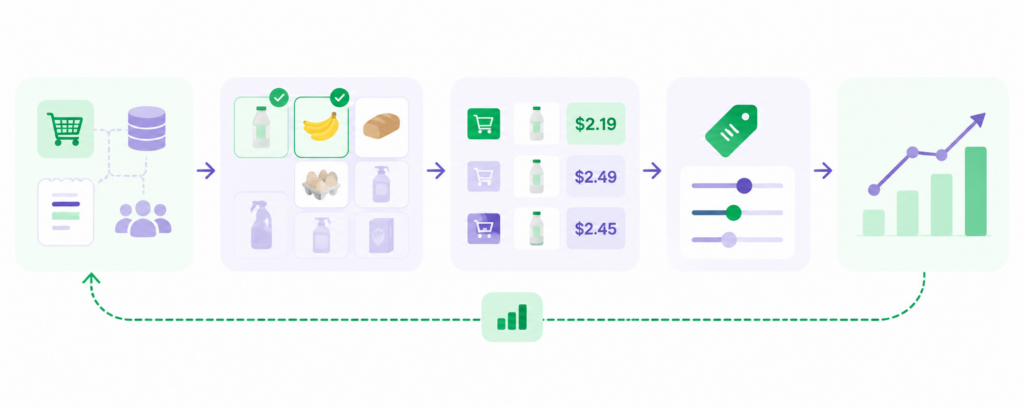
KVI pricing works by identifying products that strongly influence customers’ perception of a retailer’s overall price competitiveness. Rather than treating every SKU equally, retailers prioritize strategically important items for competitive monitoring and targeted price adjustments. The process combines customer behavior analysis, competitor benchmarking, pricing optimization, and continuous performance evaluation.
Analyze Retail Data and Customer Behavior
Retailers begin by analyzing transaction histories, shopping baskets, purchase frequency, and customer price sensitivity. These insights help identify products that customers regularly purchase, recognize, and compare across competing stores.
Identify Key Value Items
Based on the data collected, retailers can identify the products that, in their view, have the greatest impact on how customers perceive their overall price levels. A high sales volume is not the only criterion for classifying a product as a “Key Value Item” (KVI); other significant factors include price elasticity of demand, the level of customer awareness, and the strategic importance of the product category in question.
Compare Competitor Prices
Once KVIs are identified, pricing teams conduct competitive pricing analysis to evaluate their prices against relevant competitors. This benchmarking helps establish competitive targets while considering market positioning, product characteristics, and customer expectations.
Optimize Prices and Protect Margins
Retailers adjust KVI prices based on competitive targets, demand patterns, and profitability constraints. The objective is to maintain attractive prices on highly visible products while protecting margins across the broader assortment.
Monitor Performance and Continuously Improve
Effective KVI pricing requires ongoing evaluation of sales responses, competitor movements, basket profitability, and customer purchasing behavior. Regular monitoring allows retailers to refine their pricing strategies, respond to market changes, and avoid unnecessary discounts.
Why Are Key Value Items (KVIs) Important in Retail Pricing?
Pricing strategies based on “Key Value Items” (KVI), products that are particularly significant to shoppers, help retailers strengthen their market position against competitors without compromising the overall profitability of their product assortment. By focusing on items that most heavily influence how customers perceive prices, retailers can effectively attract shoppers, make more informed strategic pricing decisions, and maintain competitive price points in the marketplace.
- Improving customer price perception and competitive positioning. Competitive prices on recognizable products strengthen a retailer’s reputation for affordability. By monitoring strategically important KVIs, retailers can respond to competitor pricing more effectively without applying unnecessary discounts across entire categories.
- Supporting customer acquisition. Attractive KVI prices encourage price-conscious shoppers to choose a retailer over competitors. This is particularly important in grocery retail, where customers frequently compare prices on everyday essentials. Competitive pricing can also support repeat visits and customer loyalty.
- Protecting overall profitability. Selective KVI pricing allows retailers to concentrate competitive investments on products that matter most to customers. Products with lower price visibility offer greater flexibility for margin optimization, helping retailers maintain profitability across the broader assortment.
- Improving category management. Identifying KVIs helps category managers distinguish products that influence price perception from those primarily contributing to profitability. This supports more informed assortment decisions and better coordination between pricing, merchandising, and commercial teams.
- Enabling data-driven decisions and AI-powered optimization. KVI analysis combines transaction data, price elasticity, competitor intelligence, and customer purchasing behavior to support more accurate pricing decisions. AI-driven retail pricing solutions such as Yieldigo help retailers analyze complex assortments, identify strategically important products, and optimize prices while balancing competitiveness with profitability.
How to Identify Key Value Items in Retail
Identifying key value items requires analyzing more than sales volume or purchase frequency. Retailers need to evaluate customer price awareness, purchasing behavior, price sensitivity, and competitive visibility to determine which products genuinely influence overall price perception.
Why the traditional approach falls short
Traditional KVI identification often relies on sales rankings, historical performance, or manually selected product lists. However, high sales volume does not necessarily mean that customers remember or compare a product’s price. These methods can overlook strategically important items and fail to reflect changing shopping habits or competitive conditions.
Modern data-driven criteria for KVI identification
Modern retailers combine transaction analytics, basket penetration, price elasticity, competitor intelligence, and customer research to identify KVIs more accurately. This approach helps distinguish products that simply sell well from those that shape customers’ perceptions of value. Regular data analysis also allows retailers to adapt KVI selections across categories, locations, and customer segments. Advanced predictive pricing analytics can further support KVI identification by helping retailers anticipate demand changes and evaluate potential customer responses to different pricing decisions.
Data-Driven KVI Identification
Transaction and Basket Analysis
Transaction data makes it possible to determine with precision how frequently customers purchase specific items, as well as which products they tend to buy together. So-called “basket penetration” metrics help identify products that can attract a large number of customers, while an analysis of the relationships between products can reveal how they influence overall customer preferences.
Customer Price Sensitivity
Price sensitivity analysis examines how demand responds to price changes. Historical pricing data, promotional results, and customer research help identify products that shoppers actively compare. However, elasticity alone does not establish KVI status and should be evaluated alongside competitive visibility and customer awareness. Combining elasticity estimates with retail demand forecasting helps pricing teams anticipate potential sales responses and distinguish short-term fluctuations from meaningful changes in purchasing behavior.
Five Factors for Identifying Key Value Items
- Sales frequency and purchase patterns. Examine how regularly customers purchase products and whether they appear in recurring shopping baskets. Frequent purchases can increase price familiarity, but frequency alone is insufficient.
- Price elasticity and customer sensitivity. Analyze how demand responds to price changes while accounting for promotions, seasonality, and product availability. High sensitivity may indicate strategic importance when supported by customer research.
- Competitor price comparisons. Identify products frequently compared or promoted across competing retailers. Strong competitive visibility increases the importance of maintaining attractive and credible prices.
- Basket penetration and product relationships. Measure how often products appear in shopping baskets and analyze their relationships with complementary items. This helps retailers understand potential effects beyond individual SKU performance.
- Customer awareness and strategic category importance. Combine customer feedback, category relevance, and commercial expertise to identify products that strongly influence a retailer’s overall value proposition.
Creating a KVI Scoring Model
Combining Quantitative and Qualitative Signals
A KVI scoring model combines measurable indicators with commercial assessments. Retailers can assign weighted scores to purchase frequency, basket penetration, price sensitivity, competitive visibility, and customer awareness. These weights should reflect business objectives and be validated against actual purchasing behavior.
Ranking Products by Strategic Importance
Products can then be ranked according to their combined scores and grouped into strategic tiers. High-priority KVIs require frequent competitive monitoring, while secondary candidates may need periodic reviews. Regular reassessment ensures that KVI classifications remain relevant as customer preferences and market conditions evolve.
Key Value Item Pricing in Retail: A Modern Approach
Modern KVI pricing goes beyond traditional sales rankings and fixed pricing rules by combining customer behavior, transaction analytics, competitor intelligence, and profitability modeling. Instead of treating all popular products as equally important, retailers identify those that genuinely influence customer price perception and adjust their pricing strategies as market conditions evolve.
- How Retailers Set KVI and KVC. Retailers evaluate customer price awareness, basket penetration, competitive visibility, and category importance to establish product-level and category-level pricing priorities. This ensures that individual KVI decisions support broader Key Value Category (KVC) strategies.
- Data-Driven Selection. Advanced analytics combine transaction histories, price elasticity estimates, and competitor data to identify and rank potential KVIs. Regular validation helps retailers distinguish strategically important products from those that simply generate high sales volumes.
- KVI Categories. Retailers can segment KVIs into everyday essentials, highly visible competitor benchmarks, promotional reference products, and strategically important category representatives. Each group may require different competitive targets, pricing rules, and monitoring frequency.
Key Value Item Pricing vs. Non-KVI Pricing
When determining KVI (Key Value Item) pricing, covering essential, everyday products, priority is naturally given to items that shape how shoppers perceive a retailer’s overall price level. We have observed that these products require both rigorous monitoring of competitors’ offerings and the establishment of clear performance targets. In this context, strategic price management demands particular attention, as even minor discrepancies can influence how customers evaluate the retailer.
Non-KVI pricing provides greater flexibility to optimize profitability, demand, and product-level economics. Customers may compare these products less frequently or have weaker reference prices. Nevertheless, retailers must still consider elasticity, category relationships, and customer expectations rather than automatically increasing prices. While KVI pricing focuses on customer price perception, yield management pricing offers another approach to adjusting prices according to demand patterns, capacity constraints, and revenue objectives.
Effective promotion management is also important when retailers use temporary discounts on strategically visible products, ensuring that promotional activities support wider commercial objectives. Both approaches should operate within one coordinated pricing strategy. Excessively aggressive KVI discounts can damage profitability, while inappropriate non-KVI prices may weaken customer trust. Effective management evaluates the entire basket rather than isolated products.
| Dimension | KVI Pricing | Non-KVI Pricing |
| Primary objective | Competitive price perception | Balanced profitability and demand |
| Customer awareness | Generally high | Often lower |
| Competitor monitoring | Frequent and prioritized | Selective and category-dependent |
| Pricing flexibility | More constrained | Typically greater |
| Margin strategy | Strategic investment | Margin optimization |
| Main evaluation | Price index and basket impact | Profitability and demand response |
Unlike KVI pricing, which primarily influences customers’ overall price perception, a markdown pricing strategy focuses on planned price reductions to manage inventory, stimulate demand, and improve sell-through performance.
Key Value Item Examples by Retail Vertical
Key value items vary across retail sectors because customer purchasing habits, price awareness, and competitive dynamics differ between industries. Retailers should identify KVIs based on sector-specific purchasing behavior and competitor data rather than applying the same product list across every retail category.
Grocery and Supermarkets
Common potential KVIs include milk, eggs, bread, bananas, and cooking oil. These everyday essentials are purchased frequently, making their prices familiar to customers and important for overall price perception. Grocery retailers may also use multiple unit pricing for selected products to encourage larger purchases, although promotional offers should be evaluated separately from a product’s strategic KVI status.
Drugstore and Beauty Retail
Toothpaste, shampoo, deodorant, and popular skincare products may serve as KVIs. Brand recognition, repeat purchases, and frequent promotions make these products particularly relevant for competitive price comparisons.
Consumer Electronics
For example, popular smartphones, televisions, or headphones, as well as widely available accessories, can serve as key performance indicators (KPIs) for retailers. Transparent online pricing allows shoppers to compare similar models across different stores, which, in turn, can intensify competition among retailers.
DIY and Home Improvement
Products such as batteries, light bulbs, paint, and standard tools may influence customers’ perceptions of affordability. Retailers should consider product specifications, brand recognition, and purchase frequency when identifying potential KVIs.
Pet Supplies
Popular pet food brands, cat litter, and everyday pet care essentials can serve as KVIs. Regular purchasing patterns and recognizable package sizes make these products suitable for competitor benchmarking and price perception analysis.
Understanding KVIs and KVCs in Retail
Key Value Items and Key Value Categories represent different levels of retail price perception. A KVI is an individual product whose price customers recognize and compare, while a Key Value Category (KVC) is a broader assortment group that plays an important role in perceived value.
For example, bananas are considered “key value items” (KVI) within the fresh produce category; at the same time, the fresh produce category itself can be viewed as a “key value category” (KVC). It is highly advantageous for retailers to manage these items at every level, as they shape how shoppers perceive these strategically important categories.
| Dimension | KVI | KVC |
| Meaning | Key Value Item | Key Value Category |
| Scope | Individual product or SKU | Product category |
| Example | Bananas | Fresh produce |
| Strategic focus | Product price competitiveness | Category value perception |
| Management approach | SKU-level monitoring | Category-level strategy |
| Business objective | Strengthen product price image | Reinforce category positioning |
How to Build an Effective KVI Pricing Strategy: A Step-by-Step Guide
Managing KVI pricing effectively requires a repeatable process that connects strategic objectives with everyday pricing decisions. Retailers need clear responsibilities, reliable data, competitive benchmarks, and measurable constraints to ensure that price competitiveness supports sustainable profitability.
A Five-Step Framework for KVI Pricing
Step 1. Define Retail Pricing Objectives
Establish whether the primary objective is improving price perception, attracting customers, increasing basket value, or strengthening competitive positioning. Define measurable targets such as competitor price index, category profitability, and sales performance. Align objectives with financial constraints so that competitive pricing investments remain commercially sustainable.
Step 2. Identify and Segment Key Value Items
Analyze transaction data, customer behavior, elasticity, and competitive visibility to identify strategically important products. Use a scoring methodology to distinguish high-priority KVIs from secondary candidates. Segment selected products by category, customer relevance, and pricing objectives. Review classifications periodically to maintain their accuracy.
Step 3. Analyze Competitor Prices and Market Position
It is essential to identify the key competitors for each store format, sales channel, and, for instance, geographic region. You should compare similar products using only verified pricing data, while also accounting for variables such as pack size, promotional terms, and product quality. Be sure to define the criteria for your products’ competitiveness in a way that reflects their market positioning; do not simply focus on offering the lowest prices in the market.
Step 4. Establish KVI Pricing Rules and Margin Constraints
Define acceptable price differences, minimum margins, and category-level profitability requirements. Pricing rules should reflect product importance, competitive conditions, and commercial objectives. Include safeguards against unnecessary price reductions and evaluate potential effects on complementary products. Clear governance helps maintain consistency across pricing teams. A structured price management approach helps retailers maintain consistent pricing rules, coordinate decisions across categories, and balance competitive targets with financial constraints.
Step 5. Monitor, Test, and Optimize KVI Prices
Track competitor movements, demand responses, basket profitability, and customer behavior. Use controlled tests where practical to assess whether pricing changes produce the intended outcomes. Update product classifications and pricing rules when performance indicates that assumptions have changed. Continuous optimization keeps the strategy aligned with market conditions. As assortments grow, automated pricing optimization can help retailers evaluate pricing scenarios, apply consistent rules, and respond more efficiently to changing market conditions.
Adapting KVI Strategies Across Retail Categories
Grocery and FMCG Retail
Grocery retailers manage frequent purchases, narrow margins, and extensive assortments. Everyday essentials often require close competitive monitoring, while basket-level analysis helps determine whether targeted price investments support category profitability.
Regional Stores and Omnichannel Retail
Regional retailers must account for differences in local competitors, purchasing habits, and customer demographics. Omnichannel businesses also need consistent pricing logic across stores and digital channels while recognizing legitimate differences in costs and market conditions.
KVI Pricing at Scale vs. Smaller Product Portfolios
Pricing for key value items (KVIs) has become increasingly complex as product assortments have expanded. Small retail stores identify these items by analyzing customer transactions, continuously monitoring competitor pricing, and reviewing customer feedback on past purchases. While narrowing your product range makes manual price management easier, it also necessitates a rigorous, systematic approach to how you select which items to include.
Large retailers must evaluate thousands of products across categories, regions, formats, and customer segments. A product may be strategically important in one location but less relevant elsewhere. Automated scoring, centralized governance, and localized pricing rules become increasingly valuable as complexity grows. For large retailers, dynamic pricing software can support more responsive price adjustments across extensive assortments while maintaining predefined commercial rules and profitability constraints.
| Dimension | Smaller Portfolios | Large-Scale Portfolios |
| Assortment complexity | Limited | High |
| KVI identification | Manual or basic analytics | Automated scoring and modeling |
| Competitor monitoring | Periodic comparisons | Frequent, scalable monitoring |
| Pricing rules | Relatively simple | Category and location-specific |
| Data requirements | Basic transaction information | Integrated commercial datasets |
| Optimization | Periodic adjustments | Continuous analytical workflows |
How to manage KVI pricing effectively: best practices
Effective KVI pricing management requires a structured approach that balances competitive positioning, customer price perception, and retail profitability. By combining clear pricing rules, regular competitor monitoring, and data-driven analysis, retailers can maintain attractive prices on strategically important products without sacrificing margins across their entire assortment.
Establish Clear KVI Pricing Objectives
Define measurable objectives for KVI pricing, including competitive price positioning, customer acquisition, and category profitability. Establish target price indices and margin constraints to ensure that pricing decisions support broader business goals rather than simply matching the lowest competitor prices.
Monitor Competitor Prices Regularly
Track competitor prices for strategically important KVIs and identify meaningful changes in market positioning. Prioritize comparable products and relevant competitors, considering regional differences, promotional activity, and customer expectations. Regular monitoring helps pricing teams respond efficiently without unnecessary price adjustments. Modern pricing intelligence software helps retailers collect competitive information, identify significant price changes, and improve the accuracy of market benchmarking.
Retailers evaluating competitor monitoring capabilities may also compare Prisync alternatives to identify tools that better support their assortment complexity, reporting requirements, and pricing workflows.
Balance Price Competitiveness with Profitability
You should certainly not view every Key Product Item (KPI) as an individual item that must always be priced at the lowest level in the market. Instead, you need to carefully analyze your profitability by considering the entire consumer basket, price elasticity, and the interrelationships between products. This process will help you determine exactly when it is worth investing in competitive pricing, and whether doing so will yield the benefits you expect. Such an approach can help protect your margins while maintaining a price image that remains attractive to shoppers.
Continuously Review and Optimize KVI Performance
Measure KVI pricing effectiveness through competitor price indices, sales performance, category margins, and customer purchasing behavior. Regularly reassess product classifications and pricing rules to reflect changing market conditions. Data-driven optimization allows retailers to maintain competitiveness while improving long-term profitability. Selecting the right retail pricing software can help pricing teams automate performance monitoring and maintain consistent pricing decisions across their assortments.
KVI segmentation framework
A KVI segmentation framework helps retailers classify strategically important products according to their influence on customer price perception, competitive visibility, and commercial value. Instead of applying identical pricing rules to every KVI, retailers can establish differentiated strategies based on each product’s role within the assortment. A practical framework divides KVIs into four segments:
| KVI Segment | Characteristics | Recommended Pricing Approach |
| Core KVIs | Everyday essentials with high customer price awareness and frequent purchases | Maintain highly competitive prices and monitor competitors frequently |
| Competitive KVIs | Products commonly compared across retailers, with strong competitor visibility | Use targeted competitor benchmarking and differentiated price indices |
| Promotional KVIs | Products that attract customer attention during campaigns and seasonal promotions | Optimize promotional prices based on demand response and incremental profitability |
| Category-Specific KVIs | Products that strongly influence perceived value within strategically important categories | Align product-level pricing with broader category objectives and margin constraints |
For promotional KVIs, promotion management software can help retailers coordinate campaigns, evaluate promotional performance, and maintain consistency with broader pricing objectives. For products included in bundle offers or quantity-based promotions, multibuy management can help retailers structure promotional mechanics while considering basket value, demand response, and profitability.
Retailers should regularly review these segments using transaction data, price elasticity, competitor intelligence, and customer behavior. Products may move between segments as market conditions and purchasing patterns change, making continuous reassessment essential for effective KVI pricing.
Common KVI Pricing Mistakes and How to Avoid Them
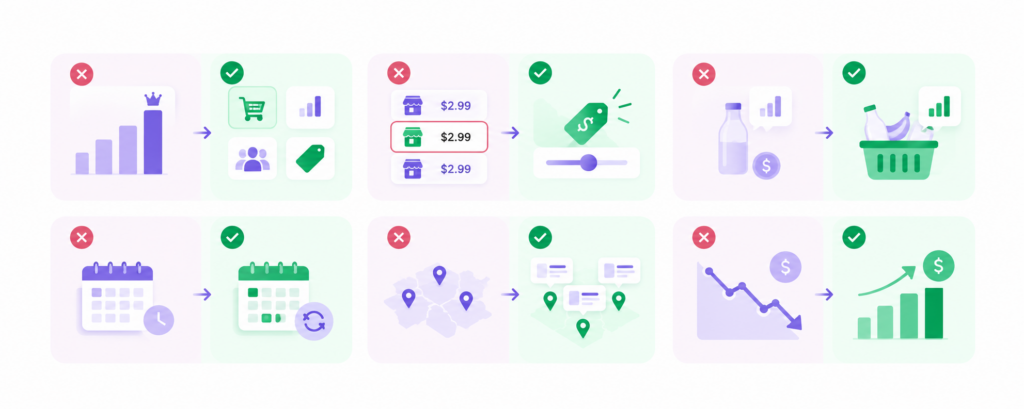
Even experienced pricing teams can undermine their strategies by selecting inappropriate products or focusing too narrowly on competitor prices. Successful KVI management requires accurate identification, clear commercial objectives, and consistent evaluation of profitability.
Many errors arise because retail merchants treat the determination of KVI (Key Value Item) pricing as an isolated process, focused solely on securing discounts, rather than as an integral component of broader category and assortment management. By avoiding this pitfall, you can protect your profit margins while continuing to offer competitive prices to your customers.
- Selecting KVIs based only on sales volume. High sales do not automatically indicate strong customer price awareness. Combine sales data with basket penetration, elasticity, competitive visibility, and customer research.
- Matching every competitor price. Automatic matching can trigger unnecessary price reductions and margin erosion. Establish differentiated competitive targets based on product importance and business objectives. When reviewing competitor monitoring workflows, retailers can explore Price2Spy alternatives to compare monitoring capabilities and determine which tools align with their pricing objectives.
- Ignoring basket-level profitability. Evaluating only individual product margins can overlook cross-product effects. Measure how KVI prices influence complementary purchases, substitution, and total basket contribution. Retailers should also distinguish strategic KVI discounts from inventory-driven price reductions, where markdown optimization helps determine appropriate discounts while considering demand and profitability.
- Using outdated KVI classifications. Customer preferences and competitive conditions change continuously. Review product rankings periodically and update them when transaction patterns or market signals shift.
- Applying identical strategies across locations. Regional competitors and customer expectations may differ significantly. Adapt KVI selection and pricing rules to local market conditions where reliable evidence supports differentiation.
- Failing to measure pricing outcomes. Price reductions do not necessarily improve overall performance. Track competitive position, sales, profitability, and customer behavior to identify whether adjustments create measurable value.
How to Measure and Optimize KVI Pricing Performance
Measuring KVI pricing performance requires evaluating competitive positioning, customer behavior, and profitability. Retailers should use performance indicators not only to track results but also to identify pricing opportunities, adjust competitive targets, and continuously optimize their KVI strategy.
- Monitor competitor price indices. Track KVI prices against relevant competitors to identify pricing gaps and optimization opportunities. A competitor price index helps retailers evaluate their market position and determine where price adjustments are necessary.
- Analyze sales performance and customer behavior. Monitor unit sales, basket value, and repeat purchasing to understand how customers respond to KVI price changes. These insights help retailers identify effective pricing adjustments while accounting for promotional activity and seasonal demand. Integrating promotion analytics into KVI performance reviews helps retailers distinguish promotional sales increases from sustained demand improvements and evaluate the profitability of temporary price reductions.
- Optimize margins and category profitability. It is important to evaluate the gross profit and margins of consumer baskets to ensure that competitive pricing on Key Value Items (KVIs) actually delivers the financial results you require. You should employ price elasticity analysis to identify opportunities for increasing sales profitability without negatively impacting consumer demand.
- Continuously test and refine pricing decisions. Combine competitor monitoring, KPI dashboards, and pricing simulations to evaluate different scenarios. Regularly update KVI classifications, pricing rules, and competitive targets based on measurable results and changing market conditions. Dedicated pricing analytics software can help retailers consolidate performance indicators, evaluate pricing scenarios, and identify opportunities for continuous KVI optimization.
KVI Price Index Formula
KVI Price Index = (Retailer’s KVI Price ÷ Competitor’s KVI Price) × 100
A price index of 100 indicates price parity with the competitor, while values below 100 indicate a lower price and values above 100 indicate a higher price. Retailers can use this metric alongside profitability and demand indicators to make more informed pricing decisions.
Conclusion
Key Value Item pricing plays an important strategic role in shaping customer price perception and competitive positioning. Retailers that identify genuinely influential products can prioritize pricing attention where it matters most, rather than relying exclusively on sales rankings or applying broad discounts across their assortments. Understanding customer purchasing behavior and price awareness is essential for building an effective KVI strategy.
A data-driven approach involves defining key performance indicators (KPIs), analyzing demand elasticity, monitoring major competitors, and continuously evaluating results. While it is important to consider competitiveness at the level of individual products, one must also account for their contribution to the overall profitability of the product mix; retailers must maintain prices that are attractive to shoppers while simultaneously ensuring sustainable margins. Regularly reviewing strategies enables pricing specialists to respond promptly to shifts in market conditions, changes in competitor sales dynamics, and evolving customer expectations.
AI-driven retail price optimization can make KVI pricing decisions more scalable and consistent, particularly for grocery retailers managing extensive assortments. Yieldigo helps businesses connect pricing analytics with broader commercial objectives while balancing competitiveness and profitability. Retailers looking to strengthen their KVI strategies can explore Yieldigo’s price optimization solutions to support more informed, data-driven decisions.
Frequently Asked Questions
How did KVI strategy change in the digital space?
Digital retail has increased price transparency, making it easier for customers to compare products across online and offline stores. Modern KVI strategies increasingly rely on automated competitor monitoring, AI-driven analytics, and dynamic pricing optimization to respond to changing market conditions.
How does KVI strategy work in Retail?
A KVI strategy identifies products that strongly influence customers’ perceptions of retail prices and manages them through targeted competitive pricing. Retailers monitor these products closely while optimizing margins across the broader assortment. This balances competitive positioning with sustainable profitability.
What is the full form of KVI in pricing?
KVI stands for Key Value Item. It refers to a product whose price has a disproportionately strong influence on customers’ perception of a retailer’s overall price competitiveness.
How to create a KVI pricing strategy?
Start by defining pricing objectives and identifying potential KVIs through transaction analysis, customer behavior, and competitive research. Establish competitive benchmarks, set margin constraints, and monitor performance through relevant KPIs. Regularly review product classifications and optimize prices based on measurable outcomes.
What does KVI stand for in pricing?
KVI stands for Key Value Item. In retail pricing, the term describes products that have a disproportionate influence on customer price perception. KVIs help retailers prioritize which products require closer competitive monitoring and strategic price management.
How do retailers identify Key Value Items?
Retailers identify KVIs by analyzing transaction data, purchase frequency, price elasticity, and competitor pricing. Customer surveys and basket analysis can provide additional insights into price awareness and shopping behavior. A reliable identification process combines multiple data sources rather than relying exclusively on sales volume.
What is the difference between KVI and KVC?
KVI refers to a Key Value Item, which is an individual product that influences price perception. KVC stands for Key Value Category, a broader product category that plays an important role in perceived value. For example, fresh produce may be a key value category, while bananas may be an individual KVI within that category.
What is the difference between KVI and non-KVI pricing?
KVI pricing prioritizes competitive positioning for products customers frequently compare. Non-KVI pricing provides more flexibility to optimize margins on products with lower price visibility. Both approaches should work together to maintain an attractive overall price image and sustainable retail profitability.
What is the difference between a KVI and a loss leader?
A KVI is identified by its influence on customer price perception, while a loss leader is a product deliberately priced at a very low or negative margin to attract customers. Some KVIs may be used as loss leaders, but the two concepts are not interchangeable. Many KVIs can be priced competitively while remaining profitable.
What role does price elasticity play in KVI pricing?
Price elasticity measures how customer demand responds to changes in price. Retailers use elasticity analysis to understand how pricing decisions may affect sales volume and profitability. Combining elasticity with competitive data and customer behavior helps businesses develop more precise KVI pricing strategies.
How can retailers improve KVI pricing without sacrificing profit margins?
Retailers can focus competitive pricing investments on products that genuinely influence customer price perception. They can then use elasticity analysis, assortment segmentation, and basket-level profitability measures to optimize prices elsewhere. Continuous monitoring and data-driven price optimization help maintain competitiveness while reducing unnecessary margin erosion.
What is a KVI in retail?
A Key Value Item (KVI) is a product that significantly influences customers’ perception of a retailer’s overall price competitiveness. Retailers prioritize these products to maintain attractive prices and strengthen their market positioning.
What is the difference between KPI and KVI?
A KPI (Key Performance Indicator) is a measurable metric used to evaluate business performance, such as revenue growth or profitability. A KVI (Key Value Item) is a product that strongly i
What does KVI stand for?
KVI stands for Key Value Item. In retail pricing, it refers to products that customers frequently recognize and compare when evaluating a retailer’s overall affordability.
How to Optimize Your KVI Pricing Strategy?
Retailers can optimize KVI pricing by analyzing price elasticity, competitor prices, customer behavior, and basket-level profitability. Continuous monitoring and data-driven price adjustments help maintain competitiveness while protecting profit margins.
What is a key value category?
A Key Value Category (KVC) is a product category that significantly influences customers’ perception of a retailer’s overall value. For example, fresh produce may be a KVC, while bananas may represent an individual KVI within that category.
How is a KVI different from a loss leader?
A KVI is identified by its influence on customer price perception, while a loss leader is deliberately priced at a very low or negative margin to attract shoppers. Unlike loss leaders, KVIs can remain profitable while maintaining competitive prices.
How does KVI strategy work in retail?
A KVI strategy focuses competitive pricing efforts on products that strongly influence customer price perception. Retailers identify these products through data analysis, monitor competitor prices, and optimize pricing decisions to balance competitiveness with profitability.
What is an example of a Key Value Item?
Milk is a common example of a potential Key Value Item in grocery retail because customers purchase it frequently and often remember its price. Other examples may include eggs, bread, and bananas, depending on customer behavior and market conditions.
What is the full form of KVI in pricing?
The full form of KVI in pricing is Key Value Item. It describes a strategically important product whose price disproportionately affects how customers evaluate a retailer’s competitiveness.
How to create a KVI pricing strategy?
Start by identifying KVIs using transaction data, customer price sensitivity, and competitor analysis. Establish competitive pricing targets, define margin constraints, and continuously monitor performance to optimize results.