
A pricing manager may be responsible for tens of thousands of SKUs across dozens or even hundreds of stores. Costs change, competitors move overnight, promotions start and end, inventory positions shift, and the spreadsheet used to coordinate it all can take days to rebuild. That manual reality is still widespread. According to the 2026 Retail Pricing Benchmark by 7Learnings and The Retail Hive, 64% of surveyed retail leaders said their pricing approach was still largely manual and experience-led, while only 4% described it as fully predictive and automated.
By the time each product row is checked, some of the assortment will be based on outdated information. Automated pricing optimization is a system that automatically calculates the correct price for each product in accordance with defined commercial goals and translates approved prices into fulfillment in accordance with the rules established by the retailer.
The point is not to hand pricing decisions over to a machine. It is to automate the repetitive work that consumes a pricing team’s time while keeping commercial strategy, guardrails, exceptions, and final accountability with the people who understand the business. A structured price management process makes that possible without giving up human control. This guide explains how that process works in practice, where different types of pricing automation fit, what to look for in software, and how retailers can move from spreadsheets to automation without putting the shelf at risk.
Table of Contents
- What is automated pricing optimization?
- Why is automated pricing important?
- Automated pricing vs. dynamic pricing vs. repricing
- Why retailers are moving away from manual price optimization
- What are the benefits of automated pricing optimization?
- How does automated pricing optimization work?
- What are the challenges and considerations of automated pricing optimization?
- How AI changes price optimization decisions and what it doesn’t
- Pricing automation maturity: where are you now?
- Which industries benefit most from automated pricing optimization?
- What automated pricing optimization looks like in practice
- Automated pricing optimization software: what to look for
- What are the common automated pricing optimization mistakes to avoid?
- How to start automatically optimizing your pricing
- FAQ
What is automated pricing optimization?
An automated pricing system can independently collect data that, in turn, influences the product price, calculates it based on established commercial goals, and translates the approved price into execution in accordance with the rules established through manual processing of each line item by the pricing manager. Instead of treating each SKU as a separate task, this system can apply the same decision-making process to thousands of products, stores, and sales channels.
There are two distinct jobs inside that process. Price optimization is the decision: it determines what a price should be based on objectives such as margin, volume, price position, or stock movement. Automation is the execution: it makes sure that decision can be reviewed, approved, and delivered to the systems where the price actually appears. Automation without optimization simply executes existing logic faster; if that logic is weak, it scales the weakness too. Optimization without automation has the opposite problem: even a strong recommendation has limited value if the team cannot operationalize it across a large assortment.
In retail, this can apply at different points in the pricing lifecycle: base price – competitor positioning – promotions – markdowns – clearance. A retailer does not need to automate the entire stack at once. Most teams can start with one clearly defined layer, establish the rules and workflow around it, and expand automation as the process becomes more mature.
What “automated” actually means day to day
In practice, automated pricing changes what the pricing manager spends time on. The system generates price proposals on an agreed cadence, while the manager reviews exceptions, unusual recommendations, and decisions that fall outside predefined guardrails instead of checking thousands of individual rows. Once approved, prices can flow into ERP and POS systems, ecommerce channels, and electronic shelf labels without being manually re-keyed at each step. The manager moves from maintaining the pricing process to supervising the decisions that actually need human judgement.
Automated pricing vs. price optimization
The simplest distinction is that price optimization answers “What should this price be?” while automated pricing answers “How does that price reach the shelf without someone typing it?” A complete retail pricing system connects both: it produces a commercially appropriate price and provides the workflow needed to put that decision into practice at scale.
Why is automated pricing important?
Pricing becomes an automation problem when the number and frequency of decisions exceed what a team can reasonably manage by hand. That pressure is already visible in how often prices need attention. A 2025 pricing strategy survey of 675 managers found that 77% of respondents update prices on a weekly, monthly, or quarterly basis, while 52% of retailers still rely on manual competitor tracking at least some of the time.
Retailers must simultaneously account for thousands of SKUs, multiple stores and distribution channels, fluctuating costs, competitors’ actions, promotions, inventory levels, and various commercial regulations. Manual processes force pricing teams to spend most of their resources on maintaining prices rather than identifying where interventions can yield the greatest benefit.
Pricing automation makes that complexity manageable without requiring every decision to be delegated to an algorithm. Retail pricing software can handle routine calculations and execution systematically, while pricing managers retain control over objectives, guardrails, approvals, and exceptions. The result is not simply faster price changes; it is a pricing process that can operate consistently across a large assortment while preserving human judgement where it matters.
Automated pricing vs. dynamic pricing vs. repricing
These terms clearly describe aspects of pricing and should not be used interchangeably. Price optimization determines the price that best meets a commercial goal. Price automation handles recurring pricing decisions and their execution at scale. Dynamic pricing itself is a strategy in which prices change in response to specific market or demand signals, while repricing typically refers to frequent price adjustments initiated by competitors, especially on online marketplaces.
These distinctions also show up in how retailers use automation in practice. A 2026 study published in the Swiss Journal of Economics and Statistics found that around 50% of retail firms automate price calculations and 49% automate competitor price comparisons, while only 31% automate price reviews.
That distinction matters because automated pricing does not automatically mean constantly changing prices. A grocery retailer, for example, can automate a weekly pricing cycle while deliberately keeping prices stable between reviews. Likewise, price intelligence is not a pricing system by itself; competitor price data is one of the inputs retailers can use when making pricing decisions. For a deeper look at how that input is collected and interpreted, see Yieldigo’s retail competitive pricing analysis guide.
| Term | What it actually is | What it decides | Typical retail example |
| Price optimization | A decision process that models demand response and commercial constraints to identify an appropriate price. | What a product should cost to support objectives such as margin, volume, price position, or stock movement. | A grocery retailer evaluates several possible prices for a category and selects the one expected to deliver the best outcome within its margin and price-position rules. |
| Pricing automation | The capability to execute pricing logic and workflows repeatedly across a large assortment without manually editing every SKU. | When defined rules or recommendations should be applied, reviewed, approved, and sent into execution. | A retailer runs its pricing cycle every week, flags exceptions for review, and sends approved prices to POS and ecommerce systems automatically. |
| Dynamic pricing | A pricing strategy in which prices can change as relevant conditions such as demand, competition, inventory, or timing change. | When and how a price should respond to changing market conditions according to the retailer’s strategy and guardrails. | An ecommerce retailer adjusts selected prices as competitor positions and demand conditions change while maintaining minimum-margin limits. |
| Repricing (marketplace) | Frequent price adjustment commonly used by marketplace sellers, often driven heavily by competing offers. | How a listing price should move relative to marketplace competition and seller-defined limits. | A marketplace seller changes an item’s price as competing offers move in order to maintain its desired competitive position. |
Why retailers are moving away from manual price optimization
Manual pricing starts to break when the number of decisions grows faster than the team responsible for making them. Large SKU counts are multiplied by stores, banners, ecommerce channels, cost updates, competitor moves, and frequent promotional cycles, while pressure on margin leaves less room for outdated or inconsistent decisions. The problem is therefore not simply that spreadsheets take time. It is that a manual process cannot reliably keep every part of a large retail assortment current, consistent, and explainable at the same time.
Prices drift out of date faster than anyone can update them
Costs, competitor prices, promotions, and inventory positions can change between one pricing review and the next. Reliable pricing intelligence software helps teams keep competitor data current, but when the broader pricing process remains manual, some products inevitably wait longer for attention than others. A price that was reasonable when the spreadsheet was prepared may therefore be based on stale information by the time it reaches the shelf, particularly across large assortments and multiple channels.
The pricing logic lives in someone’s head
Experienced pricing and category managers often develop rules that are understood by the people using them but never formally captured. That works until the rule needs to be applied across thousands of products, another banner, or a new team. Undocumented logic is difficult to audit, difficult to hand over, and easy for different people to interpret differently. When the person who understands it leaves, part of the pricing process can leave with them.
Manual errors reach the shelf
Every cell edited manually creates a good opportunity for error in transcription, wording, or copying and pasting. On the scale of retail pricing, a single incorrect value can become the price the customer actually pays. The problem isn’t just the error itself, but the fact that the team then has to determine where it originated, correct it in all affected channels, and determine whether similar errors exist elsewhere in production.
The risk is measurable. Research into operational spreadsheets found errors in roughly 0,9% to 1,8% of formula cells, depending on how errors were defined. In a follow-up analysis of 25 operational spreadsheets, researchers identified 117 confirmed errors, with the largest error carrying a 100 million quantitative impact.
Nobody can explain why a price is what it is
A price should have a traceable reason behind it: a cost movement, competitive position, margin rule, promotion, stock objective, or another defined commercial decision. In fragmented manual workflows, the final number can survive while the reasoning that produced it disappears across spreadsheet versions, emails, and individual judgement. That makes internal governance, supplier discussions, approvals, and price compliance harder because the team can see what changed without reliably reconstructing why.
The long tail never gets priced properly
Manual attention naturally goes to the products that appear most important: high-volume lines, key value items, promotional products, and categories already demanding intervention.
The economics of the long tail make this especially important. McKinsey reports that key-value categories can account for up to 80% of an average retailer’s revenue but only about half of its profit, leaving the rest of the assortment to play a disproportionate role in margin generation. At large SKU counts, optimizing that long tail manually becomes increasingly difficult.
Once routine pricing work is automated, the team’s role changes: instead of maintaining the spreadsheet, pricing managers can spend more of their time managing exceptions, refining rules, and running pricing strategy.
What are the benefits of automated pricing optimization?
The strongest benefits of pricing automation do not come from changing prices more often. They come from applying pricing logic consistently across an assortment that is too large for a team to manage SKU by SKU. The same principle applies to promotion management, where rules, timing, and execution need to remain coordinated across products and channels. By taking repetitive execution out of the workflow, an automated pricing system can extend the team’s strategy to more products while leaving people responsible for objectives, exceptions, and judgement.
- Margin recovery on the long tail. The long tail is where manual pricing leaves the most decisions untouched. High-volume and strategically important products naturally receive more attention, while thousands of lower-volume SKUs may remain on broad category rules for long periods. The financial impact can be meaningful even when individual price changes are small. In one retail implementation cited by Zebra Technologies, AI-powered pricing delivered a 5% margin lift within three months, with optimized recommendations integrated directly into the retailer’s existing planning workflow.
- Time back on the daily pricing routine. A large part of manual pricing is not strategic work at all. Teams rebuild files, reconcile inputs, check competitor feeds, transfer approved changes between systems, and repeat the same checks every pricing cycle. Automating those steps shifts the team’s attention from moving data and re-keying prices to reviewing exceptions, investigating unusual recommendations, refining rules, and making commercial decisions that actually require human judgement.
- Consistency across stores, banners and channels. Written pricing rules can be executed the same way across every product and location to which they apply. That matters when a retailer operates multiple stores, banners, or sales channels, because manual interpretation can gradually turn one pricing policy into several different versions. Automation does not remove local flexibility; it makes deviations explicit rather than allowing them to emerge accidentally.
- Faster reaction to cost and competitor moves. When an important input changes, the retailer no longer has to wait for someone to discover it during the next manual review. Competitor movements are especially important in retail. A 2026 study published in the Swiss Journal of Economics and Statistics found that 73% of retail firms with autonomous pricing authority use competitor prices as a benchmark when setting their own prices, highlighting how central competitive signals have become to day-to-day pricing decisions.
- A traceable reason behind every price. An automated workflow allows you to store information about the trigger, rule, recommendation, approval, and final action that underlies a price change. Instead of retrieving decisions from spreadsheets or emails, Comet Pricing can track how the price was set and whether any recommendations were ignored. This audit trail supports internal management. Supplier discussions, approvals, and situations where retailers cannot explain why a particular price was changed.
- Fewer manual errors. Removing repeated hand-editing also removes many opportunities for transcription mistakes. A rule is defined once and then executed systematically rather than being copied across thousands of cells or manually entered into multiple downstream systems. Exceptions can still be reviewed by people, but routine prices no longer depend on someone correctly transferring the same information at every stage.
How does automated pricing optimization work?
Retail pricing automation works as a connected chain: data in – modelling – business rules – activation – monitoring. Each stage depends on the one before it. Sophisticated modelling cannot rescue incorrect costs, strong recommendations create no value if they never reach the shelf, and automated execution becomes dangerous if commercial guardrails are missing. This is why implementation problems often begin as data and workflow problems rather than failures of the pricing model itself.
The five stages also explain why an automated pricing tool is more than an algorithm. It needs to connect information about what is happening in the business with a model of what could happen, constrain that model with the retailer’s commercial strategy, execute the approved decision, and then learn from the result.
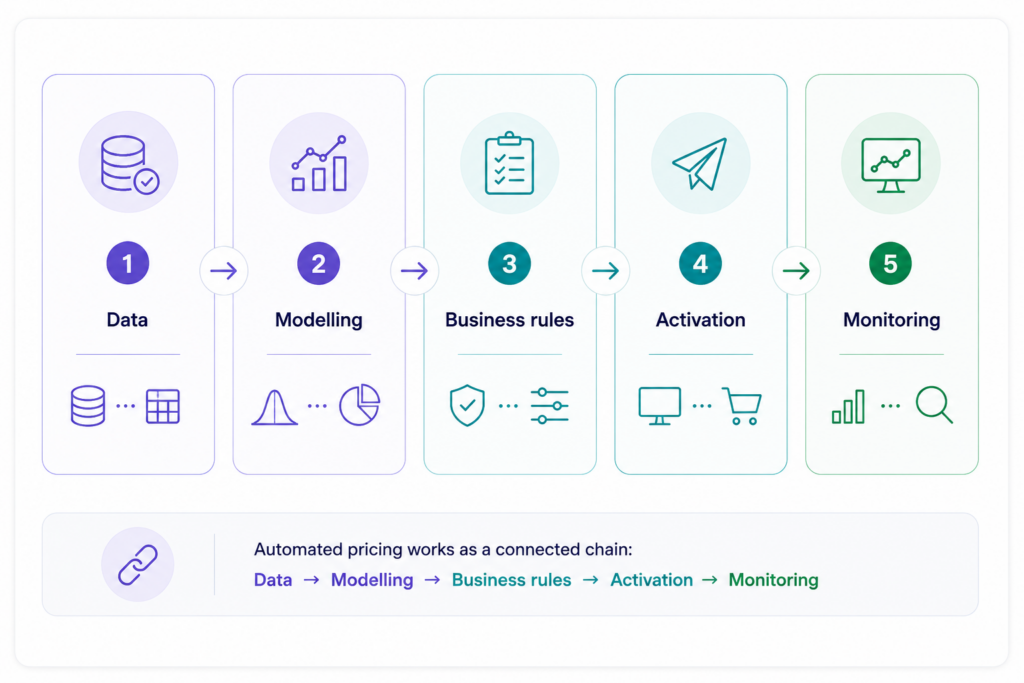
1. Pulling the data together
The first stage is assembling the inputs the pricing decision depends on. These typically include transaction history, current and historical costs, margins, stock levels, competitor prices, promotional calendars, and attributes describing products, stores, banners, or channels. Promotion analytics adds another important layer by helping teams understand how promotional activity affects demand and pricing outcomes. Together, they provide the context needed to distinguish a genuine pricing opportunity from a change caused by promotion, availability, seasonality, or differences between locations.
This is also where many implementations encounter their hardest practical problem. A model cannot make a commercially sound recommendation if its cost feed is incomplete, product mappings are inconsistent, or historical prices cannot be trusted. Cost data deserves particular attention because an apparently sensible selling price can become a margin problem immediately if the cost underneath it is wrong.
2. Modelling demand and elasticity
Price elasticity describes how much demand is expected to change when the price changes. Rather than applying one assumption to an entire category, price optimization can estimate that response at the level where the available data supports it, such as by product, store, cluster, or channel.
The commercial impact can be substantial. In a retail price optimization implementation documented by INFORMS, a machine-learning framework estimating location-specific and cross-channel price elasticities produced a projected 7% profit lift while preserving sales volume. The optimization achieved this by varying prices across online and individual store locations rather than applying the same pricing decision everywhere.
3. Applying your business rules
A price that appears mathematically attractive is not commercially acceptable in practice. Retailers operating under constraints and constraints must consider the pricing model, including departmental groups and package size hierarchies, psychological price breaks, private-label price gaps, competitor positioning indices, minimum margin levels, and legal or regulatory requirements. This may ultimately limit the set of acceptable recommendations.
For example, a model may determine a price with a higher margin for one package size, but this recommendation may create an illogical dependence of the unit price on package size. A recommendation based on competitive considerations must also be rejected if it reduces the product’s margin below the minimum level. The algorithm makes suggestions, but it limits the rules. These constraints, in turn, are not an obstacle to optimization, but this is where the retailer’s commercial strategy becomes part of the decision.
4. Pushing prices live
Once a recommendation satisfies the relevant rules, it moves through the retailer’s approval and activation workflow. Depending on the organization, some prices may require a pricing manager’s approval while routine changes within predefined limits can proceed automatically. Approved prices can then be exported or integrated into ERP and POS systems, ecommerce platforms, and electronic shelf-label infrastructure rather than being re-entered manually.
This kind of digital price execution is already operating at significant retail scale. A recent U.S. study examined the rollout of electronic shelf labels across more than 100 stores of a grocery retailer generating about 3$ billion in annual revenue, using more than 180 million product-level observations to evaluate pricing before and after implementation.
5. Measuring and correcting
Going live completes one pricing cycle and creates the input for the next. The system needs to compare what actually happened with what the model expected: margin against plan, volume response, price index against relevant competitors, and the rate at which recommendations hit rule exceptions are all useful signals.
Measurement against a credible baseline matters because relatively small pricing improvements can create meaningful financial value at scale. Controlled retail field experiments reviewed in the Journal of Retailing found that price and promotion optimization increased profit by approximately 1-2% of sales while maintaining or increasing sales, depending on the retailer’s commercial objective.
Why pricing, forecasting and stock can’t be planned separately
Price is a demand lever. Change the price and expected demand changes; change expected demand and the amount of stock required on the shelf changes with it. Treating pricing, forecasting, and inventory as independent processes therefore creates decisions that can be individually logical but operationally impossible. This connection is also central to predictive pricing analytics, where forecasts are used to evaluate the likely impact of a price before it is implemented.
The failure cases are straightforward. If the pricing system cannot see constrained stock, it can lower a price and stimulate demand for units the retailer cannot replenish. If it cannot see excess or ageing stock, it can protect today’s unit margin while leaving inventory that later requires a much deeper markdown. A useful pricing decision therefore needs to consider not only what shoppers are likely to buy at a given price, but whether the resulting demand supports the retailer’s inventory position.
What are the types of pricing automation
Pricing automation is not a single method, and most retailers do not choose one type and use it across every product. In practice, different parts of the assortment need different levels of sophistication. A retailer might use simple rules for stable products, competitor-driven logic for highly visible items, elasticity models for categories with enough transaction history, and separate markdown logic for ageing inventory.
Rule-based pricing remains a major step in the transition from manual to fully optimized pricing. According to the 2026 Retail Pricing Benchmark, 20% of surveyed retail organizations use rules-based pricing with limited automation, while only 4% report having fully predictive and automated pricing. Another 64% still rely primarily on manual, experience-led pricing.
Rule-based automation
Based on defined rules, automation takes fixed pricing logic, such as cost price and target margin, a specified markup, or a competitor’s price index, and automatically applies it to the relevant products. It’s predictable, relatively easy to test, and gives teams precise control over how prices are calculated, but it doesn’t communicate to the retailer how customers are likely to react to the final price.
Competitor-driven (dynamic) pricing
Competitor-driven pricing adjusts selected prices as the market moves, using competitor observations as a major decision input. This can be particularly useful for key value items and other products shoppers frequently compare, but applying it indiscriminately across an assortment can trigger unnecessary price matching and margin erosion unless minimum-margin floors and positioning rules are in place.
Elasticity-based optimization
Elasticity-based optimization starts with predicted customer response rather than a fixed pricing rule. It evaluates how expected volume changes at different price points and uses that relationship to find a price that best supports the retailer’s objective, making it especially useful for finding margin opportunities that broad rules cannot see. The trade-off is a heavier requirement for clean historical data and sufficiently reliable demand signals.
Prescriptive pricing
Prescriptive pricing recommends what price to take and why, while leaving the final approval with a pricing or category manager. A recommendation might show the proposed price alongside its expected demand or margin effect, the factors behind the change, and any relevant constraints.
The potential value of prescriptive pricing can be significant. Research testing prescriptive price optimization on real retail datasets found that the approach could potentially improve gross profit by 8,2% for the products being optimized, using demand predictions and mathematical optimization to determine prices across multiple products simultaneously.
Markdown and clearance automation
Markdown optimization automates time-phased price reductions based on sell-through, remaining stock, and the product lifecycle rather than relying only on fixed calendar dates. Instead of applying a fixed discount simply because a calendar date has arrived, the decision can respond to actual sell-through, remaining stock, expected demand, and time left in the product lifecycle. Yieldigo’s markdown optimization provides a dedicated example of this approach.
Machine learning and self-learning systems
Machine-learning systems use the results of previous pricing decisions as new information for future modelling. As actual demand responses accumulate, models can be retrained to improve their estimates and adapt to patterns that fixed rules would struggle to capture. That creates greater analytical potential, but it also makes transparency more important: pricing teams still need to understand what drives recommendations and when the model should not be trusted.
| Type | How it decides | Best for | Watch out for |
| Rule-based automation | Executes predefined logic such as cost-plus, margin targets, price ladders, or competitor indexes. | Stable pricing processes, clear commercial policies, and retailers beginning to automate. | Rules can consistently execute a poor decision because they do not model demand response. |
| Competitor-driven (dynamic) pricing | Adjusts prices according to competitor movements within predefined boundaries. | Key value items, highly comparable products, and competition-sensitive online categories. | Following competitors too closely can create price wars or unnecessary margin loss. |
| Elasticity-based optimization | Predicts demand at alternative price points and selects a price against a commercial objective. | Large assortments where transaction history supports product-level optimization. | Requires reliable data and enough demand history to produce useful estimates. |
| Prescriptive pricing | Produces a recommended price and supporting rationale for human review before activation. | Retail teams that want scalable analytics while retaining approval control. | Too many approval requirements can recreate the manual bottleneck automation was meant to remove. |
| Markdown and clearance automation | Uses stock, sell-through, demand, and remaining lifecycle to determine the timing and depth of reductions. | Seasonal, ageing, perishable, or end-of-life inventory. | Starting too late can leave too little time for gradual reductions to work. |
| Machine learning and self-learning systems | Learns from historical and newly observed outcomes and retrains models as new evidence becomes available. | Mature pricing operations with strong data foundations and large decision volumes. | Model complexity can make recommendations harder to explain and govern. |
What are the challenges and considerations of automated pricing optimization?
Pricing automation can remove a great deal of repetitive work, but it also exposes weaknesses that were easier to overlook when decisions were handled manually. Before expanding automation across an assortment, retailers need to address five practical challenges:
- Data quality sets the ceiling. Missing costs, inconsistent product hierarchies, unreliable competitor matching, and incomplete transaction histories can all produce recommendations that look precise but are based on weak inputs. The data problem is widespread across retail. In a Riverbed survey of retail leaders, 87% said high-quality data is critical to successful AI, yet 72% were concerned about how effective their organization’s data was for AI use, and 42% identified data quality as a barrier to further AI investment.
- Commercial rules need to be explicit. Automation cannot reliably apply a pricing strategy that exists only in the experience of individual category managers. Price ladders, margin floors, competitor relationships, pack hierarchies, approval thresholds, and exceptions need to be defined clearly enough for the system to enforce them consistently.
- Integration determines whether recommendations become real prices. A useful recommendation still has to move through approval workflows and into ERP, POS, ecommerce, and potentially electronic shelf-label systems. If those connections remain manual, the retailer creates a sophisticated decision engine with the same execution bottleneck it had before.
- Teams need a clear way to handle exceptions. It’s important to understand that not all product lines should be treated equally, and that unusual recommendations shouldn’t be lost in a large-scale automated process. Retailers need thresholds that define which decisions can be made automatically, which require verification, and how pricing managers will be informed when exceptions occur.
- More sophisticated models create a transparency challenge. As pricing moves from fixed rules toward machine-learning recommendations, it can become harder to understand why a particular price was proposed. Explainability is already a practical adoption issue for retailers. NVIDIA’s 2025 State of AI in Retail and CPG survey found that the lack of easy-to-understand and explainable AI tools was the most commonly reported AI challenge, reinforcing the need for systems that show users how recommendations are produced rather than simply presenting an output.
How AI changes price optimization decisions and what it doesn’t
AI changes pricing by expanding the number of decisions that can be informed by predicted demand rather than by a fixed rule. A rule-based system executes a policy the retailer has already defined, for example, maintain a certain competitor index or apply a specific markup. A machine-learning model can instead evaluate the available evidence and recommend which price is most likely to support the commercial objective within the boundaries the retailer has set.
These differences don’t necessarily mean that artificial intelligence determines pricing strategy independently. Rules implement management-defined policies, while models help determine revenue within the constraints set by managers. Neither determines the ultimate goal of your business. The balance between modeling and commercial control is also a significant factor when evaluating software for retail pricing. Margin targets, product positioning, customer perceptions, the role of categories, and supplier considerations, risk tolerance remain commercial decisions.
This remains a practical limitation across retail. Salesforce research found that 54% of retailers are not fully able to use their data to effectively deploy generative AI, while 60% are not fully able to use their data for decision-making. The figures reinforce a fundamental limitation of AI-driven pricing: model sophistication cannot compensate for incomplete, fragmented, or unreliable business data.
| What the model is good at | What stays with your pricing team |
| Estimating how demand is likely to respond at different price points | Setting the commercial objective: margin, volume, price position, or another priority |
| Processing product-store combinations at a scale no analyst can review individually | Defining the retailer’s desired price image and how it should differ by category |
| Detecting patterns across sales, prices, promotions, stores, and time | Deciding which products are key value items and deserve special treatment |
| Comparing the predicted volume, revenue, and margin outcomes of candidate prices | Managing supplier relationships and commercial commitments that are not fully represented in transaction data |
| Re-estimating demand relationships as new observations become available | Defining guardrails, approval thresholds, and circumstances where a recommendation should not be followed |
| Surfacing unusual recommendations and exceptions for review | Making the final judgement when commercial context conflicts with the model’s recommendation |
What machine learning genuinely does better than a rule
A fixed rule can tell every product in a category to maintain the same margin or competitor relationship. Machine learning can estimate that the products do not all behave the same way. It can identify different demand responses across products, stores, clusters, channels, and periods, using patterns in historical data that would be impractical for an analyst to calculate and maintain manually across a large assortment.
Just as importantly, those estimates do not have to remain static. As prices change and actual sales outcomes become available, the model can re-estimate demand relationships and incorporate newer evidence. That makes it better suited to environments where customer response changes over time than a rule that continues to execute until someone notices that its assumptions are no longer valid.
What stays with the pricing team
Commercial strategy does not emerge automatically from transaction history. The model may estimate how shoppers respond to a price, but it cannot independently decide what kind of retailer the business wants to be, how aggressively a category should compete, which products shape customer price perception, or when a supplier relationship changes the commercial context of a decision.
The potential shift in workload is substantial. McKinsey estimates that retail merchants could reclaim up to 40% of their time by moving manual and repetitive tasks to agentic AI, allowing more of that capacity to be redirected toward strategic activities. This illustrates the intended division of labor: automation handles scalable analytical and operational work, while people retain responsibility for commercial judgment and strategy.
Explainability: seeing why a price moved
A recommendation is only operationally useful if the pricing team can understand what produced it. For any significant price movement, the user should be able to trace the recommendation back to relevant drivers, such as a cost change, estimated elasticity, competitor position, inventory situation, or commercial constraint, and see which rules affected the final result.
Explainability is already a major adoption issue beyond pricing. IBM reports that 80% of business leaders see AI explainability, ethics, bias, or trust as major roadblocks to adoption. In pricing, where recommendations can directly affect margins, customer perception, and thousands of shelf prices, the ability to understand and challenge a model’s output becomes especially important.
Pricing automation maturity: where are you now?
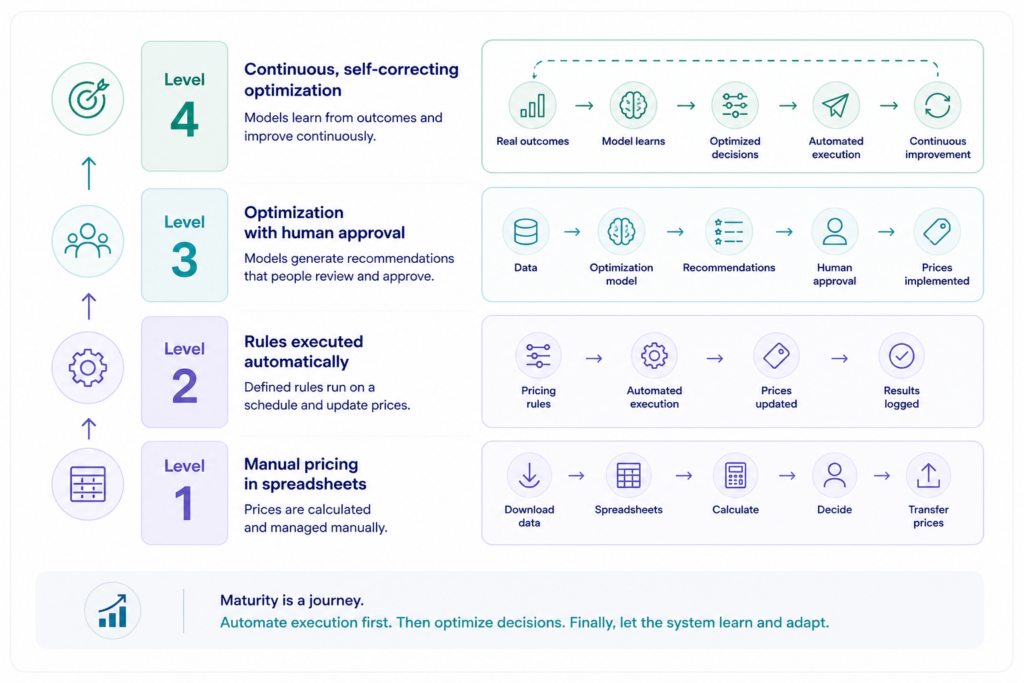
In practice, many retailers operate somewhere between the first two levels: spreadsheets still play a central role, but selected rules, feeds, calculations, or execution steps have already been automated. The important question is therefore not whether the organization is “automated,” but which parts of the pricing decision are automated today and what the next useful step should be. Understanding how dynamic pricing software works can also help retailers assess which capabilities they actually need as they move beyond rule-based automation.
Level 1. Manual pricing in spreadsheets
On Monday morning, the pricing team downloads data, opens or rebuilds spreadsheets, checks costs and competitors, runs formulas, and works through the products it has time to review. Decisions depend heavily on individual knowledge, and parts of the pricing logic may exist only in formulas, old files, or people’s heads.
The ceiling is coverage. As the assortment and number of channels grow, the team cannot increase the depth of analysis for every SKU at the same rate. Lower-priority products receive less attention, and execution remains vulnerable to delays and manual errors.
Level 2. Rules executed automatically
At level two, Monday morning starts with a system that has already applied defined pricing rules and identified the products affected. Cost-plus logic, competitor indexes, margin floors, price endings, or other policies can run on a schedule rather than requiring someone to recreate the calculations each cycle.
Level 3. Optimization with human approval
At level three, the team opens a set of model-generated recommendations rather than a file that needs to be calculated from scratch. The system estimates demand response, evaluates candidate prices against the commercial objective and constraints, and presents recommendations for approval.
The productivity potential of this human-in-the-loop model is significant. McKinsey estimates that retail merchants could reclaim up to 40% of their time by offloading manual, repetitive work to agentic AI, redirecting that capacity toward strategic activities. In pricing, the same principle means spending less time calculating and checking routine decisions and more time reviewing exceptions, setting guardrails, and managing commercial strategy.
Level 4. Continuous, self-correcting optimization
At the most mature level, actual outcomes continuously feed the next pricing cycle. Models are retrained as new sales and pricing evidence becomes available, routine recommendations within established boundaries require little manual intervention, and exceptions are routed to the relevant people for review.
At this level of maturity, the scope for automation becomes considerably larger. McKinsey estimates that up to 60% of a retail merchant’s previously manual decision-making tasks could be automated or standardized in an agentic-AI operating model. The objective is not to remove human oversight, but to reserve it for exceptions, strategic choices, and decisions where commercial context matters most.
| Level | What it looks like day to day | What it can’t do | Typical next step |
| Manual pricing in spreadsheets | Teams collect inputs, calculate prices, review rows, and transfer changes manually. | Cover the full assortment deeply or maintain consistent logic efficiently at scale. | Document existing pricing rules and automate repeatable calculations and execution. |
| Rules executed automatically | Defined rules run on schedule and routine changes require less manual handling. | Adapt individual prices to predicted demand response beyond the rules provided. | Introduce demand and elasticity modelling in a controlled category. |
| Optimization with human approval | Models recommend prices; managers review exceptions and approve or override changes. | Operate with minimal intervention or continuously improve every model from new outcomes. | Build stronger feedback loops and gradually automate low-risk recommendations. |
| Continuous, self-correcting optimization | Models learn from outcomes while the team manages strategy, guardrails, and exceptions. | Replace commercial judgement or compensate for weak underlying data. | Continuously monitor model performance, rules, data quality, and changing business objectives. |
The practical conclusion is simple: it’s impossible to simply jump from the first to the fourth level of damage, because each level depends on the capabilities built on it, including reliable data. Clear rules, working integrations, and trust management for recommendations. Trying to implement continuous AI-based decision making before these foundations are in place isn’t the fastest way to transform a pricing initiative into a data integration and cleansing project.
Which industries benefit most from automated pricing optimization?
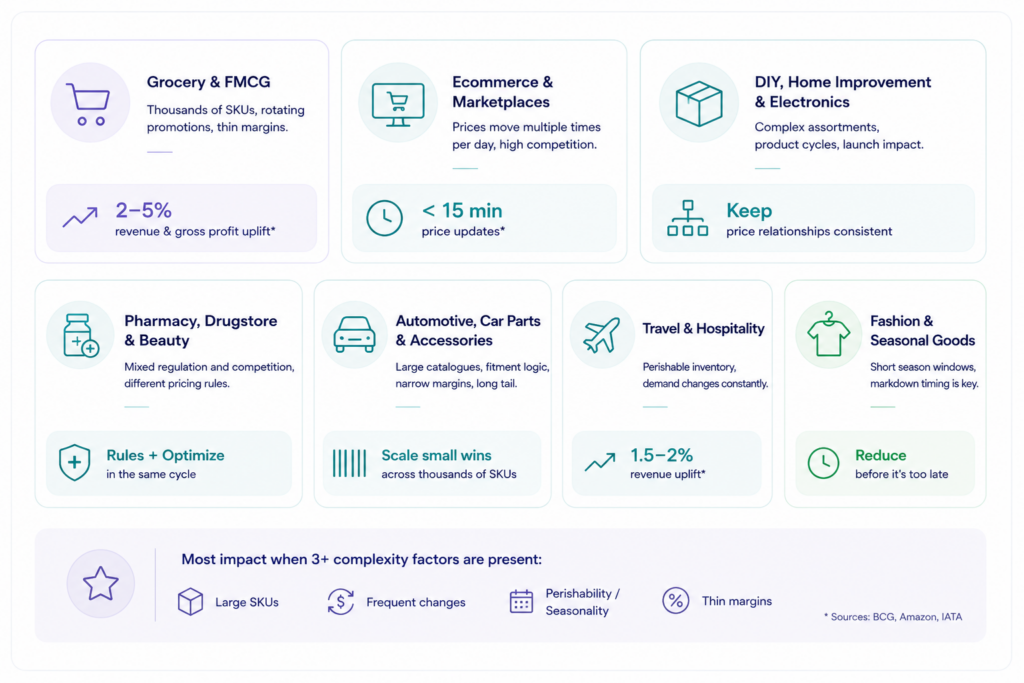
Pricing automation pays back fastest where the pricing problem has several sources of complexity at once: large SKU counts, frequent cost or competitor movements, perishability or seasonality, and thin margins. When three or more of those conditions are present, the number of pricing decisions quickly becomes too large for a team to manage consistently by hand.
Pricing is already one of the more established applications of AI in retail. According to Deloitte’s 2026 Global Retail Industry Outlook, 48% of retail leaders currently use AI for pricing optimization, making it one of the leading areas of AI adoption across retail operations.
- Grocery and FMCG. In grocery and FMCG, the clock is the weekly commercial cycle: supplier costs change, promotions rotate, competitors move key value items, and thousands of products need to remain coherent at the same time. The financial impact can be meaningful even when individual price changes are small. BCG reports that retailers using AI-powered pricing solutions have achieved consistent revenue and gross profit growth of 2-5%, while also improving customers’ perceived value. In high-volume, low-margin environments such as grocery, gains at this scale can make pricing precision commercially significant.
- Ecommerce and marketplaces. In ecommerce, the clock is the competitive market, which can move several times in a single day while shoppers compare alternatives in seconds. Automation allows retailers to respond selectively without forcing teams to monitor every competing offer manually; on marketplaces such as Amazon, this same pressure has produced specialized repricing tools that frequently adjust seller listings against competing offers.
The speed of marketplace pricing illustrates why automation matters in this environment. Amazon states that its Automate Pricing tool operates 24/7, while price updates for established pricing rules are typically processed in less than 15 minutes. At that cadence, manually monitoring and responding to competing offers across a large catalogue quickly becomes impractical.
- DIY, home improvement and consumer electronics. Here, the clock is often the product and range lifecycle. Deep technical assortments contain product families, pack hierarchies, substitutes, accessories, and generations of products that need logical price relationships, while electronics add launch cycles that can quickly change the value of an older model. Automation helps preserve those relationships across an assortment that is difficult to keep internally consistent by hand.
- Pharmacy, drugstore and beauty. In the pharmaceutical retail sector, there’s a so-called gap between regulation and competition. Some products may be subject to strict price caps, while related categories such as cosmetics, personal care products, or over-the-counter drugs enjoy much more open competition. Therefore, the pricing system must distinguish between what can be optimized and what must comply with specific regulations, and, of course, ensure compliance with my regulations within a single production cycle.
- Automotive, car parts and accessories. For automotive parts, the clock is the catalogue and competitive cycle. Fitment-based assortments can contain enormous numbers of parts and alternatives, while high-turnover products may operate on narrow margins and face direct online comparison. The long tail is particularly important because individually small pricing opportunities become meaningful when repeated across thousands of products that no team could review one by one.
- Travel and hospitality. Travel and hospitality operate against an inventory-expiry clock: an unsold hotel room tonight or an empty airline seat after departure can never be sold tomorrow. Airlines and hotels were therefore applying automated, demand-responsive pricing decades before the approach became common in retail.
The impact of more continuous pricing is already measurable in aviation. IATA reports that leading airlines have achieved a 1,5-2% revenue increase from continuous pricing. In a business built around fixed, perishable capacity, even relatively small improvements in the price achieved for each seat can translate into substantial value at scale.
- Fashion and seasonal goods. In fashion and seasonal retail, the clock is the remaining selling season. The primary automation opportunity is often not constant day-to-day repricing but markdown optimization: deciding when to begin reducing a price and how deeply to discount as sell-through, remaining inventory, and time left in the lifecycle change. The commercial risk is terminal stock, waiting too long can leave the retailer with inventory that requires a much deeper final reduction.
What automated pricing optimization looks like in practice
The difference between pricing automation in theory and in production is easiest to see in the workflows retailers have actually changed. The following examples use published Yieldigo customer cases and stick to the operational outcomes those customers have made public.
METRO Slovakia: moving complex wholesale pricing beyond spreadsheets
METRO was managing 28000 active SKUs while serving different regions, channels, and three customer segments, with spreadsheet workflows making a scalable bulk-pricing strategy impractical. The retailer introduced one pricing environment for regular prices, simulations, product families, and bulk pricing. The new workflow streamlined and automated pricing while allowing METRO to model financial impacts before execution; its multibuy management approach made buy-more-pay-less pricing scalable and was reported as margin accretive.
Lékárna.cz: automating pharmacy repricing across two markets
Lékárna.cz had been manually managing prices across the Czech and Slovak markets, a process the company described as time-consuming, inaccurate, and unable to respond effectively to changing market conditions. With 33000 active SKUs, it introduced separate pricing models for the two markets and automated the repricing workflow. The published case reports 100% automated repricing and more than 1.8 million calculated prices per month, while reducing manual pricing work and the risk of human error.
Bonami: one pricing operation across nine countries
Bonami’s expansion presented another scaling challenge. With approximately 60,000 active SKUs, multiple markets, and inconsistent pricing as the business grew across countries and regions, the retailer centralized pricing with Yieldigo rather than expand its manual workload for each market separately. Published reports for each market separately. Published datasets show that Olin’s pricing manager can set prices in nine countries and seven production areas, while the team manages 7,600 product groups in a single model.
Automated pricing optimization software: what to look for
The first test of automated pricing software is not how sophisticated its model sounds in a demo. The tool has to fit the way your pricing team actually works. If category managers cannot understand the recommendations, existing commercial rules cannot be reproduced, or moving an approved price into your systems creates extra work, even a technically strong model is unlikely to be adopted.
Model accuracy is table stakes; workflow is the differentiator. When evaluating the best dynamic pricing software, look beyond the algorithm and test how the platform handles the complete pricing cycle, from data and rules through simulation, approval, execution, and exceptions. The following criteria can be taken directly into a vendor demo.
Integration with your existing systems
Ask how the platform connects to your ERP, POS, ecommerce systems, and electronic shelf labels, including what data has to move in each direction. More importantly, ask how long those integrations took for comparable customers in production, not how quickly a prepared integration works during the demo.
Integration is often what separates a successful pilot from a system that can operate at scale. IBM’s 2025 CEO Study found that 68% of surveyed CEOs consider an integrated enterprise-wide data architecture critical, while only 16% reported that their AI initiatives had scaled across the enterprise. For pricing teams, this makes integration capability a practical selection criterion rather than a secondary technical detail.
Transparency of recommendations
A category or pricing manager should be able to see why a price was proposed without asking a data scientist to interpret the model. Look for clear drivers, constraints, expected effects, and an explanation of why the recommendation differs from the current price.
Retail executives are already treating explainability and transparency as material AI concerns. IBM reports that 76% of retail and consumer products executives identify explainability as an AI-related concern, while 73% cite transparency. Pricing software therefore needs to show more than the recommended number: users should be able to understand the inputs, constraints, and reasoning that produced it.
Rule flexibility
Test the platform using your real commercial rules: price families, pack hierarchies, competitor indexes, minimum margins, price endings, private-label gaps, and local exceptions. If the retailer has to simplify a sound pricing strategy simply because the software cannot represent it, the technology is dictating the strategy rather than supporting it.
Simulation and what-if capability
A strong system should let the team test a pricing strategy before customers see it. What-if simulations in retail allow pricing managers to compare scenarios and understand the expected effect on demand, revenue, and margin before deciding whether a change is worth taking live.
The value of scenario modelling can be measurable. PwC reports that scenario planning in pricing has delivered profit lifts of 2-3%, as companies use simulations to anticipate market conditions, forecast consumer behaviour, and account for potential competitor reactions before making pricing decisions.
Exception handling
Ask what happens when the model does not have enough information to produce a reliable recommendation. New products, sparse sales histories, one-off ranges, unusual demand events, and questionable competitor matches all create exceptions, and the system should surface them clearly rather than hide uncertainty behind a precise-looking price.
Approval workflow and permissions
The platform should define who can propose, approve, override, and activate changes at each level of the organization. Those actions should also be logged so that the retailer can reconstruct who changed a price, why it changed, and what happened to the original recommendation even after responsibilities move to another person.
Usability for non-technical users
Pricing software ultimately has to be operated by the existing commercial team. During a demo, ask a category manager to create a realistic rule, investigate an exception, and approve a price rather than watching the vendor perform a prepared workflow. The number of steps and the clarity of the interface tell you more about likely adoption than a polished dashboard does.
Time to value and implementation timeline
Ask when the first production prices can realistically go live and what needs to happen before that point: data preparation, integration, rule configuration, model training, testing, and user onboarding. Instead of asking for the vendor’s fastest deployment, ask how long implementation took for its last three comparable customers and what delayed each one.
| Ask the vendor | What a good answer sounds like |
| How will you integrate with our ERP, POS, ecommerce and shelf systems? | “Here is the data that moves in and out, the integration method for each system, who owns each step, and the timeline from comparable deployments.” |
| Can a category manager explain why this price was recommended? | “Yes. They can see the main drivers, applicable constraints, expected effect and any override without needing a data scientist.” |
| Can the platform reproduce our actual pricing rules? | “Show us your rules and hierarchies. We can configure them and demonstrate how they interact with recommendations and exceptions.” |
| Can we simulate a pricing change before activation? | “Yes. You can compare scenarios and their predicted demand, revenue and margin effects before approving one.” |
| What happens when the model is not confident? | “The recommendation is flagged or routed for review, with the reason for uncertainty visible to the user.” |
| Who can approve or override a recommendation? | “Permissions are configurable by role, and proposals, approvals, overrides and activations remain in the audit trail.” |
| Can our existing pricing team operate the system themselves? | “Yes. Let one of your users complete a real workflow during the evaluation rather than taking our word for it.” |
| How long until our first prices go live? | “Here are the timelines from our latest comparable implementations, including what caused delays and what we need from your team.” |
Is there a “best” automated pricing optimization software?
There is no single best pricing platform for every retailer. The right fit depends on assortment size and complexity, data maturity, existing systems, commercial rules, required level of automation, and how the pricing team works day to day. The criteria above are more useful than a generic vendor ranking because they reveal whether a platform can actually support your pricing operation after the demo ends.
What are the common automated pricing optimization mistakes to avoid?
Automation amplifies the pricing strategy already underneath it, good or bad. A strong process becomes more consistent and scalable; unclear objectives, weak rules, and poor inputs can become mistakes that reach thousands of products faster. Avoiding the following problems is therefore as important as choosing the pricing model itself.
Automating before the strategy is clear
The system can only optimize itself based on set goals and constraints. If a company hasn’t defined its priorities for margins, sales volume, price perception, inventory flow, or other metrics in a given product category, the model may generate technically sound recommendations that prove commercially unsound.
The foundations behind automation matter as much as the model itself. KPMG found that 85% of business leaders identified the quality of organizational data as the biggest anticipated challenge to their AI strategies. For pricing, a clearly defined commercial objective therefore needs to be paired with reliable inputs before automated recommendations can be expected to produce useful decisions.
Trusting a black box
This concern is particularly visible in retail. IBM reports that 76% of retail and consumer products executives identify explainability as an AI-related concern, while 73% cite transparency. For automated pricing, that makes the ability to understand the drivers and constraints behind a recommendation an important part of evaluating the system, not an optional feature.
Running without guardrails
Automation without minimum margins, maximum price-change limits, price relationships, approval thresholds, and exception rules leaves too much riding on every input being correct. One bad cost, competitor match, or product mapping can then propagate through a large number of decisions. Guardrails limit the blast radius: unusual recommendations stop for review instead of automatically becoming shelf prices.
Ignoring price image on key value items
Not every SKU plays the same role in how customers perceive a retailer’s prices. A model may identify an opportunity to increase margin on a highly visible staple, but taking that recommendation without considering its key-value-item role can damage price perception beyond the economics of that single product. Optimize the long tail aggressively where the evidence supports it, while treating price-image products according to their strategic role.
Pricing in isolation from stock and forecasting
A price recommendation is incomplete if it ignores whether the retailer can supply the demand it creates. Lowering the price of a constrained product can accelerate an avoidable stockout, while protecting margin on excess stock for too long can force a deeper markdown later. This is why a well-planned markdown pricing strategy needs to account for inventory position and expected demand, rather than treating markdowns as a separate end-of-season decision.
Rolling out across the whole assortment at once
A big-bang launch turns a category-level problem into a company-wide problem before the team has had a chance to learn from it. Start with a controlled category or product group, compare expected and actual outcomes, inspect overrides and exceptions, and fix weaknesses in data or rules before increasing coverage. Scaling a proven workflow is safer than testing the workflow at full scale.
Treating go-live as the end of the project
Pricing automation needs maintenance because the environment it models keeps changing. Assortments evolve, costs move, competitors change behaviour, new products arrive, and commercial strategy shifts. After launch, teams need to monitor model performance, exception rates, overrides, data quality, and the relevance of existing rules so that the system continues to reflect the business it is supposed to support.
How to start automatically optimizing your pricing
Pricing automation works best as a controlled operational change, not as a technology switch. Before selecting models or deciding how many prices should run automatically, retailers need to establish what the system is supposed to achieve, whether the underlying data can support it, and who remains accountable for the decisions.
The safest route is incremental: define the objective, prepare the foundations, prove the approach on a measurable pilot, and widen coverage only when the evidence supports it.
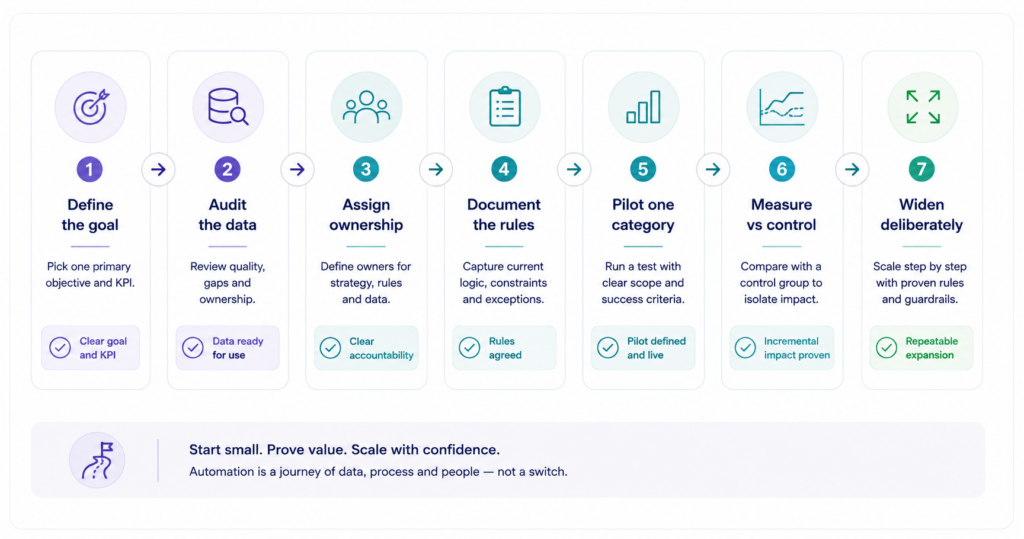
1. Define the commercial goal first
- What to do: Choose one primary objective for each product group you plan to automate: margin, volume, competitive price position, or stock clearance. Secondary constraints can still apply, but the system needs a clear definition of what it is trying to improve.
- How to know it is done: The pricing team can state the primary objective for the pilot category in one sentence and translate it into a measurable KPI.
- Failure mode: Asking the system to maximize margin, protect volume, remain cheaper than every competitor, and clear inventory simultaneously without defining priorities. A system optimizing for everything effectively optimizes for nothing.
2. Audit the data you already have
In one retail pricing project documented by The Parker Avery Group, optimized pricing was first piloted across 11 key items and generated 172000$ in financial benefit over 11 weeks, representing a 21,3% improvement. The result illustrates why testing a defined use case before expanding coverage can make the business case for wider rollout much clearer.
- What to do: Review transaction history, historical and current prices, cost accuracy, stock feeds, promotion records, product hierarchies, and competitor coverage before evaluating what a pricing model can deliver. Identify missing fields, inconsistent definitions, unusual gaps, and feeds that cannot be refreshed reliably.
- How to know it is done: The team knows which data is production-ready, which needs cleaning, who owns each source, and which gaps will limit the first use case.
- Failure mode: Selecting a tool around the assumption that the required data exists and discovering during implementation that costs are unreliable or historical prices cannot be reconstructed. Data readiness often determines the real project timeline.
3. Decide who owns pricing
Clear ownership is also associated with stronger pricing effectiveness. Research published by the Professional Pricing Society found that companies with effective pricing practices are 30% more likely to have clearly defined ownership and accountability within the pricing process. This reinforces the need to establish who owns pricing strategy, rules, data, and final decisions before automation begins.
- What to do: Assign explicit accountability for three areas: commercial pricing strategy, the pricing rules and guardrails, and the data feeding the process. These responsibilities may sit with different people, but ownership should be clear before automated recommendations begin.
- How to know it is done: When a recommendation looks wrong, everyone knows who decides whether the commercial logic, the rule set, or the underlying data needs investigation.
- Failure mode: Treating pricing automation as an IT project with no single commercial owner. The technology can execute decisions, but it cannot resolve disagreements about what the retailer’s pricing strategy is supposed to achieve.
4. Write down the rules you already follow
- What to do: Document the logic pricing managers currently apply from experience: margin floors, competitor relationships, price families, pack-size ladders, price endings, key value items, private-label gaps, approval thresholds, and known exceptions.
- How to know it is done: Another pricing manager can apply the documented rules to the same product and reach the same acceptable decision without relying on unwritten context.
- Failure mode: Automating rules before discovering that different teams interpret them differently. Codifying existing logic often surfaces contradictions that spreadsheets and individual judgement have hidden for years.
5. Pilot on one category
- What to do: Select a category with sufficiently clean data, meaningful transaction volume, and enough pricing opportunities to produce a readable result. Define the success criteria before the first optimized prices go live, including the commercial KPI, operational metrics, and conditions that would stop or modify the pilot.
- How to know it is done: The pilot has a defined assortment, start and end period, baseline, success metric, guardrails, owners, and review process before results begin arriving.\
- Failure mode: Choosing success measures after seeing the outcome. If the team changes the question once the numbers are available, almost any pilot can be made to look successful.
In a consumer-appliance retail case documented by Netscribes, the retailer initially piloted price optimization in one country and one product category, reporting an average 12% increase in revenue and 15% increase in profit. The company subsequently expanded the approach to additional countries and categories.
6. Measure against a control group
- What to do: Compare the pilot with stores, products, or categories that are as similar as practical but continue using the existing pricing process. Track the same KPIs in both groups over the same period so that external movements affect the comparison rather than being mistaken for the effect of automation.
- How to know it is done: The team can distinguish the incremental change associated with the new pricing approach from changes that also occurred in the control group.
- Failure mode: Comparing pilot performance only with the previous month or year. Demand may have changed because of seasonality, weather, promotions, competitor activity, or broader market conditions. Without a credible control, you may be measuring the season rather than the system.
In a field experiment conducted across Zara stores in Belgium and Ireland, researchers found that a new forecasting and price-optimization process increased clearance revenue by approximately 6%. The study used a controlled experimental design, illustrating why pricing pilots should be evaluated against a credible comparison rather than historical performance alone.
7. Widen deliberately
- What to do: Expand category by category once the pilot has demonstrated both commercial value and operational reliability. Carry proven rules, permissions, integrations, and guardrails forward, while adapting them where a new category has different economics or customer expectations.
- How to know it is done: Each expansion follows a repeatable process, and the team can explain why the next category is ready rather than simply increasing coverage because the technology allows it.
- Failure mode: Treating a successful pilot as permission to switch the entire assortment at once. Rules should also be revisited whenever the assortment, competitive environment, or cost base changes materially rather than being assumed to remain valid indefinitely.
The timeline depends less on how quickly an algorithm can be deployed than on the condition of the retailer’s data, integrations, and existing pricing processes. The right automation approach also depends on the pricing strategy itself: yield management pricing, for example, requires reliable demand and availability signals to support price decisions over time. A focused pilot can move faster than an enterprise-wide transformation, but retailers should expect implementation to include data preparation, rule definition, integration, testing, user training, and a meaningful measurement period.
A targeted pilot project can move significantly faster than an enterprise-wide transformation, but retailers should expect implementation to include data preparation, rule definition, integration, testing, user training, and a meaningful measurement period. The goal isn’t to automate as quickly as possible, but to reach a point where the team has enough evidence to safely automate the next solution.
Conclusion
The purpose of pricing automation is not to hand pricing over to a machine. It is to stop spending experienced pricing managers’ judgement on work that does not require judgement: rebuilding files, transferring prices between systems, applying the same rules repeatedly, and manually reviewing products that could be handled safely within established boundaries.
The financial case can become substantial when pricing technology is combined with the right processes and organizational changes. In one retail price optimization project documented by The Parker Avery Group, the retailer expects the completed implementation to deliver 22 million in annual margin improvement and a project ROI of more than 600%. The project combined the new pricing solution with redesigned processes, clearly defined roles, system integration, testing, and user training.
Frequently Asked Questions
What is automated pricing optimization?
Automated pricing optimization is a system that collects pricing data, calculates the best price for each product against defined commercial goals, and applies approved prices automatically within rules the retailer sets. It combines the pricing decision with its execution, allowing large assortments to be managed without someone manually updating every SKU.
What is the difference between automated pricing and dynamic pricing?
Dynamic pricing is a strategy in which prices change in response to factors such as demand, competition, inventory, or timing. Pricing automation is the capability that executes pricing decisions without manual work. A retailer can therefore automate a stable weekly pricing strategy without using highly dynamic, continuously changing prices.
Does automating prices mean losing control of them?
No. A well-designed system operates inside boundaries set by the pricing team, including margin floors, price ladders, competitor limits, maximum price changes, and approval requirements. Pricing managers can review exceptions, understand why a recommendation was made, and override it before activation. Automation changes the workload; it does not remove commercial accountability.
How does an automated pricing system work?
An automated pricing system collects sales, cost, stock, promotion, and competitor data, then models how demand may respond to different prices. It applies the retailer’s business rules and guardrails, routes recommendations through approval, sends approved prices to systems such as POS and ecommerce, and measures actual results to inform future pricing cycles.
Is pricing automation only worth it for large retailers?
No. The stronger indicator is pricing complexity rather than company size. A mid-sized retailer with thousands of SKUs, frequent cost changes, competitor movements, promotions, or seasonal inventory may have a stronger automation case than a much larger business with a small, stable assortment and relatively infrequent pricing decisions.
Will automated pricing push my prices to the bottom?
Only if the system is configured to follow competitors without appropriate guardrails. Margin floors, competitor limits, price-image rules, and other constraints prevent indiscriminate price cutting. Elasticity-based optimization can also recommend increasing a price when predicted demand indicates that the product can support a higher price without unacceptable volume loss.
What is pricing automation software?
Pricing automation software applies pricing rules and optimization models across an assortment and manages the workflow needed to turn recommendations into live prices. It can connect with ERP, POS, ecommerce, and other retail systems so approved changes reach relevant channels without repeated manual entry. See Yieldigo’s pricing optimization software for an example.
What are the types of pricing automation?
The main types are rule-based automation, competitor-driven pricing, elasticity-based optimization, prescriptive pricing, markdown automation, and machine-learning systems. They differ primarily in what determines the recommended price, how strongly demand modelling influences the decision, and how much human approval remains between the recommendation and its activation.
Can pricing automation handle markdowns?
Yes. Markdown automation can use sell-through, remaining inventory, predicted demand, and time left in the product lifecycle to determine when and how deeply prices should be reduced. This allows retailers to use staged reductions rather than relying only on fixed calendar dates or one large end-of-season cut. See markdown optimization for more.
What are the 5 C’s of pricing?
The 5 C’s are commonly framed as Company objectives, Customers, Costs, Competition, and Channel members. Together, they provide a framework for evaluating a pricing decision beyond the product’s cost alone. Retailers can use them to consider internal objectives, customer willingness to pay, competitive positioning, economics, and channel requirements before selecting a pricing strategy.
Is dynamic pricing illegal in the US?
No. Dynamic pricing is not inherently illegal in the United States. Businesses can adjust prices based on factors such as demand or inventory, but they still need to comply with applicable consumer-protection, antitrust, pricing-discrimination, and state or local laws. The legality therefore depends on how the pricing strategy is implemented, not simply on prices changing over time.
What are the 7 pricing strategies?
Seven common pricing strategies are cost-plus pricing, competitive pricing, value-based pricing, penetration pricing, price skimming, dynamic pricing, and promotional pricing. They differ in what primarily drives the price, from product cost and competitor positioning to perceived customer value or changing demand. Retailers often combine several strategies across different categories and lifecycle stages.