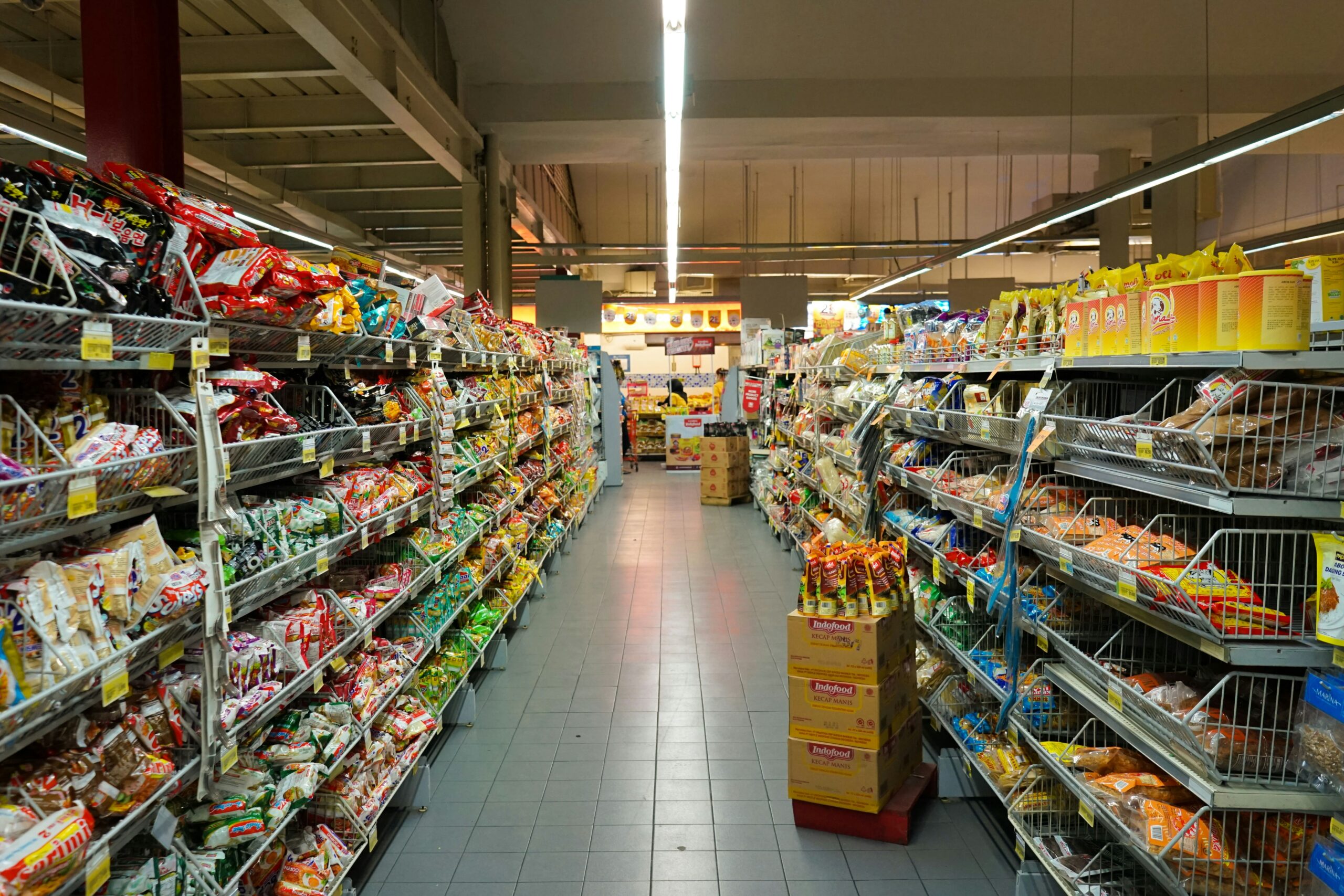
Every order placed by a retailer is essentially a bet on the future. If volumes are estimated accurately, shelves remain stocked, revenue stays stable, and customers are satisfied. However, a miscalculation risks either having unsold inventory gather dust in the warehouse or driving customers away, sending them empty-handed to a competitor who offers exactly what they want to buy. This process, predicting what, where, and when customers actually buy, enables retailers to align inventory, pricing, and planning with real demand rather than relying solely on supply-side assumptions.
The stakes have only gone up. Assortments are bigger, shoppers move between store and screen mid-purchase, and preferences change faster than any quarterly plan can keep up with. That’s why the shift to smarter forecasting is happening quickly: Gartner predicts that by 2030, 70 percent of large organizations will have adopted AI-based supply chain forecasting to predict future demand. This guide covers what retail demand forecasting is, why it matters, the methods behind it, the pitfalls to watch for, and how AI is reshaping the whole discipline.
What Is Retail Demand Forecasting?
Demand forecasting in retail is the process of determining the quantity of each product that customers will want to purchase at a specific price, in a specific location, and over a specific period. To accurately forecast future demand, this process integrates historical sales data, market trends, seasonality, pricing and promotional information, and external factors.
The key word is demand, not sales. Sales only tell you what left the shelf, which is capped by whatever you had in stock to begin with. Demand tells you what people genuinely wanted, including the customers who showed up, found nothing, and walked out. That gap is where most of the money hides. A retailer who forecasts true demand (rather than just replaying last year’s sales) can set sharper financial targets, price each SKU with more confidence, and hold just enough stock to capture the sale without drowning in surplus.
The framing matters here. Plenty of teams open the planning cycle by asking “how much do we need to sell?” and back into their orders from a target. That mindset tends to produce stock that has to be discounted into oblivion, or shortages that quietly cost you your best customers. The stronger starting point is “what will our customers actually want?” Answer that honestly, and the right quantities, prices, and store allocations follow naturally. Before going further, two pairs of terms trip people up constantly, and mixing them up quietly skews decisions across the business.
Demand Forecasting vs. Sales Forecasting vs. Demand Planning
These three get used interchangeably, but they describe different things, and the distinction changes how you plan, order, and price.
| Concept | What it means | Why it matters |
| Sales forecasting | Projects future sales by extending past sales trends. It only knows what you actually sold, which your stock levels capped. | It’s blind to lost sales. Stock 100, sell 100, and it logs 100 even if 300 people wanted the item. Reorder off that number and you keep starving your bestsellers, season after season. |
| Demand forecasting | Estimates the real appetite for a product, missed sales included, weighing price, promotions, related products, cannibalization, and assortment. | It escapes the understocking trap by predicting what customers truly want, not just echoing yesterday’s receipts. This is the base layer for smart ordering, allocation, and pricing. |
| Demand planning | Translates the forecast into decisions: budgets, category targets, assortment calls, and replenishment orders across the estate. | The forecast is the raw input; the plan is what you do with it. Even a brilliant plan collapses on a shaky forecast, which is why the engine underneath deserves the attention first. |
What Are the Benefits of Accurate Demand Forecasting?
For most retailers, inventory is the single largest place capital gets tied up, and the commitment usually happens months before anything sells. That timing is exactly what makes forecasting so consequential. Nail it and the whole operation runs cleaner. Miss it and the bill arrives from both directions at once. Accurate demand insights also support a smarter markdown strategy, helping retailers clear excess inventory without sacrificing more margin than necessary.
If supply volumes are insufficient to meet actual demand, retailers will face empty shelves and a pressing need to process backorders, leading to customer dissatisfaction and lost revenue. Conversely, if retailers purchase excessive stock, that inventory will take up warehouse space, displacing more popular items, and ultimately be sold at discounts that wipe out profit margins. However, this can be avoided through a smart approach to the calculation process, offering your business numerous advantages:
- Leaner, smarter inventory. Forecasting the right quantities keeps you clear of both extremes. Cash isn’t frozen in dead stock, and you’re not losing sales to an empty shelf. For a lot of retailers, this single outcome pays for the entire effort.
- Customers who keep coming back. When the products people expect are reliably in stock, they learn to trust you with their time. That trust compounds into repeat visits and loyalty, which costs far less to keep than to rebuild.
- Lower running costs. Sharper forecasts trim overproduction, rush reorders, surplus storage, and waste. McKinsey’s research points to AI-based forecasting cutting supply chain costs by roughly 10 to 15 percent. The scale of investment tracks that payoff, with AI-in-retail market, a compound annual growth rate near 46.5 percent, and demand forecasting sitting among the biggest use cases behind that spend.
- A tighter supply chain. When suppliers, distribution centers, and carriers all work from one credible forecast, lead times compress, bottlenecks ease, and goods flow more predictably from source to shelf.
- Cleaner financial planning. In this situation, forecasts serve as the basis for estimating future revenue, preparing budgets, and setting goals. When you have a reliable picture of future demand, the finance department can allocate resources without wasting time dealing with uncertainty or re-verifying data.
- Room to outmaneuver rivals. Anticipating demand rather than reacting to it lets you combine smarter pricing with promotion analytics and assortment decisions while competitors are still reconciling last year’s spreadsheet.
There’s a sustainability dimension surfacing too, and it’s increasingly a board-level topic. McKinsey estimates that food loss and waste account for 8 to 10 percent of global greenhouse gas emissions, which quietly makes forecast accuracy one of the strongest ESG levers a retailer holds. Ordering closer to true demand means less spoilage, fewer emergency shipments, and a smaller footprint, so the investment that defends margin increasingly supports climate targets at the same time.
And there’s a margin angle that often gets overlooked. An accurate forecast doesn’t just size your orders, it sets up smarter pricing. Once you understand true demand for a product, you can combine yield management with smarter pricing decisions to protect margin rather than reaching for a blanket discount. That connection between forecasting and profitability is why demand forecasting and automated pricing optimization work best when they draw on the same underlying demand signal.
How Do Retailers Forecast Demand?
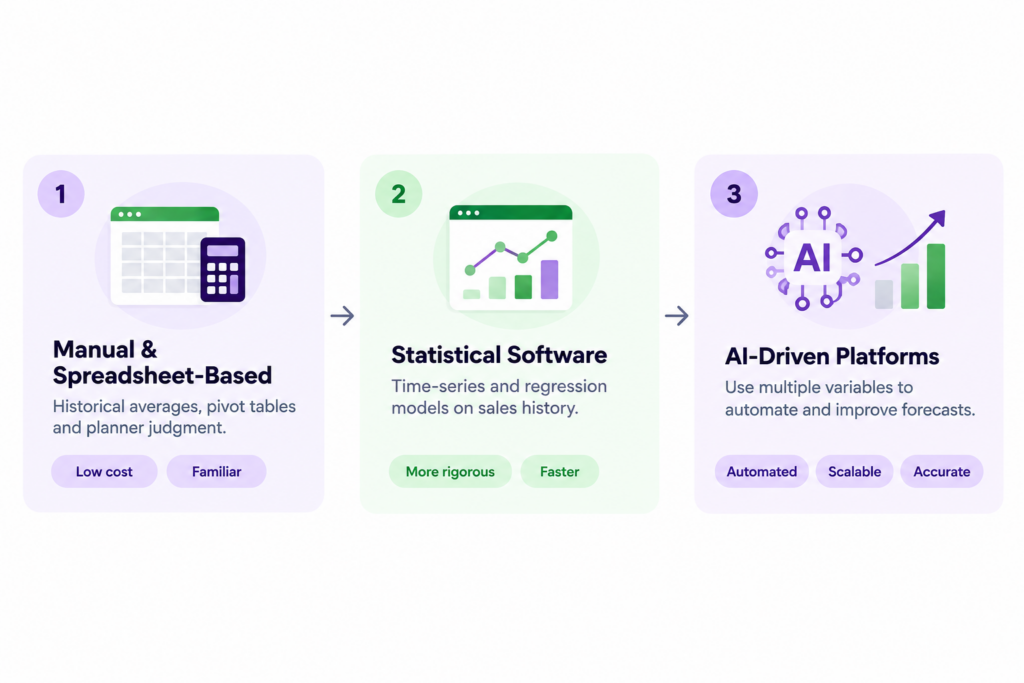
Every retailer runs on some form of demand forecast, from the largest chains to the single-location independent. What sets them apart is the approach they use and how much accuracy it buys them. In practice, retailers tend to sit somewhere on this spectrum:
- Manual and spreadsheet-based. Historical averages, a few pivot tables, and the instincts of experienced planners. It’s cheap and familiar, and it holds up for a small assortment in a single channel. But it can’t scale, it breaks when the person who built it leaves, and it never learns from its own mistakes.
- Statistical software. Dedicated tools that apply time-series and regression models to your sales history. A step up in rigor and speed, though still leaning heavily on the assumption that the past predicts the future.
- AI-driven platforms. Systems that weigh many variables at once (demand patterns, seasonality, price, promotions, and outside factors), process the flood of data retail generates daily, and use machine learning to automate the slow judgment calls that used to swallow a planner’s week. The best of them are transparent about which data they use and how the number was reached.
A sensible approach is to start with a solution that suits your current product range and switch to an AI-powered platform only when the number of SKUs, stores, and sales channels exceeds the capabilities of spreadsheets. We will explain exactly what to look for when choosing such a platform in the following sections.
Demand Forecasting Techniques and Methods
Three forecasting approaches have anchored the field for decades. They still form the foundation, so it’s worth knowing how each behaves and where each runs out of road before layering modern methods on top.
Qualitative Forecasting
This approach is built from human input: market research, customer surveys, expert opinion, and the read of experienced leaders. Surveys hint at consumer confidence and purchase intent; analysts and consultants supply industry context. It’s genuinely useful when hard data is thin, like a first-of-its-kind product or a market you’ve never sold into. The catch is that it’s slow, since surveys take weeks to run, and it inherits every bias of the people supplying the input.
Time-Series Forecasting
In this instance, you are analyzing the sales history of a specific SKU, identifying trends, cyclical patterns, seasonality, and growth rates, and extrapolating these patterns to forecast future sales. This method is fast and reliable for short-term forecasting (the next few weeks). However, it has a fundamental drawback: it assumes the future will be a mirror image of the past. This assumption becomes less valid as the forecast horizon extends and loses all meaning when something truly new emerges.
Causal Forecasting
This method uses regression and simulation to tie inputs (competitor proximity, ad spend, housing starts, and the like) to sales outcomes. It’s the most sophisticated of the three and also the most demanding. Causal models react sharply to their starting assumptions, so analysts run them repeatedly to settle on a consensus, much as forecasters run a storm model many times before committing to a track. A serious causal model can take close to a year to stand up.
The shared problem is that all three were designed for a slower, smaller retail world. A basic time-series forecast might take hours and a full causal model a year, and none of that matters if the output isn’t accurate. Spread thousands of SKUs across hundreds of stores, each with its own demand rhythm, and no analyst team can hand-tune every combination no matter how sharp their spreadsheet skills. Closing that gap is exactly what modern, AI-driven methods were built for.
The Practical Types of Forecasting Retailers Run
Underneath those three methods, it helps to recognize the working types of forecasting and where each fits. Strong teams rarely rely on just one:
- Quantitative forecasting leans on statistical models and sales history, and shines wherever the data is rich and consistent, such as grocery or electronics. It struggles with brand-new products and sudden shifts.
- Qualitative forecasting draws on judgment and research, and earns its place for launches and new markets where no history exists.
- Short-term forecasting covers days to a few months and drives replenishment and seasonal peaks like back-to-school runs.
- Long-term forecasting looks a year or more out to guide expansion, new formats, and major investment, and needs regular refreshing.
- Causal forecasting models outside forces like weather and campaigns, and suits categories swayed by them, like fashion or outdoor gear.
- Machine learning forecasting blends all of the above, learns across thousands of SKUs and stores at once, and adjusts continuously as fresh data lands.
Unfortunately, there is no universal solution that is optimal for every scenario. A grocery store, a fashion brand, and an electronics retail chain naturally have vastly different priorities; however, combining these approaches through a system that enables their automatic integration almost always yields better results than relying on any single approach alone.
How to Build a Retail Demand Forecast Step by Step
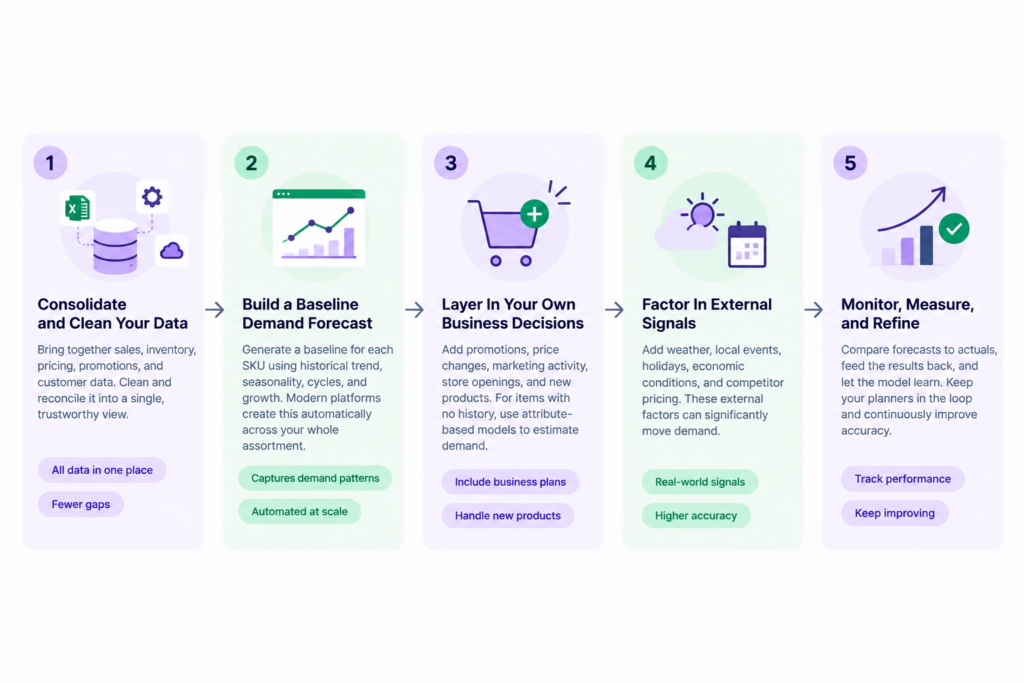
Knowing the methods is one thing; assembling them into a working forecast is another. Here’s the sequence the most accurate forecasters follow, in five steps.
Step 1. Consolidate and Clean Your Data
Everything starts here, because a forecast can only be as good as what feeds it. Bring together sales history, live inventory, pricing and promotion records, and customer data from every channel, then reconcile it into one trustworthy view. Data scattered across disconnected systems (sales here, stock there) breeds gaps that quietly poison the output later. It’s the least glamorous step and the one that most determines the result.
Step 2. Build a Baseline Demand Forecast
With clean data at hand, it is easy to generate a baseline forecast that reflects the development patterns of each product segment (SKU), specifically, the underlying trend and seasonal growth factors. Previously, time-series analysis was performed manually. Modern platforms automatically generate specific forecasts for the entire product range while identifying the relationship between a product and a specific retail outlet, a task that cannot be accomplished through manual modeling methods.
Step 3. Layer In Your Own Business Decisions
Your commercial moves swing demand hard, so they belong inside the forecast rather than bolted on afterward. Fold in promotion management, including multiple unit pricing, price changes and elasticity, marketing activity, in-store placement, and new product launches. Price changes count twice, since dropping one product’s price often pulls demand off its neighbors (cannibalization), so their forecasts need to come down too. For new items with no history, attribute-based models estimate demand by matching the newcomer to comparable existing SKUs.
Step 4. Factor In External Signals
Now add the forces outside your control: weather and forecasts, local events, holidays, economic conditions, and competitive pricing. These move demand sharply and defy manual tracking at scale. To picture the scale, a retailer with 100 stores and 5,000 products faces hundreds of millions of weather-related variable combinations on its own. Machine learning absorbs these automatically, and folding in weather alone can cut forecast error by 5 to 15 percent at the product level and up to 40 percent at the product-group and location level.
Step 5. Monitor, Measure, and Refine
A forecast is a loop, not a finished output. Compare predictions against actuals, feed the results back, and let the model recalibrate as conditions move. Keep your planners in the loop to catch shifts the data hasn’t seen yet and to override the model when their judgment demands it. That continuous tightening is what keeps accuracy climbing instead of quietly going stale.
The Modern Demand Forecasting Methodology
These five stages are the same for everyone; however, the difference between traditional and modern approaches lies in how they are implemented. Tools from previous generations were created in an era of data scarcity, when forecasts at the product category level sufficed for most goods. Such a model does not align with modern realities, where demand for each stock-keeping unit (SKU), across every store and sales channel, is influenced by hundreds of simultaneously changing factors. Using outdated methods, analysts would have to define hundreds of planning constraints and adjust them for every SKU in every store, a task no team could realistically handle. The modern approach shifts this complex workload to an advanced analytics system.
Machine learning accounts for the full web of demand drivers at the product-and-store level, then blends multiple methods and algorithms to land on the best forecast for any product, location, and moment. It reads your history to reveal true demand, exposing where understocks cost you sales and what forced markdowns on overstocks, and it keeps adapting as conditions change. It’s also built for how people actually shop now. Purchases happen in-store, on your site, in your app, or through marketplaces, and fulfillment splits across just as many paths. A modern system pulls signals from each channel-and-fulfillment combination to produce forecasts that reflect real behavior. This is also where predictive pricing analytics and dynamic pricing connect back in: once a model grasps true demand and price sensitivity, it can drive far sharper pricing and promotion calls.
Forecasting Demand Across Every Channel
Omnichannel is one of the biggest shifts retail has absorbed, and it changes demand forecasting in particular. If you sell in-store, online, and through hybrids like click-and-collect, you have to serve every channel well, and that rests on forecasting each one correctly. The first hurdle is connecting online demand to the right fulfillment path. If online orders get picked from local stores, that online demand has to sit inside the store-level forecast, or replenishment will fall short of true combined demand. And online orders rarely mirror in-store behavior. Price comparison is faster and easier online, so buying patterns diverge.
This contrast is particularly evident during the holiday season: online orders often arrive well in advance of the holidays, whereas peak activity in brick-and-mortar stores occurs only in the days immediately preceding them. This behavioral pattern is constantly evolving as shoppers come to expect increasingly rapid order processing and delivery from online retailers. Given that demand patterns differ significantly across sales channels, systems must generate separate forecasts for the online segment and physical stores to ensure greater accuracy and granularity. Separate forecasts enable more efficient inventory allocation across warehouses and distribution centers, guaranteeing product availability at every retail location. In other words, omnichannel retailers need to generate forecasts that account for the specific characteristics of individual stores, sales channels, and order fulfillment models; this ensures the right products are available in the right places, thereby maintaining high levels of customer satisfaction throughout every stage of the brand interaction.
How Accurate Does Your Forecast Really Need to Be?
No technology will ever predict demand with perfect accuracy, so your planning has to leave room for uncertainty. The more useful question is how accurate your forecasts genuinely need to be. It depends on the use case, and accuracy is best judged at different periods and levels of aggregation. For fast-selling, short-shelf-life perishables, precise day-product-location forecasts are essential, because a miss turns into spoilage or an empty shelf within hours. For slow movers, what matters is getting total volume right at the distribution-center level and avoiding systematic bias, not agonizing over daily precision.
There’s also a point of diminishing returns. Every retailer eventually reaches a plateau where accepting a bit of inaccuracy costs less than chasing marginal gains. If a product has a long shelf life, a small bump in safety stock is often cheaper than asking planners to squeeze out another point of accuracy. And remember that forecasting is only one link in the planning chain. Even a near-flawless forecast disappoints if the rest of the process falls short, leaving you with oversized batches or too much presentation stock. So the honest answer to “when is my forecast accurate enough?” is: when another point of accuracy would barely move your actual business results.
How Does AI Improve Demand Forecasting in Retail?
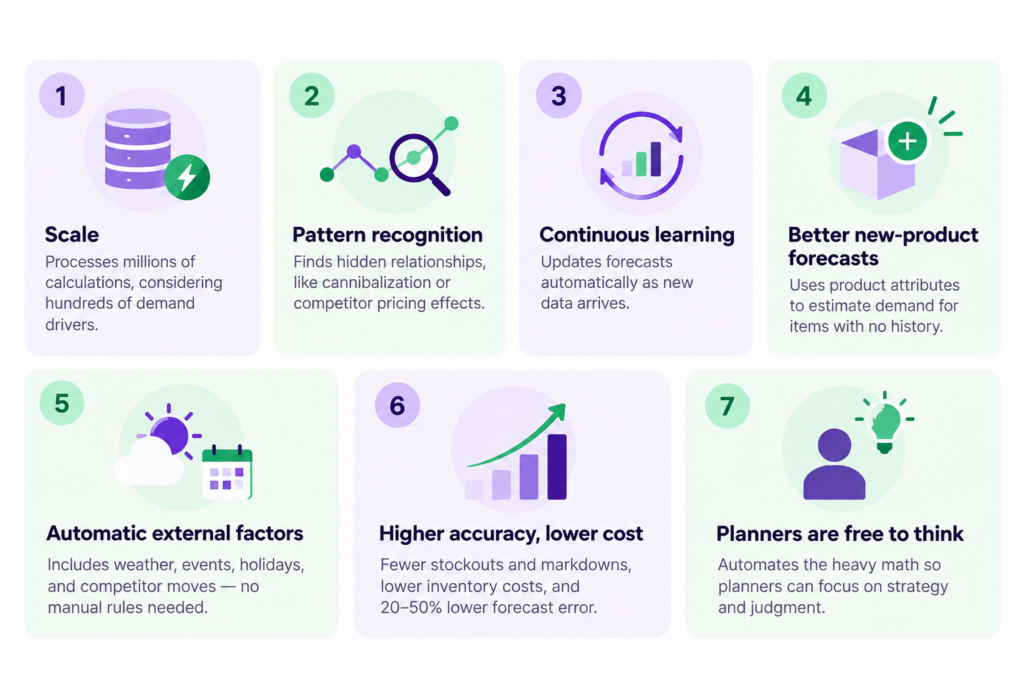
This is the question we field most from retail managers, so let’s take it head-on. AI improves demand forecasting in retail by chewing through far more data, catching patterns no human could, and refreshing forecasts continuously as conditions change, all automatically and at a scale traditional methods can’t touch. Here’s what AI and machine learning specifically bring to the table:
- Scale. Modern systems run millions of forecast calculations a minute, weighing hundreds of demand drivers at once, well past what any planning team could manage by hand.
- Pattern recognition. ML uncovers the subtle relationships rule-based models miss, like how multibuy promotions influence demand across related products, or how a nearby competitor’s pricing shifts your sales.
- Continuous learning. Instead of a static forecast that ages on contact, ML models update as new sales data arrives and correct themselves in near real time.
- Better new-product forecasts. By breaking existing SKUs into attributes (brand, size, color, use, flavor) and mapping those onto a new product, AI estimates demand for something with no history, replacing guesswork with evidence.
- Automatic external factors. Weather, local events, holidays, and competitor moves fold into the forecast without anyone coding each rule by hand.
- Higher accuracy, lower cost. The gains compound: accuracy commonly climbs by hundreds of basis points, inventory costs fall as safety stock shrinks, and stockouts and markdowns both drop, protecting revenue and margin together. In practice, AI and machine learning methods typically cut forecast errors by 20 to 50 percent versus traditional statistical methods, with the biggest gains on complex, seasonal, or promotion-heavy items.
- Planners are free to think. When the machine handles the heavy math, experienced planners stop nursing spreadsheets and start doing the judgment work only people can.
That last point deserves weight. AI doesn’t retire the demand planner; it clears the grunt work so their expertise reaches further. Trends turn, the unexpected lands, and there will always be a role for someone who reads the market and corrects the model when reality diverges from the data. The best setups pair machine scale with human judgment.
What to Use for Demand Forecasting in Retail
So with every method on the table, what should you actually reach for? Honestly, it depends on your size, your assortment, and how much complexity you’re wrestling with, but here’s a practical way to think it through. If you’re small, with a handful of SKUs and one channel, a well-built spreadsheet and solid time-series logic can genuinely carry you at the start. The moment your range grows, you add stores or channels, or your products turn seasonal and promotion-heavy, spreadsheets stop keeping up. They can’t juggle enough variables, they break when their author leaves, and they never learn. That’s the point to move to dedicated retail demand forecasting software. When you evaluate options, look for a system that can:
- Forecast at the SKU-store-day level. Not just by category or region, because that’s where the real savings live.
- Blend multiple methods automatically. So you’re not stuck with one approach and its blind spots.
- Ingest internal and external data (promotions, price changes, weather, local events, competitor pricing). Without a data science team hand-coding each feed.
- Learn and self-correct as fresh sales data arrives, rather than waiting on a quarterly manual refresh.
- Show its reasoning. Steer clear of black boxes that hand you a number with no explanation; planners have to understand a forecast to trust and act on it.
- Give you a clear forecasting dashboard. A good retail demand forecasting dashboard puts forecasts, accuracy, and exceptions in one view, so planners can act on the numbers instead of digging through exports.
- Process data fast at scale. So a full recalculation takes minutes rather than the hours legacy systems demand.
The short version: use the simplest thing that matches your complexity today, and move to an AI-driven platform before spreadsheet workarounds cost you more in lost sales and dead stock than the software ever would. If you’re weighing vendors across forecasting, pricing more broadly and other pricing tools, our roundups of the best retail pricing software in 2026 and the best pricing intelligence software solutions for retail make a useful next read. As your assortment and campaign complexity grow, demand forecasting and promotion software can work together to connect expected demand with upcoming promotional activity.
Challenges in Retail Demand Forecasting
Forecasting is powerful, but it’s not plug-and-play. These are the snags that most often trip teams up, and how to think about each. Fashion retailers in particular feel several of them acutely, since colors, sizes, and trends turn over faster than almost any other category.
- Poor data quality. A forecast is only as good as its inputs, and incomplete, inconsistent, or siloed data breeds gaps and errors that ripple into overstocks and stockouts. The fix is unglamorous but essential: invest in cleaning, validation, and integration before you invest in fancier models.
- Demand volatility. Preferences shift with trends, the economy, and events nobody saw coming. The pandemic was the extreme case, with essentials swinging overnight, but smaller shocks happen constantly. History alone leaves you flat-footed, while real-time analytics and adaptive models let you adjust as conditions move.
- Supply chain disruptions. Natural disasters, geopolitics, and transport bottlenecks distort both supply and demand. Forecasts that ignore external variables get blindsided, so building those signals in and keeping contingency plans is how resilient retailers cope.
- Technology integration. AI and ML tools take investment and expertise, and bolting them onto legacy systems can stall. A phased rollout, staff training, and an experienced partner make adoption far smoother than a big-bang switch.
- Seasonality. Holidays, back-to-school, and weather peaks create swings that simple models handle badly, and seasonality isn’t uniform, varying by store, region, and even individual product. You need models built to capture those recurring but location-specific patterns.
- New and sporadic products. Items with no history are genuinely hard to forecast the old way. Front-loaded products like games and movies break time-series methods, and new SKUs lack their neighbors’ cannibalization history. The problem peaks in fashion, where traditional methods typically produce 45 to 60 percent error rates on new SKUs thanks to short lifecycles and trend sensitivity. This is exactly where attribute-based AI forecasting earns its keep.
Retail Demand Forecasting Best Practices
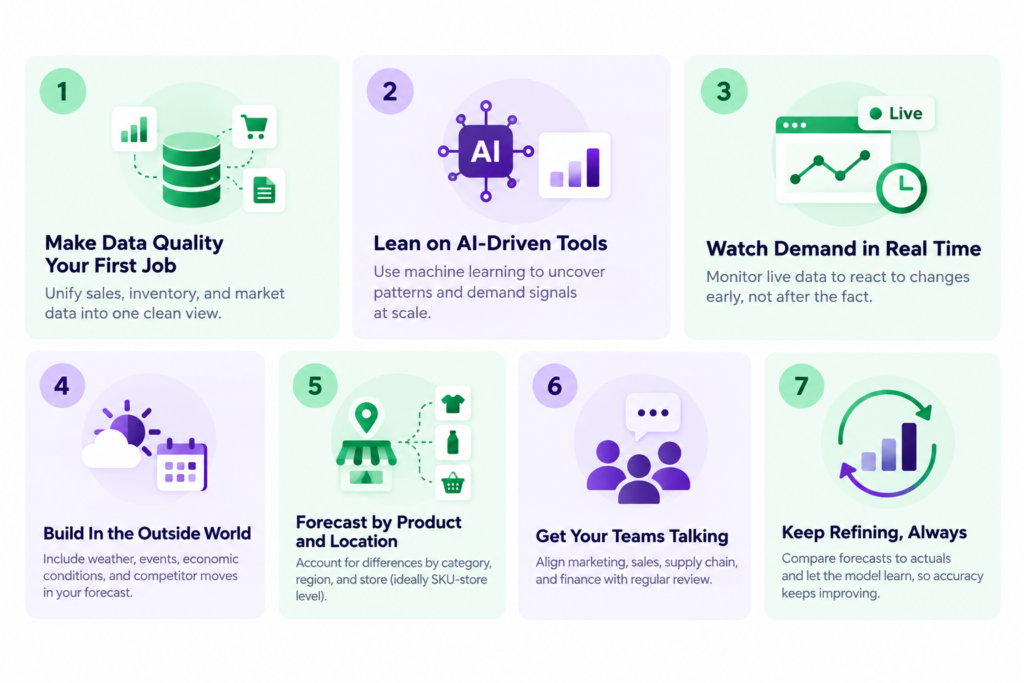
Make Data Quality Your First Job
Before you touch a model, get your data in order. What you need to do is pull sales, inventory, and market data into one clean, reconciled view, then layer real-time monitoring on top so problems surface before they distort the forecast. Skip this and every clever model downstream inherits the mess. Everything else on this list is built on this foundation.
Lean on AI-Driven Tools
Give your forecasts the horsepower to see what humans can’t. Machine learning surfaces the patterns, emerging trends, and demand surges that slip past traditional models, simply because it can read far larger datasets. Pick platforms your team can actually operate without a data science degree, so the value isn’t locked behind a specialist and your planners can pull insight directly.
Watch Demand in Real Time
Don’t let a stale forecast drive live decisions. Keep an eye on real-time data so you can shift inventory during a flash sale or an unexpected trend instead of reacting a week too late. Real-time analytics is what keeps your plan anchored to what’s happening now rather than what happened last quarter.
Build In the Outside World
Treat external factors as input data rather than surprises. Incorporate economic shifts, local events, weather conditions, and competitor actions into your models. For instance, if a sharp drop in temperature is forecast, you can stock up on winter clothing in advance, rather than waiting for a surge in demand and scrambling to catch up later. In this way, scenario planning and predictive modeling allow you to stay one step ahead.
Forecast by Product and Location
Resist the urge to forecast everything with one blanket curve. Demand differs by category and region, so a coastal store needs more sunscreen while an urban one needs more office supplies. Build forecasts at the segment, and ideally SKU-store, level to match inventory to each group and cut waste.
Get Your Teams Talking
Stop letting departments forecast in isolation. When marketing, sales, supply chain, and finance each work off their own numbers, the plans drift apart. Line up promotions with supply chain readiness and financial targets through regular cross-functional review, so the forecast reflects what the whole business is actually doing.
Keep Refining, Always
Never treat a forecast as finished. Check predictions against actuals, feed back what you learn, and use tools that recalibrate automatically so accuracy keeps climbing as conditions change. Continuous review is what keeps you tuned to the market instead of locked into assumptions that have quietly expired.
Turn Accurate Forecasts Into Better Prices and Bigger Margins
Traditional forecasting methods, relying on spreadsheets, expert experience, and historical averages, simply cannot keep pace with the speed of modern retail. The sheer number of stock-keeping units (SKUs), sales channels, and variables is overwhelming, and consumer preferences shift faster than manual processes can track. That is why successful retailers have already adopted AI-driven forecasting systems. They utilize these systems because they operate at the level of specific products in specific stores, learn continuously during operation, and make decision-making logic transparent rather than hiding it behind a “black box” approach.
But an accurate forecast is only the starting line. The real return comes when you turn that clear read on demand into smarter price optimization decisions. Understand how demand responds to price for every product and you can defend margin instead of reflexively discounting, recovering profit that guesswork leaves on the table. That holds whether you’re setting everyday prices, running promotions, or planning end-of-season markdown optimization.
That’s the connection Yieldigo was built on. Our AI reads true demand and price sensitivity across your assortment and turns it into transparent, glass-box price management recommendations you can trust and act on, with no black boxes and no spreadsheets. Retailers using Yieldigo typically recover meaningful sales margin within the first couple of months. If you’re ready to move from guessing to knowing, talk to our team and see what AI-driven pricing can do for your business.
Frequently Asked Questions
What is retail demand forecasting?
Retail demand forecasting is the practice of predicting how much of each product customers will buy, at a given price, in a given location, over a given period. It blends historical sales, market trends, seasonality, pricing, promotions, and outside factors like weather to estimate true customer demand rather than just past sales. Retailers use those predictions to decide how much to stock, how to price, and how to allocate inventory across stores and channels, meeting demand without overbuying.
What is demand forecasting?
Demand forecasting is the work of building the clearest possible picture of future demand by analyzing the variables that shape it, from historical demand patterns to internal business decisions to external factors like weather and local events. The resulting forecasts feed decisions across the supply chain, including replenishment, capacity planning, and inventory planning, and can be built at monthly, weekly, daily, or even hourly granularity depending on the decision they support.
Why is accurate demand forecasting important?
Accurate forecasts let retailers optimize inventory, cut both stockouts and overstocks, and lift customer satisfaction, with a more efficient supply chain following as a direct result. Those same insights sharpen decisions on production, distribution, pricing, and marketing, which lowers cost and lifts profitability. Put simply, the forecast is the foundation most other retail decisions quietly rest on.
How does AI improve demand forecasting in retail?
AI improves retail demand forecasting by processing far more data than any team, surfacing subtle demand patterns, and updating forecasts continuously as new information arrives. It weighs hundreds of variables at once (price, promotions, seasonality, weather, competitor activity, cannibalization) across thousands of SKUs and stores simultaneously, forecasts new products by matching their attributes to existing ones, and folds in external factors automatically. The result is higher accuracy, lower inventory costs, fewer stockouts and markdowns, and planners freed to focus on judgment over manual math.
How do you improve the accuracy of your demand forecasts?
Forecast accuracy is worth chasing because it optimizes inventory, reduces stockouts and overstocks, and improves both customer satisfaction and supply chain efficiency. To raise it, use machine learning to find patterns humans miss, build your own promotions and price changes into the forecast, factor in external influences like weather and competitor pricing, work from granular data with flexible aggregation, and keep evaluating and adjusting your models against real-world results and planner feedback.
What is demand forecasting for retail stores?
For a single store, demand forecasting means predicting what that specific location’s customers will buy and when. Demand is never uniform across a chain, since a coastal store, a downtown flagship, and a suburban location each sell a different mix shaped by local demographics, weather, events, and habits. Store-level forecasting, ideally down to the SKU-store-day level, lets you stock each location for its own real demand instead of pushing one assortment everywhere, which trims both stockouts and dead inventory.
What to use for demand forecasting in retail?
It comes down to scale and complexity. Very small retailers with few SKUs and one channel can start with spreadsheets and solid time-series logic. As soon as your assortment, store count, or channel mix grows, dedicated demand forecasting software becomes worth it. Look for a tool that forecasts at the SKU-store-day level, blends methods automatically, ingests internal and external data, learns and self-corrects, processes data fast at scale, and shows its reasoning rather than acting as a black box.
What software features matter most in a forecasting tool?
The right fit varies by business, but a few features are non-negotiable: AI-driven machine learning that automates complex calculations, transparency into how forecasts are produced, scalability and speed for large datasets, flexibility to forecast at different levels of granularity, integration with your other planning systems, and the ability to bring in both internal and external data from promotions to weather to competitor pricing.
How does seasonality affect retail demand forecasting?
Seasonality drives demand swings tied to recurring events like holidays, weather, and back-to-school. Retailers adjust inventory, pricing, and promotions to match those shifts and avoid running short or long. The nuance is that seasonality isn’t uniform, varying by store, region, and even individual product, so strong forecasting captures those location- and product-specific patterns rather than applying one seasonal curve to the whole range.
What’s the difference between short-term and long-term demand forecasting?
Short-term forecasting covers days to weeks and drives operational decisions like replenishment, promotions, and inventory management. Long-term forecasting spans months to years and guides strategic calls like capacity planning, product launches, market expansion, and supply chain investment. Most retailers run both, using short-term for operational precision and long-term for direction.
What is the best demand forecasting software for retail?
The best demand forecasting software for retail depends on a retailer’s assortment size, store network, available data, and planning complexity. Modern solutions use AI and machine learning to analyze sales history, seasonality, promotions, pricing, and external demand signals at scale. Platforms such as Yieldigo, RELEX Solutions, Blue Yonder, Oracle Retail, and o9 Solutions offer different approaches to forecasting and retail planning. The right choice should match the retailer’s specific forecasting needs and integrate effectively with its existing pricing, inventory, and planning processes.