
Retail pricing is no longer only about deciding how much a single product should cost. As retailers adopt more advanced retail pricing software, they increasingly use price mechanics that influence how many units customers purchase at once, helping them balance sales volume, margins, inventory levels, and customer value. One of the most common approaches is multiple-unit pricing, where customers receive a specific price or discount when purchasing several units of the same product, such as “2 for €5” or “3 for €10”.
In this guide, we’ll explain what multiple-unit pricing is, how it differs from standard single-unit pricing, and why retailers use it as part of their broader pricing and promotion strategies. We’ll cover the definition, the main types, the advantages and the potential downsides, and how the effective unit price is actually calculated. From a simple “3 for €10” shelf tag to more advanced optimization approaches, the goal is to show how retailers use quantity to increase purchase volume without giving away unnecessary margin.
What Is Multiple-Unit Pricing?
Multiple-unit pricing is a retail pricing strategy in which a specified quantity of the same product is sold for a single combined price, such as “3 for €5” or “5 for €12”. In plain terms: buy more, pay less per unit. The offer establishes a direct relationship between purchase quantity and effective unit price, so customers receive the advertised advantage only when they buy the required number of units. This is what separates it from standard single-unit pricing, where the price of one item stays the same whether the shopper takes one or ten. It also differs from product bundling, which combines different products into one offer, since multiple-unit pricing applies to several units of the same SKU or identical product, with mix-and-match offers the main exception.
Retailers use multiple-unit pricing to increase purchase volume, accelerate sell-through (the rate at which stock leaves the shelf), and support promotional or inventory objectives. By lowering the effective price per unit at a defined quantity threshold, the strategy can encourage customers to buy more than they otherwise would, while allowing the retailer to control the exact quantity, promotional price, and duration of the offer. It works best on frequently purchased, replenishable products that a household can reasonably consume or store, such as packaged food, soft drinks and household consumables. It works poorly on perishables with a short shelf life and on products people only ever need one of.
Why Use Multiple-Unit Pricing? Key Benefits for Retailers
Multiple-unit pricing can influence both how much customers buy and how they perceive the value of an offer. For retailers, however, the goal should not simply be to sell more units. An effective strategy needs to generate incremental demand, meaning sales that would not have happened without the offer, rather than giving away margin on purchases customers were going to make anyway. When retailers combine transaction data, demand forecasts, price elasticity, and promotion analytics, multiple-unit offers can become a precise commercial tool rather than a blanket discounting tactic.
According to the UK Food Standards Agency’s latest Food and You 2 survey, 92% of respondents in Northern Ireland had purchased food or drink on promotion during the previous two weeks, while 58% had used multi-buy promotions specifically. This illustrates how quantity-based offers such as “2 for X” or “3 for X” remain a familiar and frequently used pricing mechanism in grocery retail.
Increase Basket Size and Units per Transaction
One of the biggest benefits of multiple-unit pricing is that it moves more units in a single shopping trip. A shopper who walked in planning to buy one item may leave with three if the extra quantity comes with a saving that feels worth the larger outlay at that moment.
Create a Stronger Perception of Value
Offers such as “2 for €6” or “3 for €10” communicate value differently from a conventional percentage discount. Customers can immediately see both the quantity they receive and the total amount they pay, making the offer relatively easy to understand at the shelf or online. According to McKinsey’s 2026 Grocery Consumer Survey, 60% of consumers say getting good value for money has become more important, while 43% report relying more on promotions to save. At the same time, 71% prefer lower, more consistent everyday pricing over frequent promotions with higher base prices, reinforcing the importance of making promotional value simple, transparent, and meaningful.
Support Inventory Movement
Multiple-unit offers can also help retailers accelerate the movement of selected inventory. Increasing the quantity purchased per transaction can be useful when stock levels are high, demand is slower than expected, or retailers need to improve sell-through within a particular category.
Because the offer shifts several units per transaction rather than one, it clears surplus in fewer shopper visits than a straight price cut of the same depth. The limit is shelf life: if the promotion pushes more units into a household than it can use before the product expires, the stock problem becomes a customer experience problem and the next few weeks of demand disappear with it.
Drive Promotional Volume Without Discounting Every Unit
A traditional discount reduces the price regardless of the quantity purchased. With multiple-unit pricing, the benefit is contingent on reaching a specific quantity. This provides retailers with another mechanism for increasing sales through promotions while maintaining a standard price for customers who purchase only one item.
Strengthen Data-Driven Promotion and Pricing Decisions
Instead of repeatedly using familiar mechanics such as “2 for X,” retailers can test whether two, three, or more units produce the best balance between volume and profitability for each product or category. This turns multiple-unit pricing from a simple promotional mechanic into a measurable component of broader Price Management, where regular prices, promotions, margins, and commercial objectives can be managed as connected decisions.
Key Multiple-Unit Pricing Examples
The easiest way to understand multiple-unit pricing is to look at how quantity and price interact across different commercial models. While the core definition describes an offer in which purchasing multiple units affects the effective price, businesses can structure that relationship in several ways.
According to Kantar, promotional purchases accounted for 28.2% of total UK grocery spending in March 2025, the highest March level recorded in four years. Multibuy deals and “extra free” offers alone accounted for £686 million in promotional spending during the period, demonstrating the commercial scale at which quantity-based pricing mechanics are used in grocery retail. Note that two of the models below, two-part pricing and monopoly per-unit pricing, are not multiple-unit offers themselves. They’re included for contrast: each is a different way of setting the price of a single unit, which makes it clearer what’s distinctive about tying the discount to quantity instead.
- Two-part pricing: Two-part pricing charges a fixed access fee plus a variable rate based on how much the customer actually uses. A warehouse club is the classic case: an annual membership buys the right to shop, and each item is then paid for separately at member prices. Gyms, telecom plans, usage-based software plans, and utilities use the same structure.
- Monopoly per-unit pricing: Monopoly per-unit pricing is when a seller with enough market power to set its own price charges one flat price for every unit sold, with no bulk tiers or quantity breaks. Because buyers have no real alternative supplier, the tenth unit costs the same as the first, and no quantity break erodes the margin on additional volume. Notably, this is the opposite of the logic behind multiple-unit pricing, where the seller deliberately gives up margin per unit in exchange for higher quantities.
- Grocery and FMCG Multi-Buy Promotions: A multi-buy promotion is a retail offer that discounts a product when the shopper buys a set quantity of it, such as “3 for €7.50” or “buy 2, get 1 free”. Common in grocery and FMCG, it works only when the extra volume it drives is incremental rather than demand the store would have captured anyway.
Types of Multiple-Unit Pricing
Multiple pricing can be structured in five main ways: fixed-quantity bundles, volume-based tiers, mix-and-match offers, buy-more-save-more thresholds, and conditional pricing. Retailers can adjust the required quantity, discount structure, product combination, and eligibility rules depending on the commercial objective. The table below summarizes the five most common types and where each one tends to work best.
| Type of multiple pricing | How it works | Example | Best suited for |
| Fixed-quantity bundle pricing | A specific number of identical units is offered for one combined price | 3 yogurts for €5 | High-frequency, repeat-purchase products |
| Volume-based pricing | The effective unit price falls at each higher quantity tier | 1 for €3, 2 for €5, 3 for €7 | Products bought in widely varying quantities |
| Mix-and-match pricing | Customers can combine eligible products to reach the required quantity | Any 3 selected soft drinks for €6 | Categories with multiple flavors, sizes, or variants |
| Buy-more-save-more pricing | The discount increases at predefined quantity thresholds | Buy 2, save 10%; buy 4, save 20% | Higher-priced items where percentages feel generous |
| Conditional multiple pricing | Customers receive the promotional price only after meeting a specific quantity requirement | €2 each when buying 3 or more | Products whose regular price should stay visible |
Fixed-Quantity Bundle Pricing
Fixed-quantity bundling is the most familiar form of multiple-unit pricing. Instead of pricing one item on its own, the retailer sets a single combined price for a set number of identical units, such as “2 for €6” or “4 for €10”. The format makes the saving immediately visible on the shelf and gives the retailer direct control over the quantity that triggers it. Compared with standard unit pricing, the customer only reaches the lower per-unit price by buying the full promotional quantity.
Volume-Based Pricing
Volume-based pricing lowers the effective unit price in steps as the quantity rises: €3 for one unit, €5 for two, €7 for three. Each tier gives the shopper a slightly better deal for committing to more, but the retailer still has to calculate whether that added volume compensates for the thinner margin on every unit. Evidence from a large-scale field experiment involving more than 14 million consumers demonstrates why this matters: progressively deeper quantity discounts increased the quantities purchased by 6.7%, 11.2%, and 44.9%, yet had virtually no overall impact on revenue because the lower prices offset the additional volume.
Online, the same mechanic usually appears as pack-size options on a single product page: one unit at €12, three at €30, six at €50. Because the per-unit price is displayed next to each option, the comparison happens on screen rather than in the shopper’s head, which tends to make the higher tiers convert better than an equivalent offer on a shelf tag.
Mix-and-Match Multiple Pricing
Mix-and-match offers are the one exception to the same-product rule: customers can combine several different products from an eligible group and still receive the multiple-unit price. A retailer might, for instance, offer “any 3 products from this range for €10”. Because the quantity threshold still applies and the products come from a single defined range, the mechanic behaves like a multiple-unit offer rather than a bundle, but it gives shoppers more flexibility than requiring several identical items. It can work particularly well for categories containing different flavors, fragrances, varieties, or closely related products because shoppers can increase quantity without having to stock up on exactly the same SKU.
Buy-More-Save-More Pricing
Promotions like “the more you buy, the more you save” use several thresholds instead of a single fixed offer. For example, shoppers might get 10% off when they buy two units and 20% off when they buy four. The difference from volume-based pricing is presentation rather than structure: the saving is expressed as a percentage rather than as a set price for each tier, which tends to work better on higher-priced items where a percentage reads as more generous than the equivalent amount in euros. Each threshold gives the shopper a fresh reason to add one more item, so the incentive builds in stages rather than stopping at one quantity. It also gives retailers more flexibility than a single fixed offer, because different shoppers respond to different thresholds.
Conditional Multiple-Unit Pricing
With conditional pricing, the promotional unit price applies only when the customer reaches the required quantity. For example, an item might normally cost €2.50 but become €2 per unit when the customer purchases at least three. The economics are the same as a fixed-quantity offer such as “3 for €6”, but the framing is different: a per-unit price keeps the regular price visible as a reference point, while a bundle total presents the offer as a package. The distinction matters because the retailer preserves the regular price for customers purchasing fewer units. Instead of applying a blanket discount, the promotion rewards the specific behavior the retailer wants to encourage.
Advantages of Multiple-Unit Pricing
Understanding multiple-unit pricing also means understanding why retailers choose it over conventional discounts. When properly optimized, multiple-unit offers can simultaneously influence transaction size, customer value perception, and promotional performance. Modern retail pricing software can help retailers analyze these effects across large assortments and make more informed pricing decisions. Here are the three main advantages:
| Advantage | Retail impact |
| Higher purchase quantities | Encourages shoppers to add more units to their baskets |
| Stronger value perception | Makes the financial benefit of purchasing several products visible and easy to understand |
| Greater promotional control | Allows retailers to connect discounts with specific quantities instead of reducing prices for every purchase |
1. Encourages Customers to Purchase More
The most obvious benefit of multiple-unit pricing is the ability to increase the number of items purchased in a single transaction. Instead of asking customers if they want just one item, it directly asks whether buying two, three, or more items would be beneficial enough to justify the purchase.
2. Makes Promotional Value Easy to Communicate
Multiple-unit promotions provide customers with a concrete combination of quantity and price. A message such as “3 for €6” can be processed quickly and gives shoppers an immediate reference point for evaluating the offer.
3. Gives Retailers More Control Over Discounting
With a standard price reduction, both customers buying one unit and those buying several units may receive the same discounted price. A multiple-unit offer can reserve the benefit for customers who meet the desired quantity threshold. This gives retailers another lever for balancing volume and margin. With demand forecasting, elasticity analysis, scenario modeling, and a structured Promotion Management process, a multiple-unit pricing strategy can determine whether a specific quantity-price combination is likely to generate enough additional demand to justify the discount.
Challenges and Considerations of Multiple-Unit Pricing
Multiple-unit offers can lift sales volume and make a promotion easier to communicate, but neither outcome automatically guarantees profit. The real challenge is balancing four things at once: how many units move, how deep the promotional price goes, how customers perceive the offer, and how much margin survives it. The three most common risks, and what to do about each, are summarized below:
| Challenge | Why it matters | What retailers should consider |
| Margin erosion | Larger discounts can increase volume while reducing profitability | Measure incremental profit, not promotional sales alone |
| Demand cannibalization and stockpiling | Customers may shift purchases rather than generate genuinely new demand | Analyze baseline demand, purchase frequency, and post-promotion sales |
| Choosing the wrong quantity or price | An unattractive or unrealistic threshold can limit promotion effectiveness | Use elasticity, basket data, margins, and scenario modeling |
1. Risk of Margin Erosion
Every multiple-unit offer gives up margin on each unit sold. That trade is worthwhile if the offer persuades customers who normally buy one unit to buy three. But if many shoppers already buy three at the regular price, the promotion simply hands back revenue on demand the retailer would have captured anyway.
This is why an effective multiple pricing strategy should optimize for incremental margin rather than sales volume alone. The same principle sits at the center of automated pricing optimization: decisions should be evaluated against measurable commercial outcomes rather than volume in isolation.
2. Cannibalization, Stockpiling, and Demand Shifting
Research reviewing the effects of price promotions found that 9 – 69% of the promotional sales uplift across analyzed product categories could be attributed to purchase acceleration through stockpiling, while 10 – 56% was associated with increased consumption. This distinction is important for multiple-unit pricing: customers may purchase several units during a promotion and then buy less in subsequent weeks because they already have the product at home.
Detecting this requires extending the measurement window past the promotion by roughly one normal purchase cycle for that product, then comparing total units across the promotional period plus the recovery period against the same span of baseline weeks. Baseline here means normal, non-promoted sales for the same product, same store, same season. If total units across both windows barely differ from the baseline, the promotion moved the timing of demand rather than the amount of it.
3. Finding the Right Quantity and Price Combination
Defining multiple-unit pricing is much simpler than implementing it well. Retailers need to combine historical promotional performance, elasticity, basket composition, inventory levels, and margins to identify an offer that changes customer behavior without excessive discounting. Predictive pricing analytics can strengthen this process by helping teams estimate likely responses before committing to a specific price point.
How to Calculate an Effective Multiple-Unit Price: Step by step
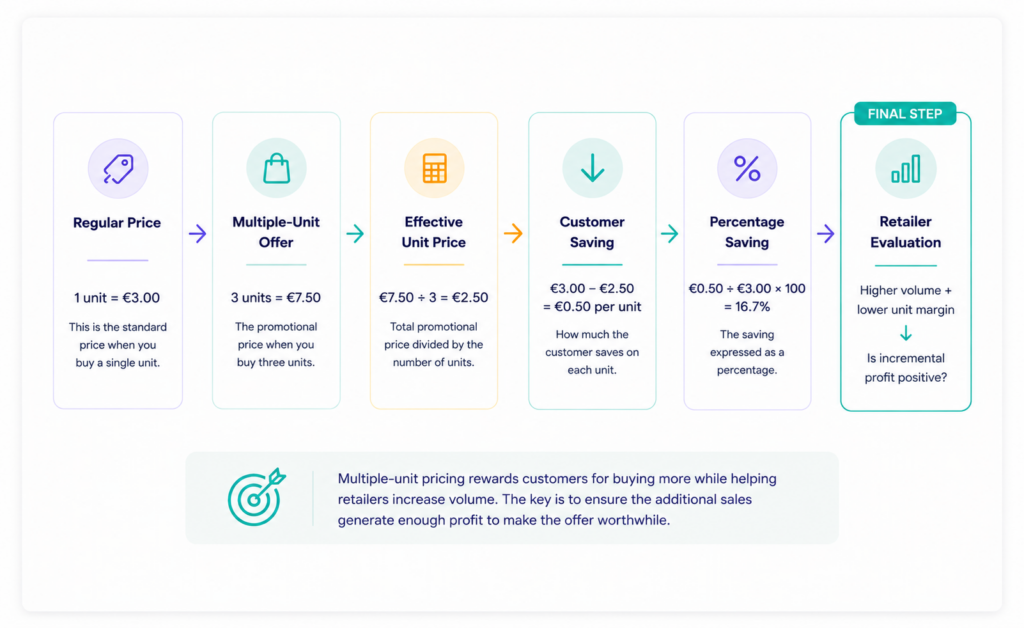
The unit price is the amount paid for a single unit of a product. When a discount covers multiple units, the effective unit price is the total promotional price divided by the number of units included. From there, a retailer can work out what the customer saves and whether the offer still earns enough to be worth running. Here’s the process step by step:
1. Start with the regular price
This is the standard price of a single unit, in this case €3.00. It’s also worth noting your unit cost at this stage, say €1.80, which leaves €1.20 of margin per unit. Everything else in the calculation is measured against these two figures, so make sure the €3.00 is the true everyday price and not an already discounted one.
2. Set the multiple-unit offer
Decide how many units the promotion covers and what the whole bundle costs: 3 units for €7.50. The practical rule is to set the threshold just above what shoppers typically buy. If most customers take one, an offer of two or three changes behavior. If the threshold sits three or four units above normal purchase quantity, it tends to be ignored by everyone except stockpilers, who are the least profitable shoppers to attract. Either way, the quantity has to be something a household can realistically use or store.
3. Divide to get the effective unit price
Take the total promotional price and divide it by the number of units: €7.50 ÷ 3 = €2.50 per unit. That figure is the real price the customer pays per item under the offer.
4. Work out the customer saving per unit
Subtract the effective unit price from the regular price: €3.00 − €2.50 = €0.50 saved on every unit. This is the concrete benefit the shopper gets for buying more at once.
5. Convert the saving into a percentage
Divide the saving by the regular price and multiply by 100: €0.50 ÷ €3.00 × 100 = 16.7%. Percentages travel better on shelf tags and ads than absolute amounts, so this is usually the number you advertise.
6. Evaluate it as the retailer
You’re trading a lower margin per unit for higher volume, so check that the swap pays. Three units cost you €5.40, so the bundle earns €7.50 minus €5.40 = €2.10, compared with €1.20 on a single sale. That’s a clear gain against a customer who would otherwise have bought one unit, but if the same shopper would have bought two anyway, you would have earned €2.40 at the regular price and the offer has cost you €0.30. The comparison that matters is always against what the customer would have bought without the promotion. If the result is negative, raise the bundle price or reduce the pack size.
How to Set a Multiple-Unit Pricing Strategy
A multiple-unit pricing strategy defines which products qualify for multi-buy offers, the quantity customers must purchase, and the combined price or discount applied, with the goal of increasing purchase volume while protecting margins.
Evidence from research based on purchasing behavior across more than 30,000 British households shows why these decisions matter: at least one-third of food and beverage volume was purchased through some form of price promotion, while multi-buy offers were found to encourage shoppers to purchase larger quantities once they had decided to buy. The following four steps provide a practical framework for developing a profitable multiple pricing strategy.
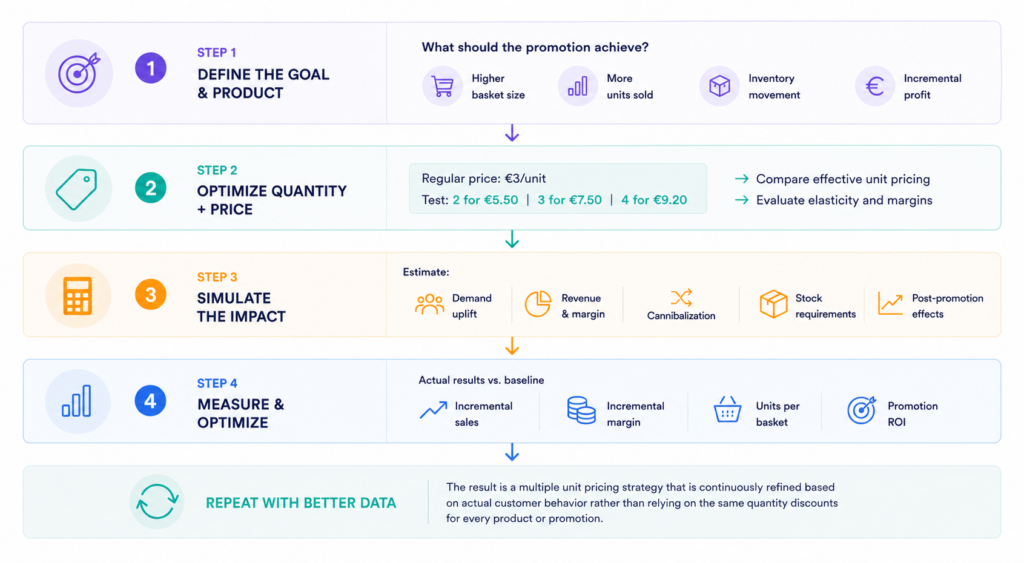
1. Identify the Right Products and Business Objective
Start by defining what the promotion is actually for. A retailer might want to increase units per transaction, boost sales in a specific category, encourage trial, speed up inventory movement, or improve overall profitability. Whichever goal you pick should dictate the structure of the offer, because clearing slow stock and lifting basket size call for very different quantities and discount depths.
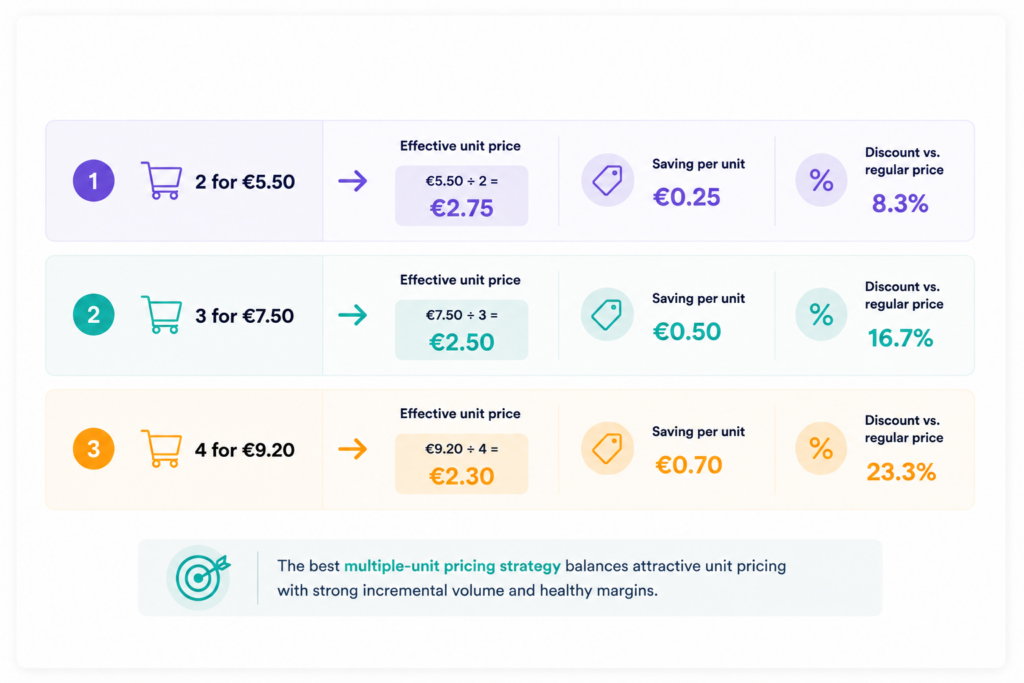
2. Determine the Optimal Quantity and Price
Once suitable products have been identified, retailers need to decide how many units customers should purchase and what price incentive they should receive. The basic unit pricing definition provides a useful starting point: divide the total price by the number of units to determine the effective price per unit. Each quantity and price combination creates a different incentive and a different margin impact. The best option is not necessarily the one with the lowest price; it is the combination expected to generate the strongest incremental commercial result. This is the core objective of Price Optimization: finding price points that support the desired balance of demand, revenue, and margin.
3. Model the Impact Before Launching the Promotion
Before implementing an offer, retailers should estimate what it could do to sales, revenue, margin, inventory, and the rest of the category. This is particularly important because higher promotional volume does not necessarily mean higher incremental profit. Retailers can apply the same scenario-based thinking used in dynamic pricing strategies to respond more intelligently to changing demand and market conditions.
4. Measure Performance and Continuously Optimize
After launch, retailers should compare actual results with both the forecast and the normal sales baseline rather than evaluating promotional volume in isolation. The importance of this distinction is demonstrated by a Marketing Science study of promotion effectiveness at CVS, which found that only around 45% of gross promotional lift was genuinely incremental and more than 50% of the promotions analyzed were unprofitable because incremental units did not sufficiently offset lower promotional margins.
Future Trends and Innovations in Multiple-Unit Pricing
The future of multiple-unit pricing is moving away from static promotional rules toward more precise, data-driven decision-making. Traditional offers such as “2 for €5” or “3 for €10” will remain common, but retailers increasingly have the ability to determine whether those combinations actually maximize incremental sales and profit.
AI-Driven Multiple-Unit Pricing Optimization
AI and machine learning can significantly improve the accuracy of pricing. Instead of relying on historical data from previous promotions or manually set quantity values, retailers can easily analyze large volumes of transaction data to determine which products, price levels, and quantities are most likely to generate profitable additional demand.
More Dynamic and Context-Aware Offers
Another important development is the transition toward more dynamic pricing and promotion decisions. The most effective multiple-unit offer may change according to seasonality, current demand, inventory availability, competitor activity, and changes in customer purchasing patterns. For retailers managing thousands of products, automation becomes particularly valuable. It allows pricing teams to focus on commercial strategy and exceptions while analytical systems process the large number of possible price and quantity combinations. Modern pricing intelligence solutions can further support these decisions by turning large volumes of pricing and market data into actionable insights.
Greater Focus on Incrementality and Profitability
Future optimization will place more emphasis on distinguishing promotional volume from genuinely incremental demand. A promotion should not be judged successful simply because more units were sold while it was running. Measuring this properly means comparing against a control: matched stores that did not run the offer, or matched customer groups that were not shown it. Retailers with loyalty data have an advantage here, as they can see whether the additional units went to new buyers or to existing households that were simply buying earlier than they otherwise would.
Personalized and Customer-Relevant Multiple Pricing
As retailers learn more about individual purchasing patterns, multiple-unit offers can be aimed at the households most likely to act on them rather than shown to everyone at the same threshold. Households vary in consumption rates, brand preferences, basket sizes, and sensitivity to volume discounts. An offer that appeals to a large family may be worthless to a shopper who rarely needs more than one item.
Integration With Broader Retail Pricing Strategies
Finally, multiple-unit pricing is increasingly likely to be managed as part of an integrated pricing and promotion strategy rather than as an isolated promotional tactic. Retailers need to understand how a multiple-unit offer interacts with regular prices, Markdown Optimization, other promotions, inventory decisions, and category objectives. For products approaching the end of their selling lifecycle, a dedicated markdown pricing strategy may be more appropriate than extending a multi-buy promotion.
Conclusion
Multiple-unit pricing works because it changes the question the shopper is answering. A standard price asks whether the product is worth buying at all. A “3 for €7.50” tag asks how many are worth buying, and for frequently replenished products the answer is often more than one. That shift in framing is why quantity-based offers have remained a fixture of grocery and FMCG retail even as the rest of pricing has moved to automation and AI.
The mechanic is simple, but the economics are not. Dividing the promotional price by the number of units takes ten seconds. What no promotional sales report shows is whether the extra units were genuinely new demand or simply demand pulled forward from next month, and the evidence is blunt about how often it is the latter.
This is why every offer is best treated as a decision to be tested rather than a habit to be repeated. Retailers who choose the quantity from basket and elasticity data instead of defaulting to “2 for X”, who model the margin impact before the shelf tag goes up, and who measure results against a normal sales baseline rather than against zero, are the ones who get real value from the mechanic. Done consistently, quantity stops being a discount given away and becomes a lever the retailer controls, managed alongside regular price, markdown, and inventory decisions as part of one connected pricing strategy.
Frequently Asked Questions
What Is Multiple-Unit Pricing?
Multiple-unit pricing is a retail strategy that sells a set quantity of the same product for one combined price, such as “3 for €5” or “buy 2, get 1 free”, so the customer pays less per unit by buying more. It is most common in grocery and FMCG, where shoppers can easily store and use several units, and in B2B, where volume tiers are a standard condition of trade. The mechanic works because the customer sees enough added value in the larger quantity to buy more now rather than later.
What Are the Benefits of Multiple-Unit Pricing?
The main benefits are higher units per transaction, a clearer value message at the shelf, faster movement of selected inventory, and greater control over discounting, since only customers who reach the quantity threshold receive the lower price.
What Is the Difference Between Bundled Pricing and Multi-Unit Pricing?
Bundled pricing usually combines two or more different products into one package at a single price, while multiple-unit pricing typically encourages customers to purchase several units of the same product, or products from an eligible group. For example, shampoo and conditioner sold together for €8 is a bundle, whereas three bottles of shampoo for €10 is multiple-unit pricing.
Does Volume Pricing Always Increase Profits?
No. Higher sales volume does not automatically produce higher profit. Multiple-unit pricing reduces the effective price per unit, so the additional volume has to generate enough extra margin to cover the discount, and it only truly pays when those units are incremental rather than purchases customers would have made anyway.
What Is the Ideal Discount Percentage for Multi-Unit Offers?
There is no universal ideal discount percentage. The right level depends on product margins, price elasticity, purchase frequency, competitive positioning, inventory levels, and the required quantity. The practical method is to work backwards from margin: calculate the effective unit price, subtract your unit cost, and check that the profit on the full bundle beats what those same customers would have spent without the offer.
Is This Pricing Model Legal in All Industries?
It depends on the jurisdiction, the product category, and how the offer is advertised. Some categories carry specific restrictions: Scotland has banned multi-buy discounts on alcohol since 2011, and the UK has introduced restrictions on volume price promotions for products high in fat, salt or sugar. Beyond category rules, retailers are generally required to display promotional prices clearly and not mislead customers about the actual saving or the terms of the offer.
Does Volume Discounting Reduce Customer Satisfaction?
Not inherently. Multiple-unit discounts can improve value perception when customers understand the offer and find the required quantity useful. Problems can arise when the pricing structure is confusing, the saving is insignificant, or customers feel pressured to purchase more than they need.
How Do I Track the Success of a Bulk Pricing Campaign?
Total promotional sales is the least useful measure, because it always looks positive. Track units per transaction, average basket value, incremental units and incremental gross profit measured against a non-promoted baseline, promotional ROI, inventory movement, cannibalization of nearby products, and the dip in demand in the weeks after the offer ends.
What Are the 4 Types of Pricing Strategies?
Pricing frameworks vary, but four commonly discussed approaches are cost-based pricing, competition-based pricing, value-based pricing, and dynamic pricing. A multiple pricing strategy can operate alongside these broader approaches. For example, a retailer may use value or competitive considerations to establish the regular price and then introduce multiple-unit promotions to influence quantity during selected periods.
What Are the 7 Pricing Strategies?
There is no single universally accepted list of exactly seven pricing strategies. A practical classification can include cost-plus pricing, value-based pricing, competition-based pricing, dynamic pricing, penetration pricing, premium pricing, and promotional pricing.
What Are the 5 Pricing Strategies?
The five most common approaches to pricing are cost-based pricing, value-based pricing, competitive pricing, dynamic pricing, and promotional pricing. The appropriate model depends on the retailer’s market position, objectives, customer behavior, and available data.