
Price2Spy is a popular choice for monitoring competitor prices, but it may not be the right fit for every retailer. As pricing needs become more complex, businesses often look for alternatives that offer different features, pricing models, integrations, or more advanced ways to use competitive data.
In this guide, we compare the best Price2Spy alternatives to help you find a solution that matches your pricing goals. Whether you need reliable competitor price tracking, automated repricing, or more advanced pricing optimization, you’ll find options suited to different retail needs.
TL;DR
The best alternative to Price2Spy will depend on why you want to switch to another platform. Companies primarily looking for a different competitor monitoring solution should also consider platforms that focus on automated repricing or AI-powered price optimization. Therefore, the shortlist below covers solutions for specific use cases, including competitor monitoring, MAP enforcement, repricing, and broader retail price optimization.
- Yieldigo
- Minderest
- DataWeave
- Dealavo
- Skuuudle
- Multiply
- Competera
- Wiser Solutions
- Omnia Retail
- Intelligence Node
Why Do Businesses Look for Price2Spy Alternatives?
Businesses typically explore Price2Spy alternatives when their pricing needs become more complex. A solution focused on competitor price monitoring may no longer be enough when a company expands its assortment, enters new markets, or needs greater automation and pricing intelligence. Common reasons include:
- Different Monitoring Requirements. Businesses may need broader marketplace coverage, more frequent updates, or monitoring across multiple countries and sellers.
- Advanced Product Matching. For particularly large or complex product lines, a fairly complex matching process is required, especially if the products do not share common identifiers or are identical.
- MAP and Reseller Monitoring. Brands may need to track reseller activity, advertised prices, and compliance with pricing policies.
- Automated Repricing. Some businesses turn to dynamic pricing software when they want competitor data and market changes to trigger automated price adjustments rather than relying on manual decisions.
- Price Optimization. Larger retailers may need price optimization that considers demand, elasticity, margins, and business objectives alongside competitor prices.
There is therefore no single Price2Spy alternative that fits every business. The right choice depends on whether the priority is competitive intelligence, product matching, MAP monitoring, automated repricing, or broader price optimization.
How We Evaluated the Best Price2Spy Alternatives
We evaluated each Price2Spy alternative based on how well it addresses the most common pricing challenges faced by retailers, ecommerce businesses, and brands. Rather than comparing platforms only by the number of features they offer, we focused on their core use cases, level of automation, scalability, and ability to turn competitive data into actionable pricing decisions. Our evaluation focused on the following criteria:
- Competitor Price Monitoring. When evaluating pricing intelligence software, we considered competitor and marketplace coverage, data freshness, price-change alerts, and historical pricing visibility.
- Product Matching. The ability to accurately identify and match identical or comparable products across different retailers, even when product information varies between sources.
- Pricing Automation & Repricing. Support for pricing rules, automatic price adjustments, and workflows that enable businesses to quickly respond to competitive and market changes.
- AI & Price Optimization. Capabilities that go beyond competitor-based repricing by incorporating factors such as demand, elasticity, margins, business objectives, and other commercial signals.
- Retail & Market Intelligence. Additional functionality such as assortment intelligence, MAP and reseller monitoring, marketplace visibility, analytics, and competitive insights.
This approach helps highlight where each Price2Spy alternative is strongest, rather than treating every platform as a direct one-to-one replacement.
Best Price2Spy Alternatives & Competitors in 2026
| Platform | Best for | Pricing | G2 rating | |
| 1 | Yieldigo | AI-powered price optimization for grocery and large retailers | Custom pricing | 4.6 / 5 |
| 2 | Minderest | Enterprise competitor price monitoring and pricing intelligence | Contact vendor | 4.6 / 5 |
| 3 | DataWeave | Ecommerce pricing intelligence and competitive analytics | Contact vendor | 4.4 / 5 |
| 4 | Dealavo | Competitor price monitoring and dynamic pricing for ecommerce | Contact vendor | 4.3 / 5 |
| 5 | Skuuudle | Competitor price tracking and product matching | Contact vendor | 4.8 / 5 |
| 6 | Competera | Intelligent pricing analytics and competitive market insights for enterprise retailers | Contact vendor | 4.9 / 5 |
| 7 | Wiser Solutions | Retail pricing intelligence, competitor monitoring, and MAP monitoring | Contact vendor | 4.3 / 5 |
| 8 | Omnia Retail | Dynamic pricing and price monitoring for retailers and brands | Contact vendor | 4.4 / 5 |
| 9 | Intelligence Node | AI-driven competitive pricing intelligence and retail analytics | Contact vendor | 4.5 / 5 |
| 10 | Multiply | AI-powered dynamic pricing for ecommerce | Contact vendor | 4.9 / 5 |
1. Yieldigo – Best for AI-Powered Retail Price Optimization
What Is Yieldigo?
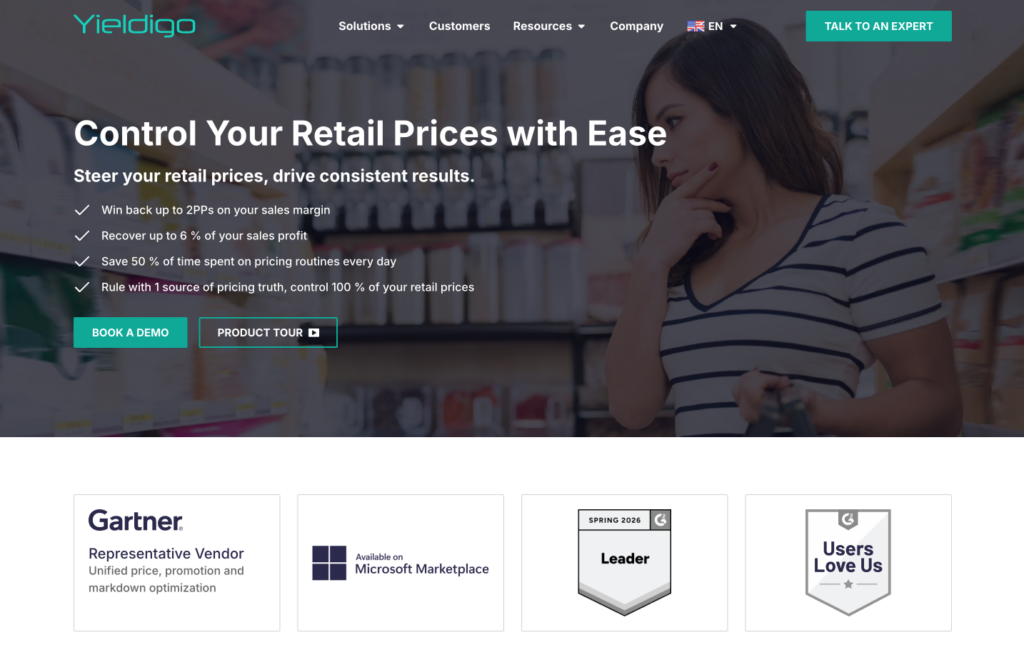
Yieldigo is an AI-powered retail price management and optimization platform designed for professional retailers and ecommerce businesses managing complex assortments, markets, stores, channels, and price lists. Rather than functioning primarily as a competitor price tracker, Yieldigo applies AI and predictive pricing analytics to turn multiple sources of commercial data into pricing decisions at scale.
This distinction matters in a Price2Spy comparison. Competitive prices can be valuable inputs, but they do not necessarily indicate what a retailer’s optimal price should be. Instead of simply reacting to competitor price changes, Yieldigo’s AI-powered approach evaluates competitive data alongside broader business signals to support pricing decisions aligned with the retailer’s own objectives.
Why Consider Yieldigo Instead of Price2Spy?
The most important difference is obvious: Price2Spy helps companies understand competitive pricing conditions, while Yieldigo becomes relevant when retailers also need to determine how their own prices should change depending on the product range they offer.
Yieldigo’s optimization capabilities are designed around the second problem. The platform uses AI/ML-supported analysis and price elasticity to help pricing teams understand the expected effects of price changes. Yieldigo also emphasizes maintaining human control: pricing experts can evaluate recommendations and potential consequences rather than surrendering pricing decisions to an uncontrolled algorithm.
Yieldigo Key Capabilities
Yieldigo brings several areas of the retail pricing lifecycle into one environment rather than limiting the workflow to competitive monitoring. Its current product portfolio includes price management, price optimization, competitive pricing, promotion functionality, markdown optimization, and multibuy management.
- Retail price management. Centralized support for managing pricing decisions across complex retail assortments, stores, markets, channels, formats, and price lists.
- AI/ML price optimization. Machine-learning-supported recommendations help retailers identify pricing opportunities and evaluate potential effects on commercial performance.
- Price elasticity modeling. The models require price changes to be taken into account, which helps teams understand where price increases or decreases are most likely to impact sales volumes.
- Cross-product effects. Supports a broader assortment perspective in which substitution, cannibalization, halo effects, and basket relationships can matter to the economics of a pricing decision.
- Competitive price positioning. Competitive information can contribute to pricing strategy without automatically becoming the sole determinant of the retailer’s price.
- Business rules and constraints. Pricing recommendations can operate within retailer-defined commercial requirements rather than treating optimization as unconstrained automation.
- What-if simulation. Allows pricing teams to evaluate the potential consequences of changes before putting them into operation.
- Promotion management. Yieldigo supports promotion management through planning and simulation workflows designed for complex retail environments.
- Promotion analytics. Its promotion analytics capabilities help retailers evaluate promotional impact using data-driven analysis.
- Markdown optimization. Yieldigo supports markdown optimization for long-life and short-life products using inventory, expiration, demand sensitivity, and retailer-defined workflows.
- Multibuy and bulk pricing. Yieldigo provides multibuy management for complex offer structures beyond standard single-unit pricing.
Yieldigo Pros & Cons
For retailers evaluating automated pricing optimization, Yieldigo represents a broader approach than competitor monitoring or rule-based repricing alone.
| Pros | Cons |
| Deep retail price optimization: Goes beyond collecting competitive prices by supporting demand- and elasticity-informed pricing decisions. | Potentially excessive for monitoring-only requirements:Businesses that simply need to track competitor URLs and receive price-change alerts may not need the breadth of an enterprise pricing platform. |
| Designed for complex assortments: Supports pricing environments involving large numbers of SKUs, stores, markets, channels, price lists, and interconnected products. | Requires internal preparation: Advanced optimization depends on retailer data and integration with the existing pricing ecosystem, so implementation requires more preparation than adopting a lightweight tracker. |
| Combines AI with commercial constraints:Optimization can operate alongside retailer-defined business requirements instead of treating algorithmic recommendations as unrestricted decisions. | No simple sticker-price comparison: Pricing is customized, making immediate cost comparison with standardized monitoring subscriptions more difficult. |
| What-if analysis before implementation: Pricing teams can assess the potential consequences of decisions instead of only measuring results afterward. | Not positioned as a lightweight standalone competitor tracker: Organizations primarily interested in competitor scraping and monitoring should compare specialist tools first. |
| Retailer remains in control: AI supports pricing professionals rather than requiring fully autonomous price execution. | Broader organizational scope: Extracting the full value from optimization may involve pricing, category, merchandising, data, and IT teams rather than a single ecommerce user. |
Yieldigo Pricing
Yieldigo does not publish standardized package prices on its website. Its pricing is custom and quote-based, with prospective customers directed toward a demo and sales-led evaluation process. Yieldigo’s own 2026 pricing-software materials likewise describe its pricing as available upon request.
This model is suitable for enterprise-level retail pricing software, where implementation rates can vary significantly depending on the size of the product line, markets, modules, integrations, data complexity, and business requirements. This also means that companies comparing Yieldigo to Price2Spy should avoid unreasonable monthly estimates or assumptions about total costs.
What Do Yieldigo Customers Say?
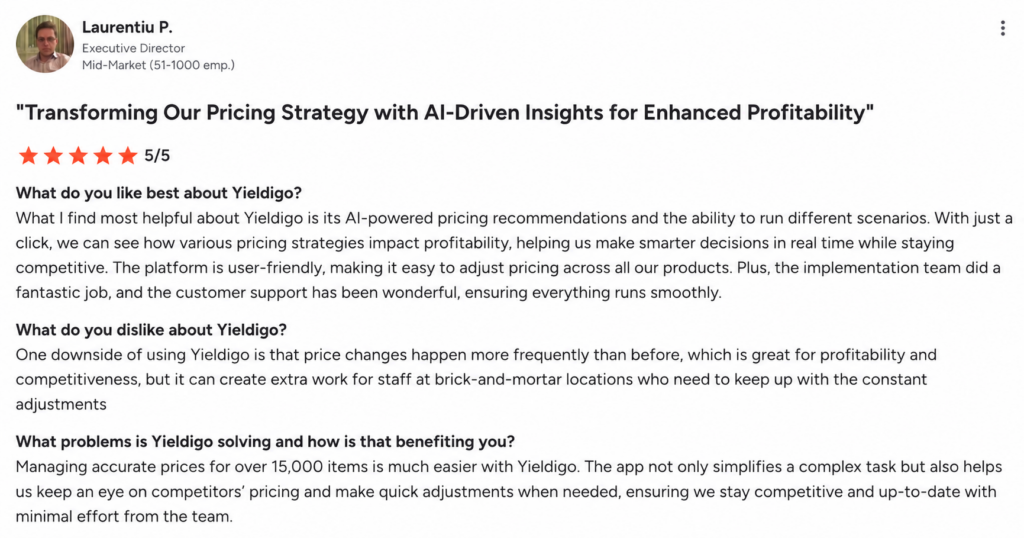
Current G2 feedback is broadly positive and provides useful evidence about how customers experience the platform in practice. As of August 2026, Yieldigo has 28 reviews and an average rating of 4.6 out of 5, with 85% of reviewers assigning five stars and 14% assigning four stars.
G2 Rating: 4.6 / 5 based on 28 G2 reviews, verified in September 2026.
2. Minderest – Best for Enterprise Price Intelligence and Competitor Monitoring
What Is Minderest?
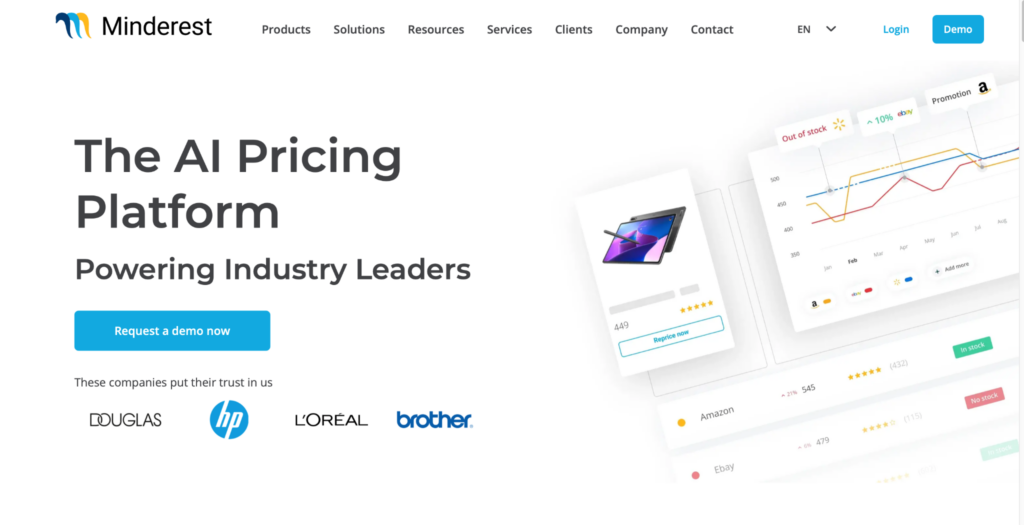
Minderest is a price analysis platform for retailers and brands seeking a systematic overview of competitor activity across large product catalogs. Among Price2Spy alternatives, Minderest is one of the closest alternatives to Yieldigo, as competitor monitoring remains a key part of its value proposition.
Why Consider Minderest Instead of Price2Spy?
Minderest becomes particularly interesting when the reason for evaluating Price2Spy alternatives is not a desire to move away from competitor monitoring, but to strengthen it. The platform is designed for large-scale price intelligence, including competitive price tracking, assortment monitoring, product matching, and market analysis. When comparing enterprise pricing software, retailers should therefore distinguish competitive intelligence platforms from tools designed for broader pricing optimization.
Minderest Key Capabilities
- Competitor price monitoring. Tracks competitor prices and changes across relevant ecommerce environments.
- AI-supported product matching. Helps connect equivalent products across large and potentially inconsistent catalogs.
- Assortment intelligence. Enables retailers to compare product availability and assortment differences between themselves and competitors.
- Promotion monitoring. Provides visibility into competitive promotional activity alongside regular prices.
- Historical pricing analysis. Allows teams to examine how market prices and competitor strategies evolve over time.
- Market positioning. Helps retailers assess where their prices sit relative to selected competitors.
Minderest Pros & Cons
| Pros | Cons |
| Strong enterprise competitive intelligence: Suitable for organizations that need extensive visibility across large assortments. | Primarily intelligence-oriented: Retailers seeking deep demand- and elasticity-based optimization may need broader pricing technology. |
| Advanced product matching: Valuable when maintaining reliable matches at scale becomes difficult. | Potentially more than smaller businesses require: Enterprise-scale capabilities may not be necessary for companies monitoring a small competitive set. |
| Price and assortment visibility: Competitive analysis can extend beyond the listed price itself. | Implementation scope depends on complexity: Large catalogs and custom competitive sets require appropriate setup and data governance. |
| Useful for retailers and brands: Can address multiple forms of ecommerce market intelligence. | Not equivalent to full retail optimization: Competitive intelligence and optimal-price determination remain different problems. |
| Historical competitive analysis: Helps teams understand patterns rather than relying only on current snapshots. | Custom evaluation required: Buyers need to establish precisely which markets, competitors, products, and data points they want monitored. |
Minderest Pricing
Minderest does not operate primarily as a simple self-service product with one universal public subscription price. Enterprise buyers generally need to contact the company to discuss requirements and obtain pricing appropriate to their monitoring scope.
What Do Minderest Customers Say?
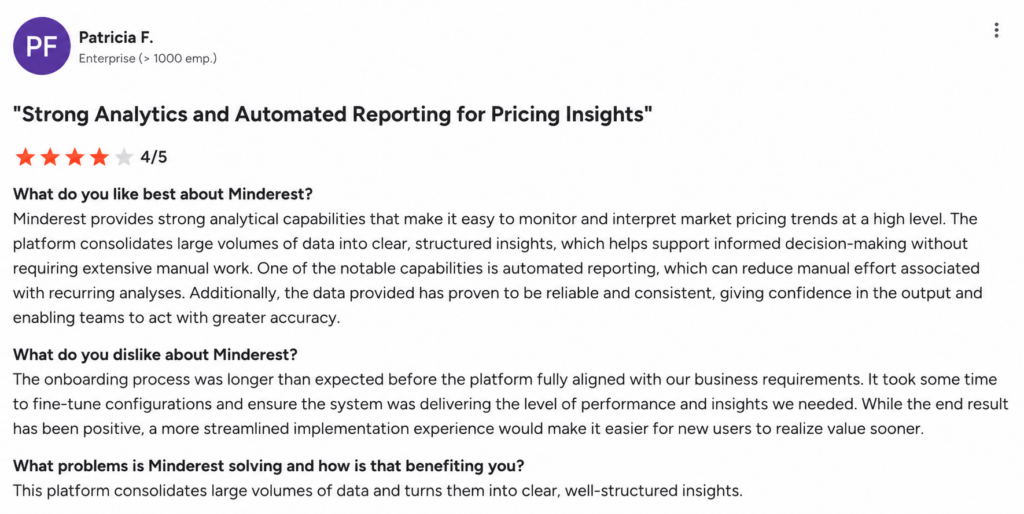
Public customer feedback commonly emphasizes the usefulness of having competitive information consolidated and accessible for pricing analysis. Product matching and the ability to work with extensive competitive datasets are particularly relevant strengths for enterprise users.
G2 Rating: 4.6 / 5 based on 4 G2 reviews, verified in September 2026.
3. DataWeave – Best for Competitive Pricing and Digital Commerce Intelligence
What Is DataWeave?
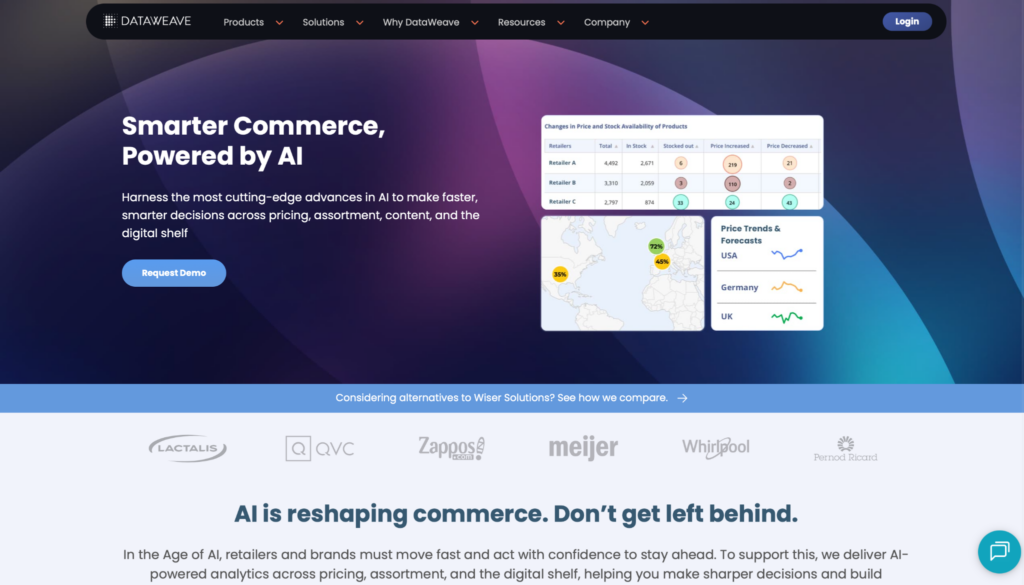
DataWeave is a digital commerce intelligence platform serving retailers and consumer brands that need visibility into how products, prices, assortments, and brands appear across online commerce environments. Its scope makes it an interesting Price2Spy alternative because competitive pricing intelligence forms part of a wider digital commerce picture. Instead of considering price entirely in isolation, organizations can analyze pricing alongside other ecommerce signals that influence competitive performance.
Why Consider DataWeave Instead of Price2Spy?
The primary reason to consider DataWeave is the need to connect competitive pricing to broader e-commerce data analysis. While pricing remains a critical factor, competitiveness in online retail can also depend on assortment gaps, product availability, promotions, content, and digital store design. For organizations operating in multiple e-commerce environments, analyzing these elements together can provide more context than just a price monitor.
DataWeave Key Capabilities
- Competitive price intelligence. Monitors and analyzes pricing across competing ecommerce environments.
- Product matching. Uses technology to identify equivalent products across retailer catalogs and listings.
- Assortment analytics. Helps organizations identify assortment differences and competitive gaps.
- Promotion intelligence. Provides visibility into promotional activity and competitive offers.
- Availability monitoring. Adds stock and availability context to competitive analysis.
- Digital shelf analytics. Extends intelligence beyond price into how products appear across ecommerce channels.
DataWeave Pros & Cons
| Pros | Cons / Considerations |
| Broader than price monitoring alone: Combines pricing with assortment and digital commerce intelligence. | Breadth may be unnecessary for simple monitoring:Businesses needing only competitor prices may not use the wider functionality. |
| Strong ecommerce orientation: Particularly relevant to businesses competing heavily through digital channels. | Not primarily a retail price optimizer: Competitive intelligence should not be confused with demand-based optimal price calculation. |
| Product matching capabilities: Important for analyzing large and inconsistent ecommerce catalogs. | Enterprise evaluation process: Organizations should expect a more consultative buying process than with lightweight monitoring software. |
| Useful to retailers and brands: Supports different competitive intelligence perspectives. | Potential organizational overlap: Multiple teams may need to coordinate how digital commerce intelligence is used. |
| Context around competitive prices: Assortment, availability, promotions, and digital shelf information can explain why price differences occur. | Total scope can increase implementation complexity:Broader intelligence requirements mean more decisions about coverage and data priorities. |
DataWeave Pricing
DataWeave uses a sales-led enterprise approach rather than presenting a simple universal public price list for all potential configurations. Pricing should therefore be requested directly based on the organization’s intended use case and coverage.
Catalog size, geographic reach, competitive set, required intelligence products, and the amount of ecommerce data being analyzed can all affect the practical scope of an implementation.
What Do DataWeave Customers Say?

Public customer evidence around DataWeave tends to focus on the value of obtaining structured ecommerce information at scale and gaining visibility into competitive markets that would otherwise be difficult to monitor manually.
G2 Rating: 4.4 / 5 based on 90 G2 reviews, verified in September 2026.
4. Dealavo – Best for Ecommerce Monitoring Combined With Automated Repricing
What Is Dealavo?
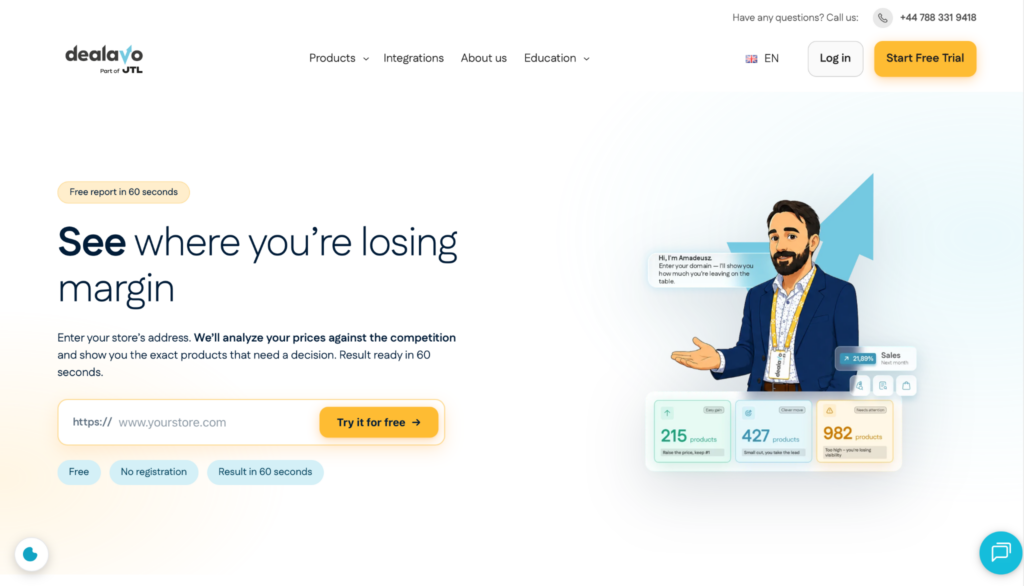
Dealavo is a price intelligence and repricing platform designed for ecommerce retailers, online sellers, and brands. Compared with the first alternatives in this ranking, its most important distinction is the connection between observing competitive prices and acting on that information through pricing automation.
The platform can collect competitive pricing information across online channels and help businesses understand their market position.
Why Consider Dealavo Instead of Price2Spy?
The main reason is to bridge the gap between competitive analysis and pricing. Monitoring informs e-commerce companies of changes in their competitive position. The repricing function can determine whether this change meets pre-defined response conditions and, if necessary, initiate appropriate price adjustments.
Dealavo Key Capabilities
- Competitor price monitoring. Collects competitive prices across relevant ecommerce environments.
- Automatic repricing. Supports automated price adjustments based on configured strategies.
- Rule-based pricing. Allows businesses to define conditions and guardrails governing automated decisions.
- Product matching. Connects the retailer’s products with corresponding competitor offers.
- Marketplace monitoring. Supports competitive visibility in marketplace environments.
- Price position analysis. Helps businesses understand their relative position against competitors.
Dealavo Pros & Cons
| Pros | Cons |
| Connects monitoring with repricing:Competitive data can lead directly to controlled pricing actions. | Competitor-led logic is not the same as optimization: Following market conditions does not necessarily determine the economically optimal retail price. |
| Useful for dynamic ecommerce markets:Automation can reduce manual workload where prices change frequently. | Requires carefully designed pricing rules: Poorly constructed automation can produce undesirable price movements. |
| Rule-based guardrails: Businesses can maintain greater control than with unrestricted automatic price matching. | Not every retailer needs frequent repricing: Stable categories may receive less value from automation. |
| Scalable monitoring: Relevant to sellers managing larger online catalogs. | Broader retail economics may require another layer: Demand, cross-elasticity, category relationships, and promotions can require more advanced optimization. |
| Monitoring and execution in a connected workflow: Reduces the operational gap between observing and responding. | Automation requires governance: Teams still need to decide which competitors matter and what commercial boundaries automation should respect. |
Dealavo Pricing
Dealavo’s commercial offering depends on the selected services and the scale of the monitoring or repricing requirement. Businesses should obtain a current quote directly from Dealavo rather than relying on third-party price estimates.
When comparing costs with Price2Spy, buyers should also consider whether they are comparing monitoring alone or a combination of monitoring plus automated repricing, since the functional scope is different.
What Do Dealavo Customers Say?
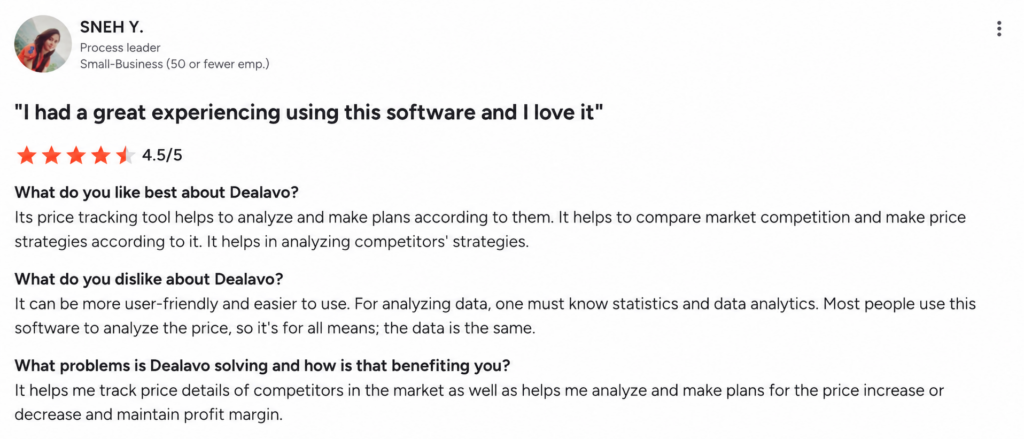
Public customer feedback commonly points to the practical value of automated competitor monitoring and reducing the amount of manual work involved in ecommerce price management. The connection between collected market information and repricing is especially relevant for teams dealing with large product catalogs.
G2 Rating: 4.3 / 5 based on 16 G2 reviews, verified in September 2026.
5. Skuuudle – Best for Managed Competitive Pricing Intelligence
What Is Skuuudle?
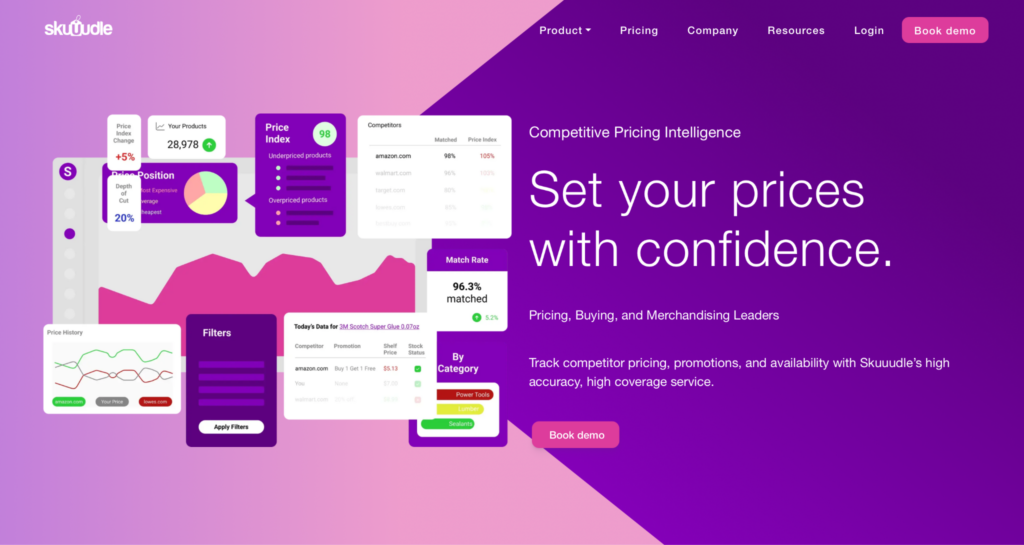
Skuuudle is a competitive pricing analysis platform designed specifically for retailers, distributors, and brands who require reliable competitive data without relying solely on internal processes to maintain data quality and product portfolio consistency. It is especially relevant for companies with a wide product range, where simply collecting specific prices is not enough: the information must be accurately collated, verified, and prepared for commercial use.
Why Consider Skuuudle Instead of Price2Spy?
Skuuudle deserves consideration when a business wants competitor monitoring but places particularly high importance on data quality, product matching, and managed intelligence. The central issue is that collecting prices is only the first stage of competitive intelligence. A retailer must also determine which products should be compared, maintain those relationships as catalogs change, identify exceptions, and ensure that commercial teams can trust the resulting dataset.
Skuuudle Key Capabilities
- Competitive price monitoring. Tracks competitor pricing across selected products and markets.
- Managed product matching. Combines technology and human-supported processes to establish useful product comparisons.
- Price intelligence. Converts collected competitor information into structured data for pricing decisions.
- Assortment intelligence. Helps organizations identify overlaps and differences between their own and competitors’ product ranges.
- Historical data. Allows pricing teams to examine competitive movements and patterns over time.
- Promotion visibility. Can provide context around competitor offers rather than treating every observed price as a permanent regular price.
Skuuudle Pros & Cons
| Pros | Cons |
| Managed competitive intelligence: Reduces the amount of monitoring and matching administration placed entirely on internal teams. | Less appropriate for businesses seeking a purely self-service tool: The managed approach may exceed the needs of smaller monitoring projects. |
| Strong focus on data quality: Useful when pricing decisions depend on trustworthy competitive matches. | Competitive intelligence remains the core use case: It should not be mistaken for comprehensive demand-based retail optimization. |
| Suitable for complex catalogs: Particularly relevant where maintaining product relationships manually would be difficult. | Potentially unnecessary for simple branded catalogs: Businesses with easy GTIN-based matching may not need extensive matching support. |
| Human expertise complements technology: Can help address ambiguous matches that automation alone may struggle to resolve. | Less immediate than plug-and-play monitoring: Enterprise requirements generally involve defining the required competitive dataset and scope. |
| Historical and market-level context: Enables analysis beyond isolated current prices. | Automation requirements should be evaluated separately:Businesses wanting direct automatic repricing need to determine whether another solution better fits that workflow. |
Skuuudle Pricing
Skuuudle follows a customized commercial model rather than publishing one universal subscription price applicable to every monitoring project. The scope of competitive intelligence can vary according to the number of products, competitors, markets, matching requirements, and the level of service required.
What Do Skuuudle Customers Say?

Customer evidence around Skuuudle frequently centers on the usefulness of reliable competitive data and the service element surrounding its delivery. This is consistent with the platform’s differentiation: its value proposition is not simply access to another dashboard but reducing the difficulty of obtaining structured, commercially usable competitor information.
G2 Rating: 4.8 / 5 based on 14 G2 reviews, verified in September 2026.
6. Competera – Best for Retail Pricing Analytics & Competitive Intelligence
What Is Competera?
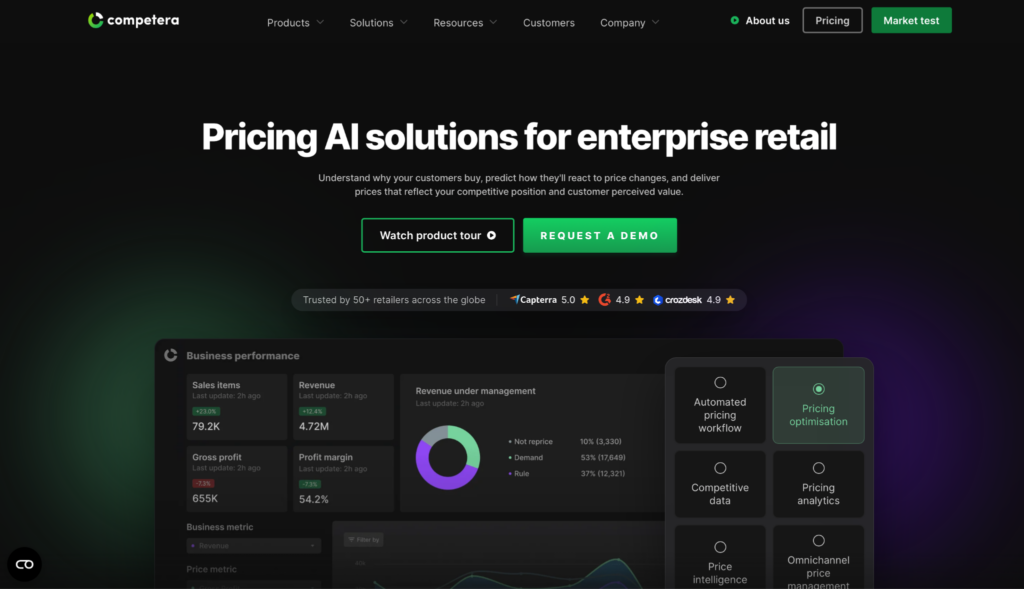
Competera is an artificial intelligence (AI)-powered retail pricing platform that helps retailers optimize pricing across a wide range of products. Instead of focusing solely on filtering out competitor prices, the platform combines competitive data with demand signals and other pricing factors to generate pricing recommendations and model the potential impact of pricing decisions on business.
Why Consider Competera Instead of Price2Spy?
Price2Spy is primarily centered around competitor price monitoring, price comparison, reporting, and repricing. Competera covers competitive pricing intelligence as well, but extends this into AI-powered price optimization.
This makes Competera relevant for retailers that need to determine not only what competitors are charging, but also what their own optimal prices should be based on demand drivers, business objectives, product relationships, and expected financial outcomes.
Competera Key Capabilities
- AI-powered price optimization. Uses AI and multiple demand drivers to recommend prices according to business objectives rather than relying exclusively on competitor prices.
- Competitive pricing intelligence. Tracks market pricing and competitive changes so retailers can incorporate competitor behavior into pricing decisions.
- What-if simulations. Allows pricing teams to test different pricing scenarios and estimate their potential business impact before implementing changes.
- Pricing strategy customization. Enables retailers to create different pricing approaches according to product roles, relationships, sales parameters, and strategic objectives.
- Smart product segmentation. Products can be dynamically categorized and assigned to appropriate pricing campaigns.
Competera Pros & Cons
| Pros | Cons |
| AI-powered price optimization beyond basic competitor tracking | More complex implementation than a straightforward monitoring tool |
| What-if simulations for evaluating pricing decisions | May be more functionality than businesses needing only competitor monitoring require |
| Supports large retail assortments and multiple channels | Pricing is not publicly disclosed |
| Strong pricing automation and analytics | Advanced AI capabilities can increase onboarding complexity |
| G2 reviewers highlight intuitive dashboards and integrations | G2’s review base is relatively small |
Competera Pricing
Competera does not publish standard pricing packages on G2. Pricing is available on request and final costs depend on the retailer’s requirements and implementation scope. G2 also states that the platform does not currently offer a free trial.
What Do Competera Customers Say?

G2 reviewers frequently highlight Competera’s real-time pricing intelligence, ease of use, integrations, and intuitive dashboard. One recent enterprise-oriented review also praised its scalability and AI-driven competitive pricing capabilities. The most consistent drawback identified by G2 is implementation complexity associated with the platform’s advanced functionality.
G2 Rating: 4.9 / 5 based on 14 G2 reviews, verified in September 2026.
7. Wiser Solutions – Best for Retail & Competitive Intelligence
What Is Wiser Solutions?
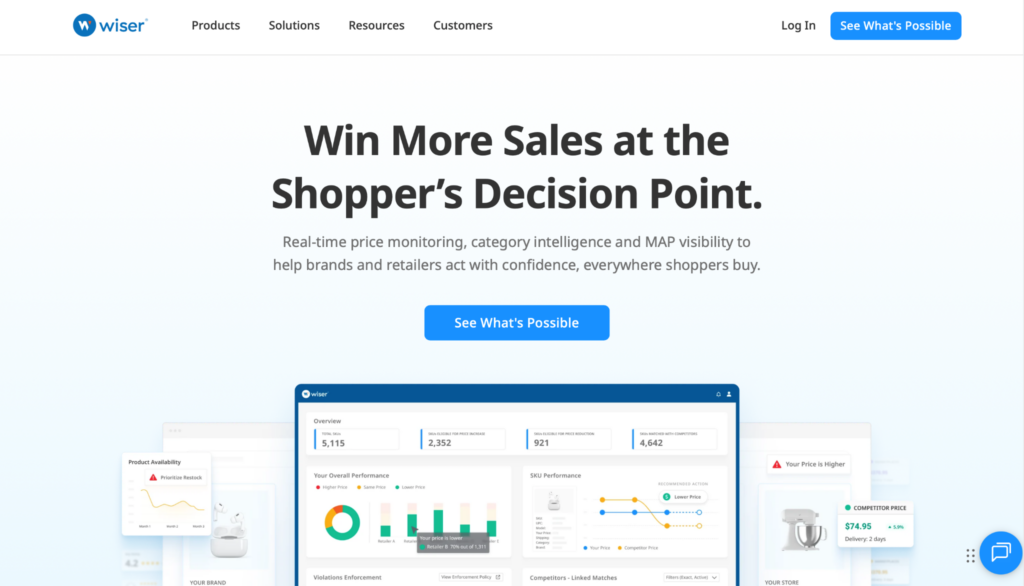
Wiser Solutions is a retail analytics platform designed for brands and retailers that combines online price analysis with broader store and retail management capabilities. The platform allows companies to monitor competitor prices across websites and marketplaces across their entire network. Wiser also offers minimum recommended retail price (MAP) monitoring, retail audits, on-shelf price analysis, and other tools designed to provide transparency across online and offline retail metrics.
Why Consider Wiser Solutions Instead of Price2Spy?
Wiser is worth considering when competitor price monitoring is only one part of a broader retail intelligence requirement. While Price2Spy focuses strongly on online price monitoring and repricing, Wiser combines pricing intelligence with MAP monitoring, marketplace visibility, retail auditing, and in-store intelligence. This can make it more relevant to brands and larger retailers that need to understand both online pricing and retail execution.
Wiser Solutions Key Capabilities
- Price Intelligence. Monitors competitor prices across retailer websites and marketplaces to identify market changes and support pricing decisions.
- MAP Monitoring. Helps brands identify Minimum Advertised Price violations across online sales channels.
- Competitive intelligence. Provides market data that brands and retailers can use to compare their pricing and positioning against competitors.
- Marketplace monitoring. Extends visibility across ecommerce marketplaces rather than limiting monitoring to individual competitor websites.
- Retail auditing. Collects information about physical retail execution, giving companies visibility beyond ecommerce.
Wiser Solutions Pros & Cons
| Pros | Cons |
| Combines pricing intelligence with broader retail intelligence | Can be more complex than a dedicated price-monitoring platform |
| Strong MAP monitoring capabilities | Some G2 reviewers report a steep learning curve |
| Covers online marketplaces and physical retail | User experience receives mixed feedback from reviewers |
| Suitable for brands as well as retailers | Implementation can require more effort for new users |
| Reviewers frequently praise customer support and actionable data | Pricing is not transparently published |
Wiser Solutions Pricing
Wiser does not provide a simple standardized public price for its broader enterprise retail intelligence offering. Companies generally need to contact Wiser to discuss their requirements and receive a quote.
What Do Wiser Solutions Customers Say?
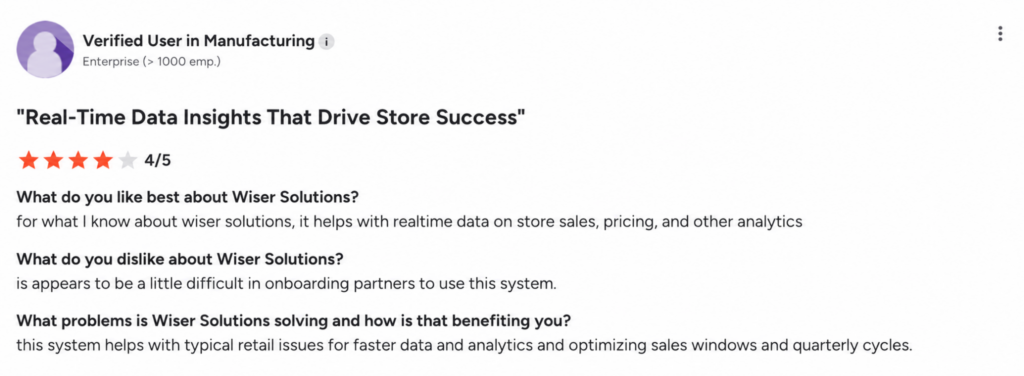
G2 feedback frequently mentions useful and actionable retail data, responsive customer support, and an interface that experienced users can use effectively for analysis. At the same time, some reviewers describe the platform as difficult for newcomers and point to a learning curve and implementation complexity.
G2 Rating: 4.3 / 5 based on 63 G2 reviews, verified in September 2026.
8. Omnia Retail – Best for Automated Dynamic Pricing

What Is Omnia Retail?
Omnia Retail is a retail pricing platform focused on dynamic pricing, price monitoring, and pricing automation for retailers and brands. Its Dynamic Pricing solution combines internal business data with external market information to automate pricing strategies. The platform is designed to support pricing operations ranging from relatively small assortments to enterprise environments with large catalogs, multiple markets, and multiple sales channels.
Why Consider Omnia Retail Instead of Price2Spy?
Omnia Retail is particularly relevant when a retailer wants to move from observing competitor prices to automatically executing a pricing strategy. Price monitoring remains part of the offering, but Omnia adds dynamic pricing, business-rule automation, pricing strategy management, and enterprise-scale execution. This makes the platform more suitable for businesses that want competitive data to feed directly into automated pricing decisions.
Omnia Retail Key Capabilities
- Dynamic Pricing. Automatically adjusts prices based on predefined strategies, business rules, market information, and other pricing inputs.
- Competitor price monitoring. Tracks competitor pricing to help retailers understand market movements and react accordingly.
- Pricing Strategy Tree. This is what provides a structured way to create, edit, review and analyze pricing strategies.
- Pricing automation. Reduces the manual workload involved in repricing large product assortments.
- Market analysis. Provides competitive market information that pricing teams can incorporate into decision-making.
Omnia Retail Pros & Cons
| Pros | Cons |
| Combines competitor monitoring with automated dynamic pricing | Advanced strategies can have a learning curve |
| Supports customizable pricing strategies | Some reviewers want greater customization |
| Suitable for large, multi-market retail operations | Can become complex for non-standard pricing strategies |
| Strong API/integration capabilities | Cost can be high for smaller businesses |
| Customer support is frequently praised on G2 | More extensive than necessary for basic price tracking |
Omnia Retail Pricing
Unlike the other three platforms, Omnia has some public pricing information on G2. Its SMB Pricing Solutions start at €399, while Enterprise Pricing Solutions require contacting the vendor. G2 states that the €399 pricing information was last updated in December 2024, so it should be treated as a starting price rather than a guaranteed current quote.
What Do Omnia Retail Customers Say?
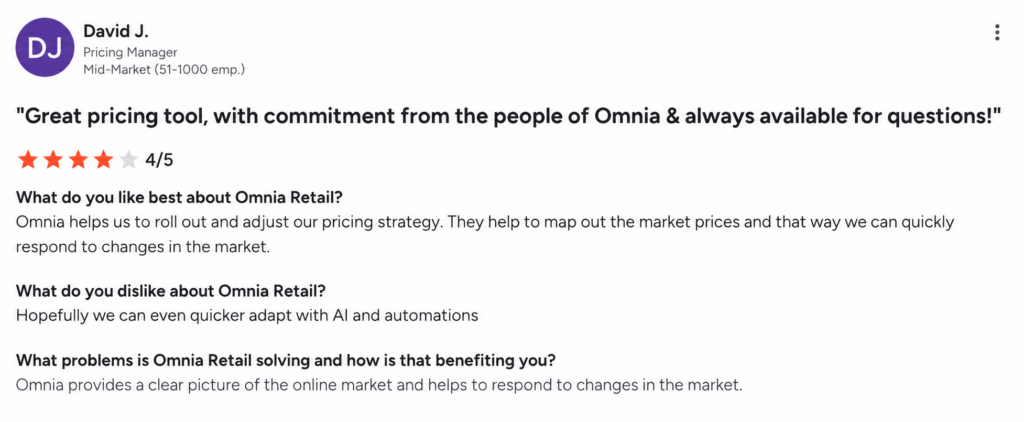
G2 reviewers commonly praise Omnia’s support, market insights, integrations, and ability to automate pricing strategies. Recent reviewers have highlighted the platform’s ability to map market prices and react quickly to market changes, as well as API-based data integration. Criticism tends to focus on the learning curve, limited customization in some areas, complexity of advanced pricing strategies, and cost.
G2 Rating: 4.4 / 5 based on 110 G2 reviews, verified in September 2026.
9. Intelligence Node – Best for AI-Driven Competitive Pricing Intelligence

What Is Intelligence Node?
IntelligenceNode is an AI-driven retail intelligence and pricing platform designed to help retailers and brands monitor competitors, analyze market conditions, and make data-driven pricing decisions. The platform combines competitive pricing intelligence with retail analytics and automated pricing capabilities, providing businesses with a centralized view of competitor and market data.
Why Consider Intelligence Node Instead of Price2Spy?
IntelligenceNode is relevant for companies that need broader retail intelligence and AI-driven pricing capabilitiesalongside competitor monitoring. Rather than using competitive prices primarily as information to monitor, IntelligenceNode can use market data to support pricing recommendations and automated repricing. Its broader retail intelligence capabilities also make it suitable for organizations managing large catalogs and complex competitive environments.
Intelligence Node Key Capabilities
- Competitive price intelligence. Provides visibility into competitor prices and market movements to support faster pricing decisions.
- Real-time competitor analysis. Helps businesses monitor changes in competitive positioning and respond to market developments.
- AI-driven pricing optimization. Uses market and pricing information to support optimized pricing decisions rather than relying solely on manual rules.
- Automated repricing. Supports automatic price adjustments in large product catalogs.
- Product matching. Matches comparable products across competitors so pricing teams can make meaningful price comparisons.
Intelligence Node Pros & Cons
| Pros | Cons |
| Real-time competitor pricing visibility | Advanced functionality creates a learning curve |
| AI-driven pricing optimization | Some reviewers report slow dashboard/report performance |
| Suitable for large product catalogs | Large amounts of data can feel overwhelming |
| Combines pricing with broader retail intelligence | May be excessive for companies needing simple price tracking |
| G2 reviewers generally praise its interface and competitive analysis | No transparent standard pricing |
Intelligence Node Pricing
IntelligenceNode uses scope-based custom pricing. According to the vendor information displayed by G2, pricing can depend on factors such as the number of SKUs, competitors and categories being tracked, data-refresh frequency, and translation requirements.
What Do Intelligence Node Customers Say?

G2 reviewers frequently highlight real-time visibility into competitor pricing, an intuitive interface, and the ability to make faster pricing decisions. Recent reviews specifically emphasize retail insights and real-time pricing intelligence. Negative feedback centers mainly on the learning curve, occasional slow performance, and the volume of data that users need to navigate.
G2 Rating: 4.5 / 5 based on 37 G2 reviews, verified in September 2026.
10. Multiply – Best for Marketplace and Multichannel Repricing

What Is Multiply?
Multiply is a dynamic pricing and repricing platform oriented toward ecommerce and marketplace sellers that need to adjust prices across highly competitive digital sales environments. Its strongest distinction in this ranking is its marketplace-first pricing use case. Marketplace competition operates differently from conventional competitor monitoring. Multiple sellers can compete for the same product, prices can change frequently, availability shifts continuously, and seller performance can influence commercial outcomes alongside price.
Why Consider Multiply Instead of Price2Spy?
Multiply deserves consideration when a business needs to move from watching marketplace competition to continuously managing prices within it. The fundamental difference is frequency and execution. Traditional competitive monitoring can work well when pricing teams have enough time to review market changes and respond manually. Marketplace environments can make that workflow increasingly difficult because sellers may change prices repeatedly and competition can vary by channel.
Multiply Key Capabilities
- Dynamic repricing. Automatically adjusts prices according to configured strategies and changing market conditions.
- Marketplace pricing. Designed for competitive environments where multiple sellers and frequent price movements make manual management difficult.
- Multichannel price management. This is what helps e-commerce companies coordinate pricing across different trading environments.
- Competitor-based strategies. Market prices can contribute directly to automated repricing logic.
- Pricing guardrails. Minimum prices and other commercial rules can limit undesirable automated movements.
- Automated execution. Reduces the need for pricing teams to implement individual price changes manually.
Multiply Pros & Cons
| Pros | Cons |
| Strong marketplace specialization: Particularly relevant to sellers operating in fast-moving online marketplaces. | Less relevant to offline-first retailers: Marketplace repricing solves a more specific problem than general retail price management. |
| Automates frequent price adjustments: Reduces manual workload in environments where competitive conditions change rapidly. | Repricing is not synonymous with optimization: Fast competitive reactions do not inherently account for demand elasticity or cross-product economics. |
| Supports multichannel operations: Useful when sellers need to coordinate pricing across several ecommerce environments. | Automation requires carefully defined boundaries: Poor guardrails can expose margins to unnecessary pressure. |
| Scales better than manual marketplace pricing:Particularly valuable for substantial online catalogs. | Marketplace requirements vary: Businesses should confirm support for the specific channels on which they sell. |
| Business rules can protect commercial objectives:Automated pricing does not have to mean simply chasing the lowest offer. | Not designed to solve every retail pricing problem: Promotions, markdowns, category relationships, and long-term price architecture may require broader software. |
Multiply Pricing
Multiply’s current commercial terms should be confirmed directly with the provider, particularly because requirements can vary according to sales channels, assortment size, integrations, repricing scope, and implementation complexity. Price comparisons with Price2Spy require additional caution here. Price2Spy and Multiply can occupy different stages of the workflow: one organization may primarily be purchasing competitive visibility, while another is purchasing technology intended to automate actual marketplace price execution.
What Do Multiply Customers Say?
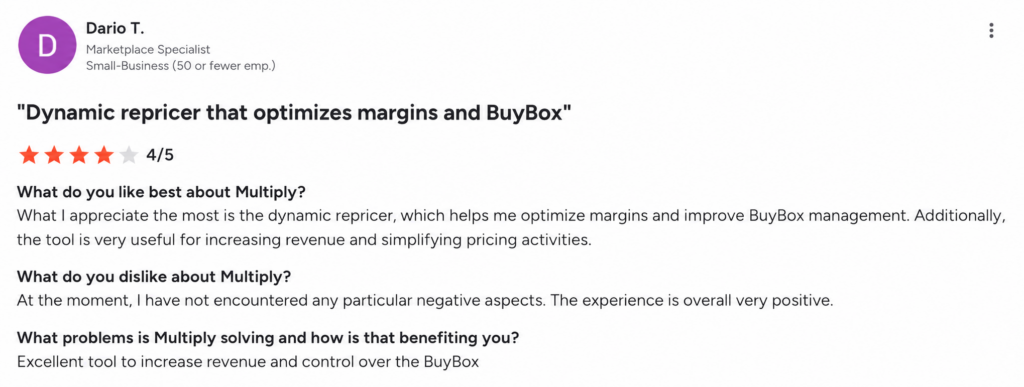
For Multiply, customer feedback is most useful when it addresses the realities of marketplace repricing at scale: automation reliability, ease of configuring strategies, integration quality, control over pricing rules, and reductions in repetitive manual work.
G2 Rating: 4.9 / 5 based on 29 G2 reviews, verified in September 2026.
How to Choose the Right Price2Spy Alternative
A retailer that primarily wants to know when competitors change prices needs a different solution from an ecommerce seller that wants prices automatically adjusted in response. A manufacturer monitoring reseller compliance has another set of requirements, while an enterprise retailer trying to optimize thousands of interconnected prices needs a substantially broader analytical environment.
Therefore, the selection process should begin with determining price and operating model. Data coverage, product fit, automation, integration, organizational scale, and cost are all important considerations, but their importance varies depending on the task at hand.
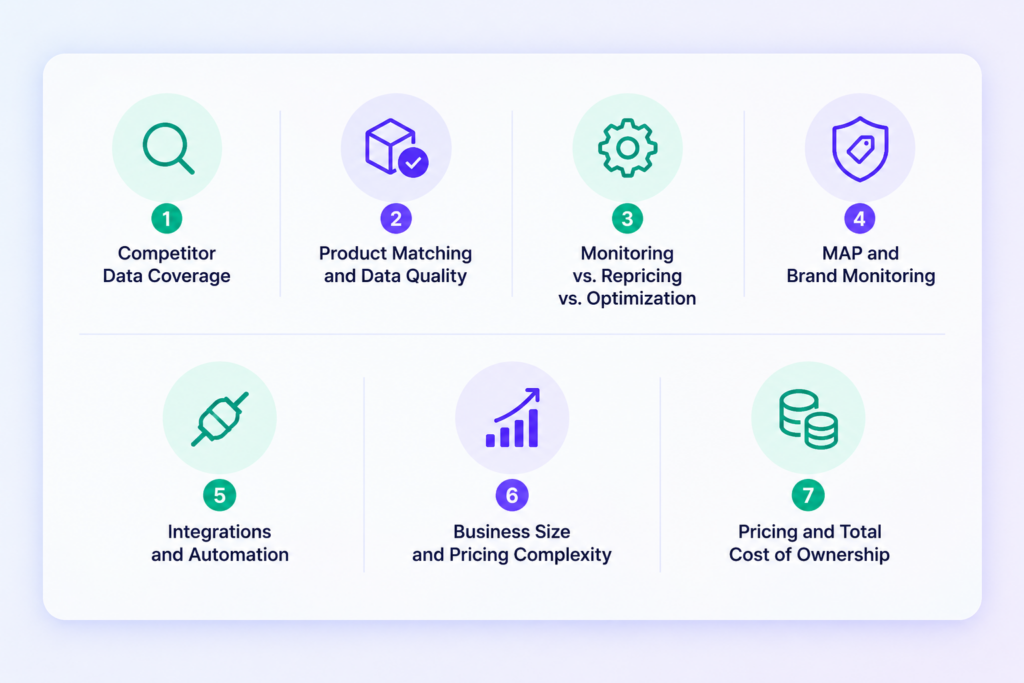
Competitor Data Coverage
Start by determining whether a platform can reliably observe the part of the market that actually influences your pricing decisions. A monitoring system can offer sophisticated analytics, but those analytics have limited value if important competitors, sellers, marketplaces, or countries are missing from the underlying dataset.
Product Matching and Data Quality
Product matching is one of the most important, and easiest to underestimate, elements of competitive price intelligence. If products are incorrectly matched, everything downstream can be misleading regardless of how sophisticated the dashboard or pricing algorithm appears. The simplest scenario involves identical branded products with standardized identifiers such as EAN, UPC, or GTIN. Identifier-based matching can make comparison relatively straightforward when the same code is consistently available across retailers.
Monitoring vs. Repricing vs. Optimization
This is arguably the most important distinction to understand before selecting an alternative because the terms are sometimes grouped together even though they solve fundamentally different problems. Monitoring asks: “What are competitors charging?” A monitoring platform collects external information and makes the competitive environment visible. More advanced approaches, such as yield management, also consider how changing demand can influence pricing decisions over time.
MAP and Brand Monitoring
Manufacturers and brands should evaluate Price2Spy alternatives differently from retailers setting their own consumer prices. Their central requirement may be distribution and reseller visibility rather than competitive repricing. Start with reseller identification. Determine whether the software can show which sellers are offering your products and whether it can distinguish known partners from potentially unauthorized sellers.
Business Size and Pricing Complexity
Company size matters, but pricing complexity is usually the more useful selection criterion. Retailers managing frequent campaigns may also require dedicated promotion software alongside their core pricing tools. Two businesses with similar revenue can require entirely different software because of their assortments, channels, organizational structures, and pricing objectives. Pricing complexity can increase further when retailers use mechanics such as multiple unit pricing across large assortments. Retailers managing seasonal or excess inventory may instead place greater emphasis on a structured markdown strategy. If one pricing manager handles a few thousand products, introducing a complex enterprise optimization environment could create more overhead than value.
Key Features to Look for in Price2Spy Alternatives
When comparing Price2Spy alternatives, it is worth looking beyond basic competitor price tracking. The right platform should support your specific pricing needs, whether that means collecting competitive data, automating price changes, or optimizing prices based on market conditions. Here are some of the key features to consider:
- Competitor price monitoring: Track competitor prices, product availability, promotions, and other market changes automatically across websites and marketplaces.
- Automated repricing: Create pricing rules that automatically adjust your prices based on competitor movements, inventory levels, margins, or other business conditions.
- MAP monitoring: Monitor Minimum Advertised Price compliance and quickly identify retailers or marketplaces selling products below agreed price thresholds.
- Pricing analytics: Use dashboards, reports, and price comparisons to understand your competitive position and turn market data into actionable pricing insights.
- Price optimization: Look beyond competitor prices with advanced algorithms or AI that help identify prices designed to balance competitiveness, demand, and profitability.
Price2Spy Alternatives by Use Case: Which Platform Is Best for What?
The best Price2Spy alternative depends primarily on why a business is considering another platform. A company looking for more advanced competitor monitoring has a very different requirement from a retailer that wants to optimize prices using demand and elasticity. Likewise, an ecommerce seller interested in automated repricing should evaluate different capabilities from a manufacturer concerned with MAP compliance and unauthorized sellers.
For this reason, the platforms listed below should not be viewed as interchangeable competitors, ranked from strongest to weakest. Each addresses different pricing challenges. The most important benefit of this comparison is the discussion of the main platforms that address the specific pricing challenge an organization faces.
| Business Need | Alternative to Evaluate | Why? |
| AI retail price optimization | Yieldigo | Goes beyond competitor monitoring by incorporating demand, elasticity, commercial objectives, rules, constraints, and broader retail economics into pricing decisions. |
| Enterprise pricing intelligence | Minderest | Provides broad competitive price and market intelligence for retailers managing extensive assortments and competitive sets. |
| Pricing + assortment intelligence | DataWeave | Combines competitive pricing with broader ecommerce intelligence, including assortment and other digital commerce signals. |
| Ecommerce monitoring + repricing | Dealavo | Connects competitor price information with automated pricing strategies and repricing workflows. |
| Managed competitive data | Skuuudle | Emphasizes product matching, data collection, validation, and managed competitive intelligence rather than leaving the complete data-quality process to internal teams. |
| AI pricing optimization | Competera | Combines competitive pricing intelligence with AI-driven price optimization, demand signals, business rules, and what-if simulations for enterprise retailers. |
| Retail + competitive intelligence | Wiser Solutions | Extends competitor price monitoring with MAP monitoring, marketplace intelligence, retail execution data, and broader online and in-store visibility. |
| Automated dynamic pricing | Omnia Retail | Combines competitor price monitoring with automated dynamic pricing, customizable pricing strategies, and multi-market pricing workflows. |
| AI competitive pricing intelligence | Intelligence Node | Combines real-time competitor monitoring and product matching with AI-driven pricing intelligence, retail analytics, and automated pricing capabilities. |
| Marketplace repricing | Multiply | Built around automated, multichannel marketplace pricing and frequent competitive price adjustments. |
Conclusion
There is no single Price2Spy alternative that fits every business. The right choice depends on what you need competitive pricing data to do. For some retailers, the priority is simply gaining a clearer view of competitor prices. Others need to turn that data into automated price changes, while more advanced pricing teams may be looking for broader optimization capabilities that go beyond competitor monitoring.
This makes it useful to think about Price2Spy alternatives in terms of the problem you are trying to solve, rather than comparing feature lists alone. If your main goal is straightforward competitor price tracking, dedicated monitoring platforms may be the most practical fit, including tools often considered among Prisync alternatives.
If your pricing needs have grown beyond monitoring competitors and reacting to market changes, however, it may be worth looking at platforms that combine competitive intelligence with pricing optimization. This is where Yieldigo can be a relevant option for retailers looking to make more data-driven pricing decisions across a complex assortment.
Frequently Asked Questions
What Is the Best Price2Spy Alternative?
There is no universal best Price2Spy alternative. The answer depends on the use case. For AI-powered retail price optimization, Yieldigo and Competera are relevant candidates in this comparison. For enterprise competitive intelligence, consider Minderest. Skuuudle is particularly relevant for managed competitive data and product matching, while Wiser Solutions combines competitive pricing intelligence with broader retail and MAP monitoring capabilities.
What Are the Main Price2Spy Competitors?
The Price2Spy alternatives covered in this comparison are Yieldigo, Minderest, DataWeave, Dealavo, Skuuudle, Competera, Wiser Solutions, Omnia Retail, IntelligenceNode, and Multiply. These platforms cover different parts of the pricing technology landscape, from competitor monitoring and retail intelligence to automated repricing and AI-powered price optimization.
Is Price2Spy a Price Monitoring or Price Optimization Platform?
Price2Spy is primarily positioned around competitor price monitoring and pricing intelligence, with additional functionality that can extend the workflow into areas such as repricing. Its product capabilities include competitor price monitoring, price-change alerts, reporting and analytics, marketplace monitoring, and automated repricing.
What Is the Difference Between Price Monitoring and Price Optimization?
Price monitoring observes the market; price optimization determines pricing decisions using a broader set of commercial variables. Price monitoring answers questions such as: What are competitors charging? Who has changed a price? Which seller is cheapest? How has our competitive position changed?
Price optimization asks a different question: What price should we set to best support our commercial objective?
Which Price2Spy Alternative Is Best for Large Retailers?
Large retailers should select a platform based on pricing complexity rather than company size alone. For enterprise-scale competitive intelligence, platforms such as Minderest, DataWeave, Wiser Solutions, and IntelligenceNode provide broader market and competitive visibility. When the requirement extends to AI-powered price optimization and automated pricing decisions, Yieldigo and Competera address a broader pricing optimization use case.
Which Price2Spy Alternative Is Best for MAP Monitoring?
For brands and manufacturers that require MAP and reseller monitoring, Wiser Solutions is one of the relevant candidates in this shortlist. Its capabilities extend beyond competitor price tracking to MAP monitoring and broader retail intelligence, helping brands monitor advertised prices and reseller activity across online channels.
Which Price2Spy Alternative Is Best for Automated Repricing?
For automated repricing, Dealavo, Omnia Retail, and Multiply are among the relevant alternatives in this comparison. The appropriate platform depends on the sales environment and pricing requirements. Ecommerce retailers may prioritize competitor monitoring, pricing rules, integrations, and catalog-scale automation, while marketplace sellers may place greater importance on rapid competitive price adjustments across channels. Competera is also relevant when the requirement extends beyond rule-based repricing toward AI-driven price optimization.
When Should Retailers Move Beyond Competitor Price Monitoring?
Retailers should consider moving beyond competitor monitoring when knowing market prices, or automatically reacting to them, no longer provides enough information to make effective pricing decisions. Common signals include large assortments, frequent price decisions, multiple stores or markets, complex product relationships, tight margin constraints, substantial promotional activity, markdown requirements, demand sensitivity, and the need for scenario planning.