
Unsold inventory ties up cash, takes up valuable shelf or warehouse space, and becomes harder to sell the longer it sits. According to AccountingTools, businesses commonly incur inventory carrying costs of around 20% of the cost of their inventory, including shrinkage, obsolescence, insurance, interest, taxes, warehouse costs and handling. That makes holding slow-moving stock expensive even before its selling price is reduced.
Of course, we mustn’t forget that price reduction isn’t free. In practice, we have to deduct the discount from gross profit. Therefore, the most difficult question for sellers (today) isn’t whether price reductions are truly necessary for specific products experiencing low demand. The key question is always how to keep the price low enough and understand when future price reductions are necessary.
That balance has become harder to get right. Product lifecycles are shorter, carrying costs are higher, and customers can compare prices almost instantly. A good markdown pricing strategy replaces last-minute clearance decisions with a plan, while Markdown Optimization can support more granular decisions around timing and markdown depth.
Given that this topic is truly complex and relevant today, we decided to prepare this guide for you. In it, we’ll examine the most essential and important pricing formulas (discounts), attempt to clearly demonstrate how to correctly determine terms and develop the best markdown pricing strategy, and, of course, retail discount schedules that you can adapt to your products in the future.
TL;DR
It’s important to understand that a proper strategy should help you quickly identify the weakest inventory (preferably early on), help you set minimum discounts (which will influence future demand), initiate the first price reduction (based on actual sales), and continually implement planned price changes, rather than making one abrupt price cut at the end of a season.
- what needs to be reduced? Of course, first and foremost, you should focus on products whose sales aren’t satisfactory, products for which you have too much inventory left (for example, several weeks’ worth), products approaching expiration dates, or products that are losing residual value. But remember that you can’t automatically reduce prices (especially for a high-priced product category at a time). Even though some of them may perform poorly,
- when you need to reduce prices for the first time? Try playing with performance triggers; don’t wait for a specific date. If you understand. If the situation is critical, the product is lagging far behind the sales figures you were hoping for, and you have absolutely no time to restore sales to full capacity, an early price reduction will be significantly cheaper than waiting for a favorable moment or a change in the situation for the better.
- how deep do you need to go? The right markdown percentage is the smallest reduction likely to generate enough additional unit sales to compensate for the margin sacrificed. Elasticity, remaining inventory, time to exit, competitive position, and minimum-margin constraints all matter.
- how often should you to step down? Set a cadence that matches the product lifecycle. Fast-moving seasonal or perishable goods may need frequent adjustments, while longer-life categories can leave more time between markdowns.
The financial impact can be substantial: McKinsey reports that well-executed markdown optimization can improve margin rates by 400 to 800 basis points (4-8 percentage points), reinforcing why decisions around which SKUs to mark down, when to act, and how deep to go matter far more than simply applying a blanket end-of-season discount.
What is markdown pricing?
Markdown pricing is a continuous reduction in the original retail price of goods, which should be affordable to all customers. The main goal of this process is to increase the speed of sales until the product ceases to have any commercial value.
Markdown pricing in retail only occurs when the seller is forced to specifically reduce the previously set price. When the original price of an item is, for example, 100€ and its fixed price is changed to 80€, the resulting difference (20€) is the actual price reduction, and in this case, the item is sold at the reduced price (80€).
While this may sound simple, in practice, such price reductions have a significant impact on sellers. Retailers rarely resort to price reductions without a reason (especially not because they want to make the product cheaper). This process is a response to commercial problems or changes in the residual value of the goods.
Common triggers include:
- excess inventory caused by overbuying;
- sell-through running below forecast;
- the end of a season;
- an upcoming range or model replacement;
- approaching expiry dates;
- competitor price movements;
- inaccurate demand forecasts.
The scale of these decisions can be substantial. A study on large-scale markdown pricing at Zalando reports that its production system operates across a catalog of millions of products, with markdown optimization contributing millions of euros in weekly profit improvements. This illustrates why markdown decisions increasingly need to respond to product-level demand and inventory signals rather than broad category assumptions.
Within the broader retail pricing lifecycle, markdowns also occupy a specific place:
Opening price – Promotions – Markdowns – Clearance.
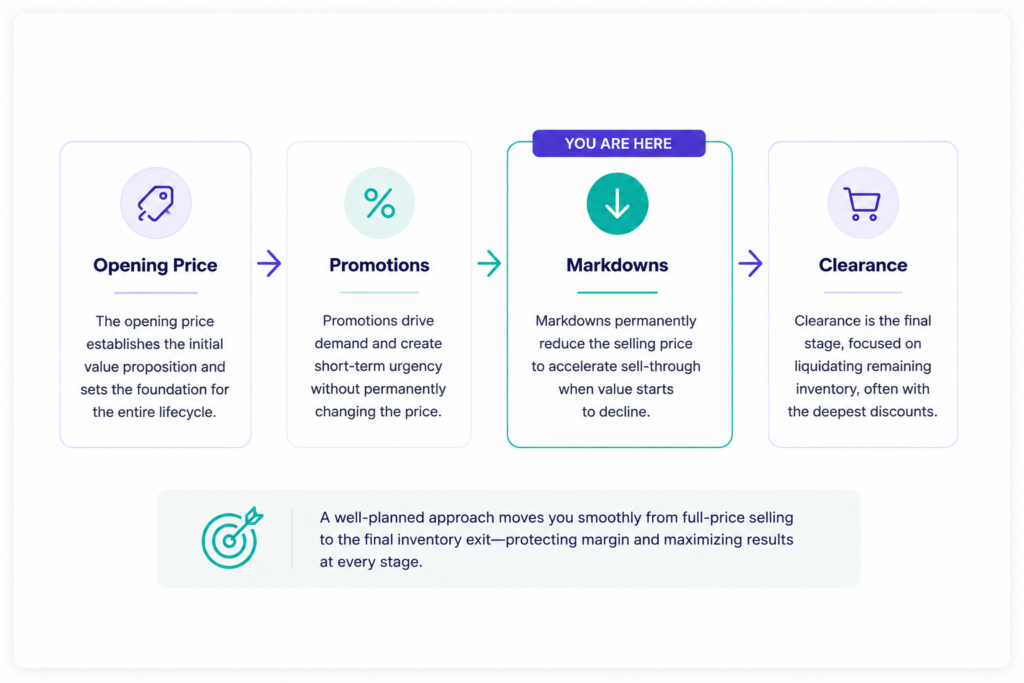
The opening price establishes the initial value proposition, while Price Management helps retailers manage pricing decisions across the broader product lifecycle. Markdown pricing, by contrast, changes the selling price itself. Clearance is normally the final and deepest stage, when getting the remaining stock out of the assortment becomes more important than preserving unit margin.
What is a markdown pricing strategy?
A markdown pricing strategy is a specific plan that determines which products will be subject to price reductions in the future, what triggers the price reduction process, how intense each price reduction project should be, and when the product should be discontinued.
A real-life scenario: A retailer wants to launch a seasonal sale (for example, a jacket). Initially, they planned to sell it at 100€. They have 1000 jackets in stock and aim to sell at least 70 percent of them by the end of the season. During the fifth week, they realize they’ve only sold 40 percent of the jackets, signaling that they’re significantly behind their original plan. Rather than wait until the previously planned seasonal sales, they decide to launch a 20 percent price reduction (now selling the jackets for 80€). If the situation is such that no significant changes occur within two weeks, he will repeat this process again and reduce prices to 60€, while moving the remaining inventory to a seasonal sale.
This markdown pricing strategy helps us avoid unplanned price cuts. Retailers don’t have to wait for excess inventory; they can now quickly understand which items need to be reduced, what performance signal to wait for to initiate the process, how it should proceed, and what to do if there are still items in the warehouse.
According to McKinsey, one retail transformation using product segmentation and a more adaptive approach achieved a 2-4% reduction in inventory and markdowns, showing why markdown decisions should be built into the product lifecycle rather than left until excess stock becomes obvious.
Without a defined retail markdown strategy, the default is often reactive: the season is nearly over, somebody notices that too much inventory is left, and the team responds with a broad price cut. By that point, demand may already have weakened enough that a much deeper reduction is required to move the remaining units.
A markdown pricing strategy should therefore sit inside the wider product lifecycle plan alongside the opening price and promotions. It is not something bolted onto the process when a product fails to sell. Planning markdowns from the beginning gives retailers a clearer path from full-price selling through the final inventory exit.
Types of markdown pricing
The main types of markdown in retail are seasonal, clearance, promotional, competitive, progressive, and expiry-driven markdowns. They differ mainly in what triggers the price reduction, how long it lasts, and how deep the reduction typically needs to be.
According to Shopify, reducing a product priced at 500$ to 300$ represents a 40% markdown; if that product costs the retailer 200$, gross profit falls from 300$ to 100$ per unit. This illustrates why different types of markdowns need different timing and depth rather than being treated as interchangeable price cuts.
Seasonal Discount
Seasonality is the most predictable issue, the end of the sales season. For example, you might see discounts on swimsuits in September or on winter jackets in March. Since these dates are already known in advance, this type of retail sales simply must be planned in advance. You can’t use it only if the season has already ended.
Real-life scenario: At the beginning of March, a retailer has 300 winter jackets left in stock, priced at 120€. They won’t wait until spring; they’ll immediately reduce prices by 20 percent to 96€, because these jackets are still in demand.
Clearance Discount
Clearance discounts are the most important and final price reduction process, applied to discontinued products or those that haven’t sold. The main cost of this stage is getting rid of the remaining unsold products, not maintaining sufficient margin per unit.
Real-life scenario: A furniture retailer has decided to discontinue a dining table priced at 500€, but only to free up warehouse space for a new collection. Since they have 25 tables remaining in stock, they need to apply a final discount of 50 percent to 250€. This will free up warehouse space for further work.
Promotional Discount
An auction discount is a temporary price reduction that should, in practice, increase demand for these products. Technically, we can consider this merely a promotion, rather than a price reduction for specific products, since in practice, the product price will return to its previous level after the promotion.
Real-life scenario: A store has decided to temporarily reduce the price of coffee from 4€ to 3€ for one week. The goal of this action is to increase store traffic and coffee sales. Once the promotion ends, exactly one week later, the price of coffee will return to its regular price, namely 4€.
Competitor Discounting
A competitor discounting is a response to a competitor’s price changes on similar products (or nomadic goods). Retailers try to use competitive pricing analysis to determine whether competitors’ actions are truly worth countering.
A real-life scenario: An electronics retailer sells high-power headphones for 150€, while competitors are selling the same headphones for 135€. The retailer conducts a thorough analysis of its profit margins and competitors’ positions before deciding to demonstrably reduce the price of its product to 19€, simply to remain competitive.
Progressive Price Reduction
This method uses a predetermined, gradual price reduction at set intervals. Instead of immediately switching from full price to sale price, the discount percentage on the product increases gradually. This method is very common among retailers in the apparel and food industries.
A real-life scenario: a clothing retailer has a dress for 100€, but it’s already selling below its target price. The price is initially reduced to 80€, then to 60€, and if inventory is still high, the dress will be reduced by 40€ at the end of the season (of course, only if inventory needs to be sold).
Price Reduction Based on Expiration Date
This method reduces the price of a product based on how close it is to its expiration date. Since the product’s expiration date is known in advance, price reductions are automated by retailers in advance according to predefined rules. This process makes pricing one of the most illustrative examples of rules-based pricing.
Real-life scenario: A grocery store sells a salad for €5, but only 3 days remain until its expiration date. The price will automatically be reduced to €4 (three days before the expiration date), €3 (two days before the expiration date), and €2 (on the last possible day of sale). This will increase the likelihood of selling the item before it’s no longer available.
| Type | Duration | Typical trigger | Typical depth |
| Seasonal markdown | Until seasonal inventory is cleared | Approaching or reaching the end of a season | Increasing reductions as the season ends |
| Clearance markdown | Final | Product discontinuation or terminal stock | Deepest markdown |
| Promotional markdown | Temporary | Planned need to create a demand spike | Limited, temporary reduction |
| Competitive markdown | Depends on competitor pricing | Competitor price move on a comparable or key-value item | Enough to restore competitive positioning |
| Progressive (stepped) markdown | Multiple planned intervals | Inventory remains after each planned step | Increasing reduction at each step |
| Expiry-driven markdown | Until sell-by date | Product approaching expiry | Increasing reduction as expiry approaches |
Markdown vs. discount: what’s the difference?
A markdown is a permanent price reduction available to everyone, while a discount is temporary and is often limited to a particular customer segment, promotion, coupon code, or period.
The two terms are often used interchangeably, but they represent different pricing decisions. A retail markdown changes the selling price of an SKU because the retailer needs to move inventory or respond to a change in its commercial value. A discount temporarily changes what a customer pays without necessarily changing the product’s underlying ticket price. Managing these decisions consistently becomes especially important when retailers evaluate their broader retail pricing tools and processes.
| Markdown | Discount | |
| Duration | Permanent | Temporary |
| Who gets it | All customers | Often a specific segment, promotion participant, or code holder |
| Primary goal | Accelerate sell-through and clear inventory | Generate demand, traffic, conversion, or incremental sales |
| Does the SKU return to full price? | No | Usually yes |
| Typical owner | Merchandising, pricing, or inventory team | Marketing, trade, or promotions team |
This difference is only significant from an operational perspective. Available price reductions will trigger a reduction in available inventory margins and will subsequently impact the economics of remaining merchandise.
On the other hand, promotions are planned solely within the framework of a sales or marketing budget, and these, in turn, have clear start and end dates. It’s important to approach price reductions correctly, both as a promotional tool and as the most common and easily made mistake in retail sales. These decisions must be coordinated; they cannot be interchanged. You can find the information available to us in our promotion management guide.
Why retailers use markdown pricing: the business case
Retailers typically use price-cutting strategies to convert slow-selling merchandise back into cash, reduce inventory costs, make assortment management easier, and protect overall portfolio margins. The primary goal of this process isn’t to sell as much of a necessary product as possible, but to extract the highest profit from it in the future before prices have to be reduced further.
According to MetricHQ, inventory carrying costs typically account for 15-30% of total inventory value, including storage, insurance, taxes, capital costs, and the risk of spoilage or obsolescence. This makes slow-moving stock progressively more expensive to hold and strengthens the business case for acting before excess inventory loses even more value.
A markdown reduces the gross margin earned on each unit, but waiting can be even more expensive. Unsold inventory ties up capital, accumulates holding costs, and loses value over time. Predictive pricing analytics can help retailers weigh these costs against expected demand and determine whether an earlier price reduction is justified.
Inventory clearance and working capital recovery
Every unsold unit represents working capital sitting on a shelf or in a warehouse. Deloitte describes inventory as the single largest investment in working capital for many businesses and notes that days inventory outstanding measures how quickly that investment can be converted back into sales. A well-timed inventory markdown accelerates that conversion, releasing cash that can be used for the next buy rather than remaining tied up in ageing merchandise. According to Deloitte’s “DIO: 4 Ways to Make Working Capital Work Smarter, Not Harder”, effective inventory management requires visibility into excess stock and the factors driving inventory levels.
A real-life scenario: A homeware retailer has 1200 outdoor dining sets left as summer demand begins to slow. Rather than holding the stock until next season, the retailer introduces an early markdown to accelerate sell-through and free up cash for the autumn assortment.
Cutting the cost of carrying inventory
Inventory does not become cost-free once it reaches the warehouse. Storage, handling, insurance, shrinkage, capital costs and obsolescence continue accumulating for as long as the product remains unsold. According to AccountingTools’ “Inventory Carrying Costs” guide, an inventory carrying cost of around 20% of inventory cost per year is common, which means waiting for a higher selling price can become progressively less attractive as stock ages.
A real-life scenario: An electronics retailer has 500 units of an older television model sitting in its warehouse while a replacement model is already available. A controlled markdown may sacrifice some unit margin, but it can reduce the storage and carrying costs that would continue to accumulate if the stock remained unsold.
Managing product lifecycle transitions
Old and new products do not sell independently when they occupy the same assortment. Research into product cannibalization specifically measures how demand for one product can reduce demand for another. The study “Brand-Pack Size Cannibalization Arising from Temporary Price Promotions”, published in the Journal of Retailing, examined 12 grocery product categories and found that, on average, 22% of the sales uplift for a promoted pack size came at the expense of other pack sizes of the same brand. The practical implication for lifecycle transitions is straightforward: leaving an ageing range beside its replacement can shift demand between products rather than allowing the new range to establish clean full-price sales.
A real-life scenario: A retailer is preparing to launch a new generation of wireless headphones while significant inventory of the previous model remains. Marking down the older model before the launch helps clear residual stock and reduces the risk that its lower price will draw demand away from the new full-price product.
Overall margin protection across the portfolio
The objective of markdown sales is not to maximize the margin of every individual SKU. It is to protect total gross margin across the assortment. Sometimes that means accepting a smaller, earlier reduction on a weak SKU rather than allowing excess stock to create a much larger clearance problem later. According to Deloitte’s MarkdownEdge, retailers can give away 5-10% more margin than necessary during clearance sales, while the solution has delivered a 5-15% increase in cash gross margin through improved markdown pricing and timing decisions.
In this case, the fixed end date of the price reduction season serves as a so-called signal, directing retailers to what’s on their calendars rather than what’s already been happening in the marketplace. Using current sales volumes, inventory levels, and product lifecycle monitoring, such as the so-called trigger, allows for rapid price reductions. A more comprehensive approach will be described in the guide to dynamic pricing.
A real-life scenario: A fashion retailer sees that one group of winter jackets is falling behind its sell-through target while the rest of the category is performing as planned. Instead of applying a 30% end-of-season discount across all jackets, it marks down only the underperforming SKUs earlier and leaves stronger sellers at full price, protecting more margin across the assortment.
Common markdown pricing mistakes to avoid
The most common and costly markdown mistakes that can occur in pricing stem from several factors. For example, these consequences arise from taking action too late, applying the same conditions to the entire product range, ignoring interactions between products, confusing discounts and promotions, planning discounts separately from the overall pricing cycle, or relying on manual decisions at a scale where SKU-level assessments are completely meaningless.
Initiating discounts too late
A very common mistake occurs: retailers implement discounting after the product range has lost much of its appeal to customers. To avoid such situations, it is necessary to implement the price reduction process when sales volumes are not meeting plan targets, but there is still time for a small discount to positively impact demand.
Using flat percentage rules across all SKUs
Applying the same markdown percentage to every SKU is easy to execute but ignores differences in elasticity, remaining inventory and residual value. Price Optimization allows pricing decisions to reflect these differences rather than relying on a blanket category-wide rule.
Ignoring cross-product cannibalization
Price reduction is more likely to increase demand than to create it. A very sharp price cut on an outdated item can significantly slow sales of its replacement, or, for example, a price reduction on a specific color or size can significantly distract customers from similar options. This is why retailers must carefully evaluate the impact of discounts on specific items within the assortment, not just the discounted item.
According to a study published in the Journal of Retailing, an average of 22% of the sales uplift generated by a promoted pack size came at the expense of other pack sizes of the same brand. The study also found cross-pack cannibalization in 74% of the frequently promoted products analyzed, showing how easily a price reduction can redistribute demand rather than create genuinely incremental sales.
Treating markdown as a promotional tool
Repeated markdowns used simply to stimulate demand can train customers to wait for lower prices and gradually weaken the product’s reference price. A retail markdown should solve an inventory or lifecycle problem, while temporary demand-generation activity belongs in the promotional plan.
Research published in the Journal of Marketing Theory and Practice found that repeated discounting can lower consumers’ internal reference prices, with deeper discounts producing lower reference prices than shallower discounts even when the latter were offered frequently. This helps explain why repeatedly using markdowns to stimulate demand can make the regular price progressively harder to sustain.
Planning markdowns in isolation
Markdowns cannot work properly when they are decided separately from opening prices, promotions and the next inventory buy. Promotion Analytics can help teams evaluate promotional performance alongside these pricing decisions. If a category repeatedly requires heavy markdowns, the underlying problem may be the buying plan rather than the markdown strategy itself, so results should feed directly into future assortment and purchasing decisions.
Managing markdowns manually at scale
Planning discounts for every product in millions of stores and thousands of retail outlets quickly became beyond the merchandising department’s capabilities, as it was no longer always feasible to do so on a regular basis. In this situation, the team must rely on specific rules for certain product categories, significantly compromising accuracy at the individual product and store level, potentially risking profit loss.
How to calculate markdown pricing
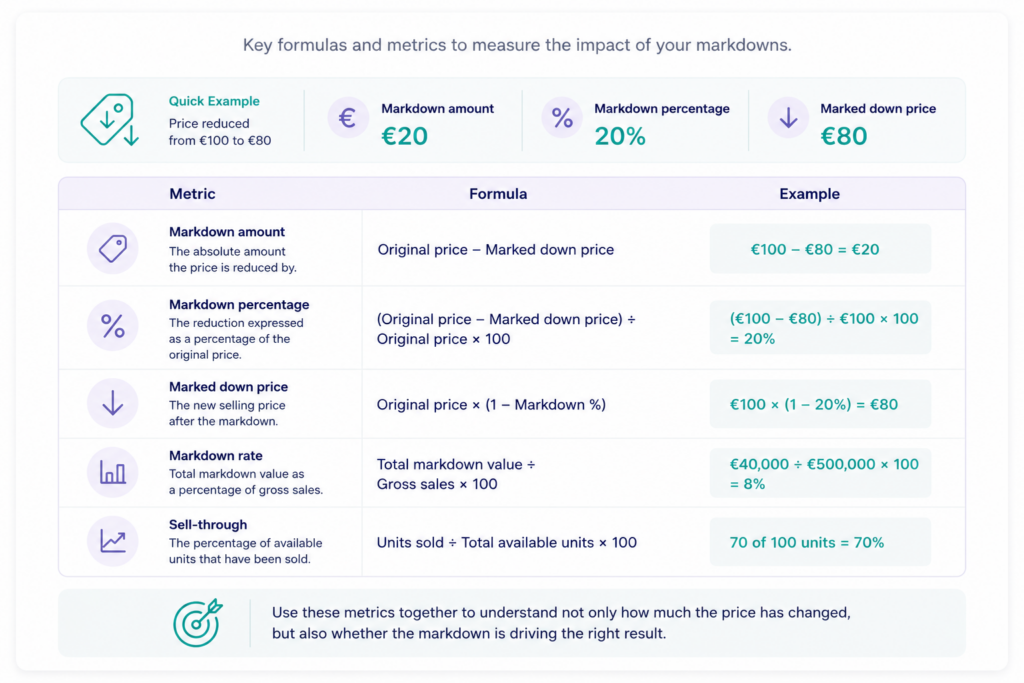
To calculate a markdown, subtract the new selling price from the original price. To find the markdown percentage, divide that difference by the original price and multiply by 100. A product reduced from 100€ to 8€ therefore has a 20€ markdown, or 20%.
Markdown pricing formulas
- Markdown amount = Original price − Marked-down price
- Markdown percentage = (Markdown amount ÷ Original price) × 100
- Marked-down price = Original price × (1 − Markdown percentage)
- For example, if the original price is €100 and the new selling price is €80:
Markdown amount = €100 − €80 = €20
Markdown percentage = (€20 ÷ €100) × 100 = 20%
Marked-down price = €100 × (1 − 0.20) = €80
The basic markdown pricing calculations are simple, but each metric answers a different question. Markdown amount and percentage show how much the price has changed, while sell-through and weeks of supply help determine whether that lower price is clearing inventory quickly enough.
| Metric | Formula | Example |
| Markdown amount | Original price – Marked down price | €100 – €80 = €20 |
| Markdown percentage | (Original price – Marked down price) ÷ Original price × 100 | (€100 – €80) ÷ €100 × 100 = 20% |
| Marked down price | Original price × (1 – Markdown %) | €100 at 30% off = €70 |
| Markdown rate | Total markdown value ÷ Gross sales × 100 | €40,000 ÷ €500,000 = 8% |
| Cumulative markdown | (Original price – Current price) ÷ Original price × 100 | €100 – €60 = 40% |
| Sell-through | Units sold ÷ Total available units × 100 | 70 of 100 units = 70% |
| Weeks of supply | Units on hand ÷ Average weekly unit sales | 120 ÷ 20 = 6 weeks |
One reporting rule is especially important: cumulative markdown is always calculated from the original ticket price.If an item moves from 100€ to 80€ and later to 60€, its cumulative markdown is 40%. The reductions should not be stacked from one reduced price to the next.
Markdown money is a separate concept. It is a supplier allowance that offsets part of the retailer’s markdown, usually through a credit, discount or chargeback. For example, if a retailer takes a 20€ markdown and receives 5€ per unit from the supplier, the customer still gets the full 20€ reduction, but the retailer’s effective margin impact is lower.
According to Deloitte’s MarkdownEdge, retailers can give away 5 – 10% more margin than necessary during clearance sales. This highlights how seemingly small differences in markdown depth can have a substantial financial impact when applied across large volumes of inventory.
Deloitte also reports that improved markdown pricing and timing decisions can deliver a 5-15% increase in cash gross margin. The figures reinforce why retailers need to measure the economic impact of each reduction rather than treating markdowns simply as a mechanism for clearing remaining stock.
The break-even test: will this markdown pay for itself?
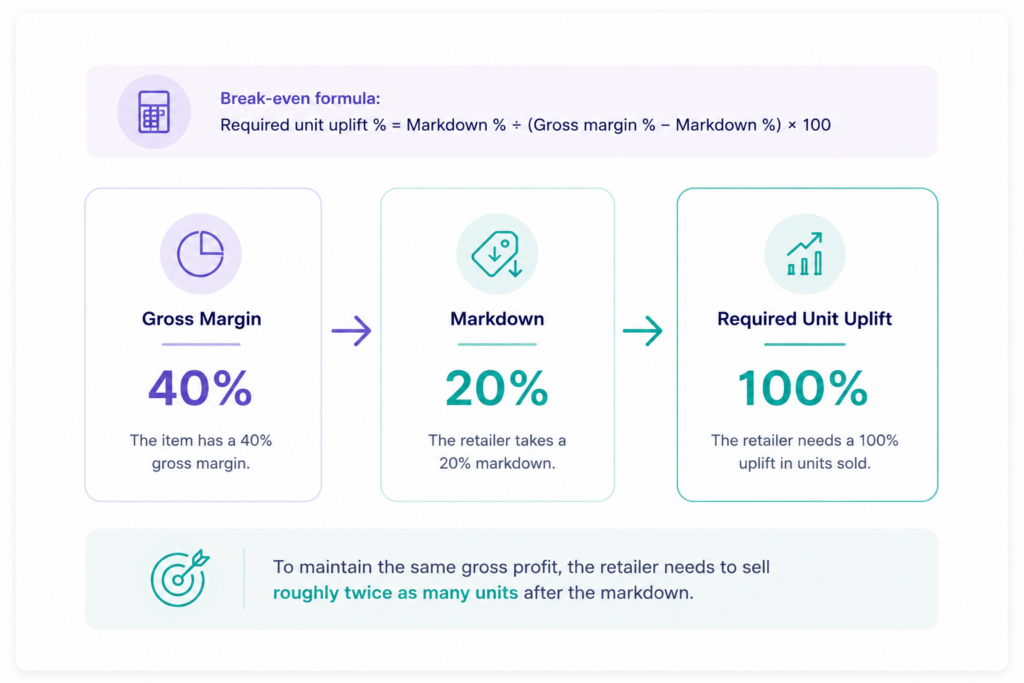
A markdown pays for itself only when the additional unit sales generated by the lower price compensate for the gross margin sacrificed on each unit. Required unit uplift % = Markdown % ÷ (Gross margin % – Markdown %) × 100 Suppose an item has a 40% gross margin and the retailer takes a 20% markdown: 20% ÷ (40% – 20%) × 100 = 100%. The retailer therefore needs roughly a 100% uplift in units sold, twice as many units, to maintain the same gross profit.
This break-even calculation is useful because it turns the question from “Can we afford a 20% markdown?” into “Can a 20% lower price realistically double unit sales?” If the required uplift is not achievable, the proposed reduction may destroy more margin than the additional volume can recover. This trade-off between price, demand and revenue is also central to yield management pricing.
What markdown percentage is too deep?
There is no universal maximum markdown percentage. A markdown becomes too deep when the additional unit sales required to compensate for the lost margin are no longer realistically achievable.
The appropriate depth depends on gross margin, price elasticity, remaining inventory, residual value and the time available to sell. As a practical reference point, an initial seasonal apparel markdown might start around 20 – 30%, while terminal clearance can reach 50 – 70% or more when inventory exit becomes more important than unit margin. These ranges are starting points rather than rules; the break-even test and the SKU’s actual response should determine whether another reduction makes sense.
Markdown pricing example: one SKU, start to finish
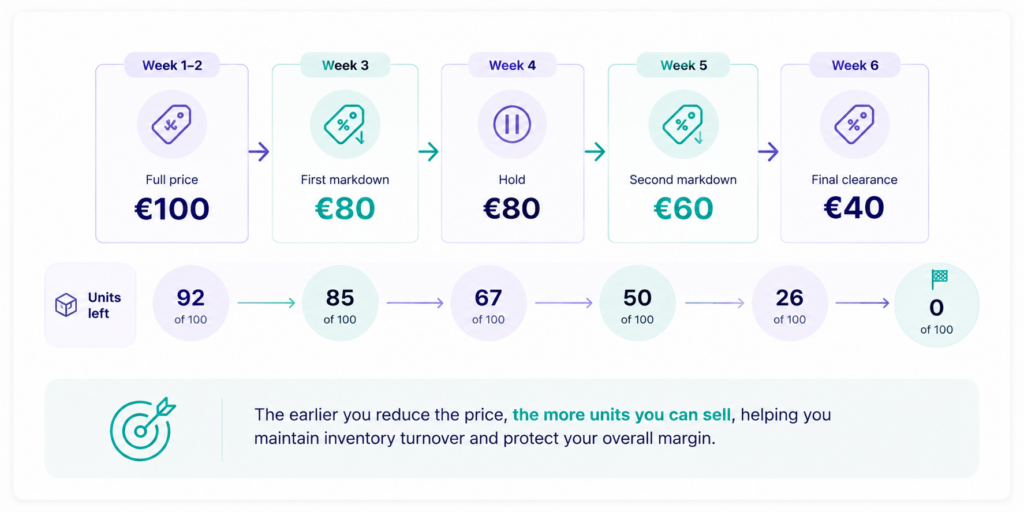
A progressive markdown pricing example shows why timing matters as much as depth: an earlier reduction on a weak SKU can generate sell-through while meaningful demand remains, instead of forcing a much deeper cut on large residual inventory later. Consider one seasonal style originally priced at 100€, with a unit cost of 60€ and 100 units available.
| Week | Action | Price | Cumulative markdown | Units sold | Units left | Gross margin |
| 1 | Full price | €100 | 0% | 8 | 92 | 40% |
| 2 | Full price | €100 | 0% | 7 | 85 | 40% |
| 3 | First markdown | €80 | 20% | 18 | 67 | 25% |
| 4 | Hold | €80 | 20% | 17 | 50 | 25% |
| 5 | Second markdown | €60 | 40% | 24 | 26 | 0% |
| 6 | Final clearance | €40 | 60% | 26 | 0 | -50% |
The example illustrates the trade-off clearly. A weak colorway identified in week 3 receives an early 20% reduction while customers still have time and reason to buy it. Waiting until week 5 to apply one blanket markdown across the whole style would leave more units competing for demand and could force the retailer to move directly to a deeper cut.
How to build a retail markdown strategy
To build a retail markdown strategy, define the objective first, segment inventory by performance, establish sell-through triggers, pre-plan the markdown schedule, localize decisions by store, test alternatives to permanent price cuts, coordinate markdowns with Promotion Management, and feed the results into future pricing and buying decisions.
1. Try to initially develop clear KPIs and goals for the price reduction strategy you plan to use in your business
This can be done as follows. You need to set one primary goal that is tied to the specific product group for which you want to offer discounts. These goals could include, for example, clearing out inventory at the end of its shelf life, restoring working capital, protecting your business’s gross profit, or freeing up warehouse space. After that, you need to define KPIs that will allow you to track success, including the percentage of these processes being completed, the discount rate, and the gross profit after price reductions for specific products: the number of weeks of inventory remaining, and the number of units in stock. Failure of this process is only likely if attempts are made to implement all processes simultaneously. Price reduction is carried out to clear remaining inventory, and this process will differ significantly from a price reduction process designed to protect the company’s profits.
2. Try to segment your inventory rather than reducing prices by category.
Try to group SKUs by age, by their sales rate compared to your plan, by the number of weeks of inventory, elasticity, and residual value of the items. The problem is that two products in the same category can have significantly different demand curves, making the same price reduction strategy in retail inappropriate for them, as this could lead to excessive discounts on some products and insufficient discounts on others.
The impact of this more selective approach can be significant. In a markdown optimization case study by The Parker Avery Group, a specialty retailer with more than 800 stores used item and store-level inventory analysis to identify products at risk of remaining unsold at the end of the season. The resulting markdown decisions delivered approximately 20% higher sell-through, a 15% increase in revenue, and a 2x improvement in margin for markdown-eligible items.
3. Trigger markdowns on sell-through, not the calendar
Define the condition that opens the first markdown in advance. For example, the trigger might be sell-through below a target percentage by week N, or weeks of supply exceeding the number of selling weeks remaining.
Expert insight: “At best-in-class retailers, merchants and planners run scenario analyses to determine the timing and frequency of markdowns.”
McKinsey notes that these retailers typically introduce markdowns in phases, beginning with a smaller reduction and lowering the price further depending on subsequent performance. This supports a planned, performance-led markdown schedule rather than a single predetermined end-of-season discount.
The first markdown is the highest-leverage decision in the sequence because waiting reduces the time available for a smaller cut to work. The failure mode is automatically waiting for an arbitrary end-of-season date even when the SKU has been falling behind plan for weeks.
4. Plan your retail markdown schedule in advance
Set the reduction steps, intervals between them and terminal action before the first markdown is taken. A retail markdown schedule gives teams an agreed path to follow instead of reopening the same pricing debate every time inventory is reviewed.
Cadence should follow lifecycle length. The failure mode is applying the same timing to products that have fundamentally different selling windows.
Markdown timing schedule example
The following schedule is a starting template, not a universal rule. Actual triggers and markdown percentage should be calibrated against each retailer’s own sell-through patterns, elasticity data, margins and inventory objectives.
| Category | Typical lifecycle | First markdown trigger | Step 1 | Step 2 | Step 3 / exit |
| Fast fashion | ~ 60 days | Sell-through behind plan early in lifecycle | 20% | 40% | 60% / clearance |
| Seasonal apparel | One season | Sell-through behind plan with season end approaching | 20 – 30% | 4 – 50% | 60%+ / clearance |
| Consumer electronics | ~ 12 months | Slowing velocity or replacement model approaching | 10 – 15% | 20 – 30% | Clearance / exit |
| Home and hardlines | Long lifecycle | Excess weeks of supply or space requirement | 10 – 20% | 30 – 40% | Clearance / transfer |
| Grocery | Days to weeks depending on product | Sell-through insufficient relative to remaining shelf life | 10 – 20% | 30 – 40% | Deep reduction / exit before expiry |
5. Localize your markdown strategy by store attribute
Cluster stores by climate, demographics, format and actual sell-through, then vary markdown timing and depth between those clusters. A winter coat that has stopped moving in Málaga may still sell at full price in Helsinki, so applying the same markdown strategy to both stores can sacrifice margin unnecessarily.
The financial impact of localization can be substantial. According to a MathCo case study of a multinational grocery retailer, replacing rigid markdown rules with dynamic pricing at the product-store level resulted in an approximately 3x increase in recovered revenue, an 8% increase in profit margins, and around 750000$ in annual savings on excess inventory holding costs. The results show why markdown timing and depth should reflect local inventory and demand rather than a single network-wide rule.
The failure mode is assuming geographic consistency simply because stores carry the same SKU. Local demand should determine whether stock needs a markdown, transfer or no intervention at all.
6. Try to use different pricing strategies when discounting.
The problem is that certain product bundles, “buy one and get one free” offers, and accessory combinations can have a significant impact on inventory sales even without implementing a fixed price adjustment process. Such systems are very useful when there are specialty products and the retailer wants to independently stimulate sales before initiating a policy of permanent price reduction.
The downside, in this case, is that when using these alternative solutions, the availability of these products across the entire assortment is not checked. No bundle will effectively solve the problem of excess inventory if the accompanying product becomes a factor limiting the promotion.
7. Try to coordinate promotions and subsequent purchasing elements, and only then will it provide the desired results.
Always check for potential cannibalization before publishing discounts and coordinate decisions with planned promotions, incoming inventory, or initial prices. At the end of a sales period, it’s crucial to compare actual sales volumes, margins, and ending inventory with the initial planned figures and use these results as input for future purchasing for the following season.
In this situation, the solution may be to view discounting as the end of a process. Let’s imagine a recurring product category consistently ends up with excess inventory. In this case, deeper discount optimization will certainly not solve the underlying purchasing problem. In this situation, it’s essential to create a flowchart showing seven steps and a downloadable progress checklist for the price reduction strategy, which will help streamline the process for pricing and merchandising departments in the future.
Why do markdown strategies fail?
Markdown strategies usually fail when retailers react too late, rely on rigid rules, use poor or disconnected data, or fail to measure whether previous markdown decisions actually worked. The result is often the same: unnecessary margin loss combined with inventory that still does not clear on time.
Markdown decisions are made too late
A markdown strategy cannot recover value that has already disappeared. When teams wait until excess stock is obvious, the remaining selling window is shorter and customer interest is weaker, forcing deeper reductions to achieve the same inventory exit.
Expert insight: “Many retailers treat markdowns as an afterthought-a quick way to shed excess inventory. As a result, retailers tend to use a one-size-fits-all approach, applying the same pricing strategy across a range of products regardless of item-level performance.” – McKinsey & Company
Rules are too rigid for actual demand
We can say that, on the one hand, it’s very easy to implement fixed rules like “20 percent discount in week 6, 40 percent cut in week 8,” but even these assume that every SKU in the entire product range must belong to and follow the same demand curve. The most effective pricing strategy using discounts significantly influences the timing and depth of discounts depending on sales volumes, demand elasticity, remaining inventory, and the remaining product life cycle.
The cost of relying on rigid or manual markdown decisions can be substantial. In a controlled online test at ASOS, two machine-learning markdown systems outperformed decisions made by experienced operations teams, delivering 86% and 79% higher profitability relative to the manual strategies. The results show how much value can be lost when markdown timing and depth cannot adapt systematically to individual demand patterns.
Data is incomplete or disconnected
Markdown decisions fail when pricing teams cannot see current inventory, sales velocity, promotions, incoming stock and store-level performance together. This is one reason why pricing intelligence software is increasingly used to bring relevant pricing and market data into the decision-making process.
Results are not fed back into future decisions
A markdown is not finished when the inventory sells. Retailers need to compare planned and actual sell-through, gross margin, markdown rate and terminal stock, then use those results to improve the next pricing and buying cycle. Otherwise, the same overbuying and markdown patterns repeat season after season.
How to choose the right retail markdown strategy
The right retail markdown strategy depends on the product’s remaining lifecycle, inventory position, demand response and margin objective. Retailers should choose the approach that clears stock within the available selling window without reducing the price more than necessary.
Align strategy and product lifecycle
You need to start with the remaining sales lead time. Products with a short lifespan require more rapid and gradual price reductions, but for products with a longer lifespan, for example, this allows retailers more time to observe demand before changing discounted prices again.
Use inventory levels and sales volumes to better determine urgency
You need to constantly compare the current sales volume situation and calculate a specific number of weeks of inventory based on how much sales lead time you have left. A product with more inventory remaining but a short remaining lead time will require a completely different strategy from your team than a product that is only slightly behind schedule and still has plenty of useful life.
Try to set the depth of price reductions in line with demand response and margins
The best discount shouldn’t be the smallest or largest according to Bulem. You need to choose a discount percentage that will realistically provide the necessary increase in unit cost while remaining within the product brand’s limitations, and only increase the price reduction when recent steps have not provided your business with sufficient sales volumes.
Evidence from a European apparel retailer shows how much the choice of markdown timing and depth can affect performance. According to an invent.ai case study, introducing product-level markdown optimization resulted in 6,9% higher sell-through, 2,4% higher overall revenue, and a 2% reduction in markdown loss. The system accounted for factors including elasticity, seasonality, inventory position and the diminishing impact of markdowns over time when determining the appropriate markdown path for each product.
Choose the level of execution the business can support
Decide whether markdowns should operate at category, SKU, store-cluster or individual-store level based on assortment size and available data. More granular markdown pricing can protect margin by reflecting local demand, an approach that is also central to modern dynamic pricing software, but the strategy must remain practical enough to execute consistently across the retail network.
Markdown pricing examples by retail vertical
Markdown pricing works differently across retail verticals because each category has a different clock. Apparel follows seasonal and assortment cycles, electronics follows product launches, grocery follows expiry, hardlines are influenced by space and carrying costs, while ecommerce can respond rapidly to real-time demand and competitor prices.
Clothing and Footwear
In the fashion industry (clothing and footwear), the sizing and sizing curves fluctuate frequently and vary widely. Therefore, price reductions should be based on these curves rather than automatically reducing the price of the entire model. It’s also important to consider that the seasonal sales period in this case acts as the primary mechanism determining the speed with which to clear remaining inventory.
Consumer Electronics
Price reductions in this sector are primarily driven by new model launch schedules and competitors’ price movements, rather than traditional seasonal trends. As the launch date of a new model approaches, the residual value of existing inventory can decline very quickly. Therefore, it’s important to consider the time until the next launch, as it becomes a critical factor in price reduction.
A recent consumer electronics case study shows how important this end-of-life timing can be in practice. According to LTPlabs, a retailer that introduced machine-learning-supported markdown decisions for end-of-life products achieved more accurate sellout predictions, while over 90% of the markdown recommendations generated by the system were accepted by pricing managers. The case highlights the value of responding to changing inventory and product lifecycle signals rather than relying on manually set markdown rules.
Grocery and perishables
For grocery and perishables, expiry is the clock. As the sell-by date approaches, retail markdowns can become progressively deeper, automated and increasingly localized, sometimes changing at individual-store level or even intraday according to remaining stock and shelf life. Where product economics and remaining stock allow it, Multibuy Management can also provide an alternative way to stimulate volume without immediately relying on a deeper permanent markdown.
Household Goods and Hardware
These types of products currently have a relatively long life cycle, but some categories can take up a significant amount of space in a warehouse or retail outlet. In this case, it’s necessary to develop a price reduction mechanism that takes into account the shelf life and the critical need to free up warehouse space. It’s also crucial to consider whether the cost of space becomes more expensive than the profit from the goods, as this is maintained due to the long-term storage of goods in the warehouse.
E-Commerce and Marketplaces
This sector operates with constant price visibility and requires much more timely feedback from competitors. Therefore, in this case, it’s necessary to develop a price reduction mechanism driven by real-time demand and market price changes. This will help retailers in this sector test and adjust sales and discounts much more effectively than is typically the case in other retail outlets.
How AI improves markdown pricing decisions
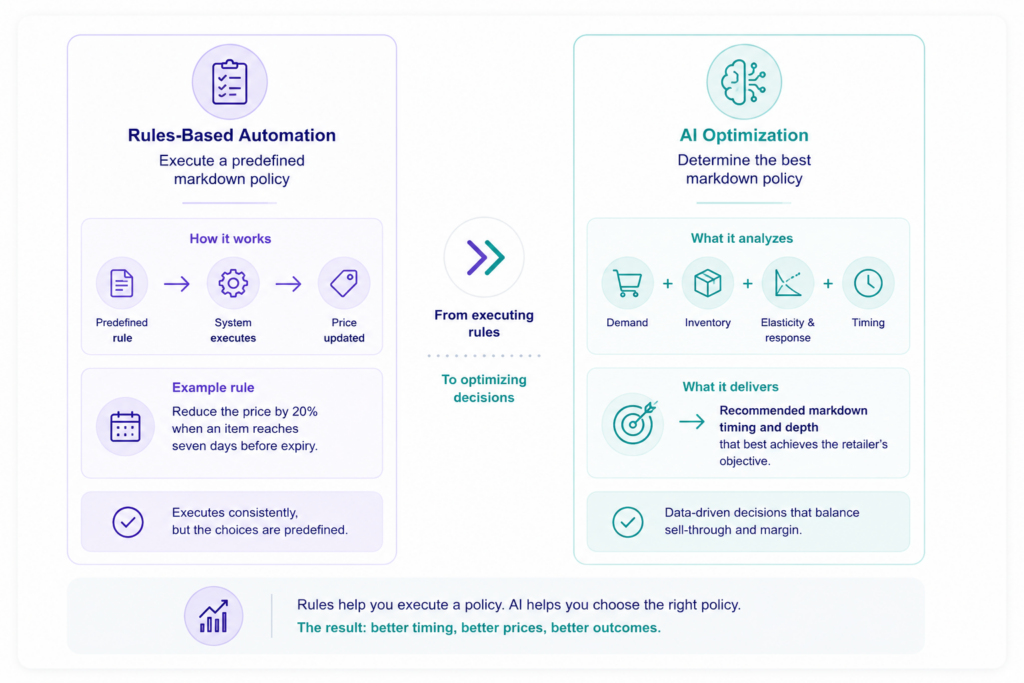
AI improves markdown pricing by analyzing demand, inventory, elasticity and product relationships at a level of detail that is difficult to manage manually. Rules execute a markdown policy the retailer has already decided; optimization helps determine what that policy should be.
Rules-based automation and markdown optimization solve two different problems. A rule might say, “reduce the price by 20% when an item reaches seven days before expiry.” The system can execute that policy consistently, but the retailer still had to decide that seven days and 20% were the right choices.
Optimization has clearly advanced. The lunar process uses accumulated data on sales, inventory, price, and demand response to better assess the specific timeframes and discount percentages that are most likely to achieve retailers’ desired goals. For example, the goal might be to clear inventory by a certain date while maintaining maximum profit. By reviewing research on previously implemented price reduction systems, we saw how magnetic learning approaches can combine demand assessment with multi-level price optimization, rather than relying solely on fixed price reduction rules.
Expert insight: “Fashion and short life cycle products require accurate and proactive pricing to confront the aggressive discounting culture.”
Gartner’s analysis reinforces the shift from reactive markdown rules toward proactive, AI-supported pricing. For short-life-cycle assortments in particular, retailers need to anticipate demand changes and adjust pricing before excess inventory forces deeper discounts.
In practice, AI-supported markdown pricing can provide:
- SKU-store level recommendations rather than one markdown rule for an entire category or network.
- Elasticity and cannibalization modelling to estimate how demand responds to a lower price and how that change affects related products.
- Constraint handling for price ladders, ending digits, minimum margins, competitor floors and other commercial rules.
- Scenario simulation to compare different markdown timing and depth before prices are changed.
- Store clustering to apply different recommendations where local demand patterns differ.
- Execution into POS/ERP systems so approved markdown decisions can move into operational systems without rebuilding them manually.
According to LTPlabs’ consumer electronics case study, more than 90% of AI-generated markdown recommendations were accepted by pricing managers after the retailer introduced machine-learning-supported markdown decisions for end-of-life products. The result is a useful practical signal: optimization can support granular pricing decisions at scale while still keeping the pricing team in control of the final action.
Currently, there’s a major limitation. The reliability of the desired results depends on the quality of the sales data, inventory levels, and prices used by the models. The absence of this information (for example, inventory levels), as well as inconsistent historical prices or poor sales data, can lead to weaker recommendations, regardless of the complexity of the optimization process. Yieldigo also strives to capture pure inventory levels and expiration dates, using these inputs as the starting point for the price reduction process. For a detailed explanation of the optimization process, please refer to our price reduction optimization guide.
Explainability: seeing why a price moved
Pricing teams need to understand why a recommendation changed. If an SKU moves from full price to a 20% markdown, the user should be able to trace that recommendation back to factors such as weak sell-through, excess inventory, remaining selling time or expected price response.
This matters because a recommendation that cannot be explained is difficult to review, challenge or approve. Explainability therefore becomes a practical requirement when evaluating AI-driven markdown pricing, rather than simply a technical feature.
How to choose the right markdown solution
When comparing markdown solutions, look beyond whether a platform describes itself as AI-powered. The practical question is whether it can support the decisions, constraints and level of detail your pricing team actually needs.
- Objective fit. Can the solution optimize against the goal you care about, such as sell-through, gross margin, waste reduction or inventory exit by a deadline?
- Granularity of recommendations. Does it work at category level only, or can it produce SKU-store recommendations where required?
- Constraint handling. Can pricing teams define minimum margins, approved price points, price ladders, ending digits and competitive boundaries?
- POS/ERP integration. Can approved recommendations flow into the systems responsible for executing prices?
- Explainability. Can users see the factors behind a recommendation and understand why the proposed price changed?
- Data prerequisites. What historical sales, inventory, price and product data does the model require, and is that data available at sufficient quality?
Does markdown optimization actually pay off?
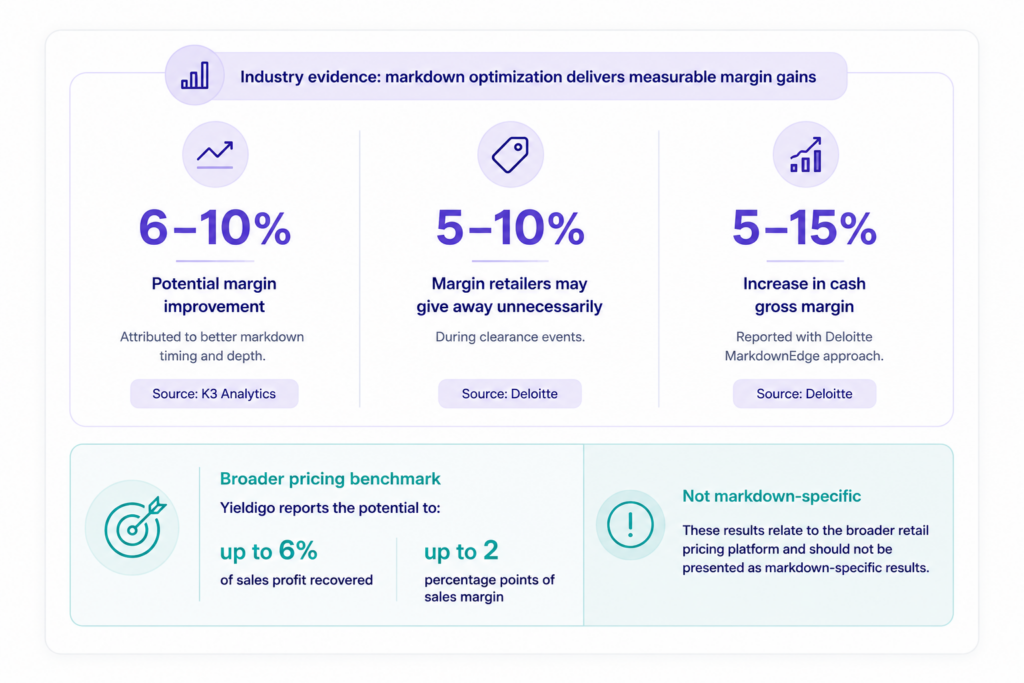
Evidence suggests that markdown optimization can produce measurable margin gains, but results vary significantly by retailer, category, starting process and implementation quality.
Conclusion
A good markdown pricing strategy is not about avoiding markdowns altogether. Some markdown is simply part of carrying a retail assortment: demand will miss forecasts, seasons will end and products will eventually need to leave the range. The goal is to make each markdown the smallest and earliest price reduction capable of clearing the inventory within the available selling window.
Retailers that protect margin treat markdowns as a planned part of the product lifecycle. They define the objective in advance, trigger decisions using sell-through and inventory signals, and measure the outcome against that objective. Whether those decisions are managed manually, through rules or with optimization, the principle remains the same: markdowns work best when they are planned before excess stock becomes an emergency.
Frequently Asked Questions
What is markdown pricing?
Markdown pricing is a permanent reduction of a product’s original retail price, available to all customers. Retailers use it to accelerate sell-through when inventory is moving too slowly, a season is ending, or a product is losing residual value, allowing stock to clear before a deeper reduction becomes necessary.
What are markdowns in retail?
Markdowns in retail are the permanent difference between a product’s original ticket price and its new, lower selling price. Unlike temporary promotions, retail markdowns change the product’s selling price and affect the gross margin retailers can recover from the remaining inventory.
What are the types of markdown in retail?
The main types of markdown in retail are seasonal, clearance, promotional, competitive, progressive and expiry-driven markdowns. They differ primarily in their trigger and duration: some respond to predictable lifecycle events, while others respond to competitors, inventory performance, planned demand generation or approaching expiration dates.
How do you calculate markdown percentage?
To calculate markdown percentage, subtract the marked down price from the original price, divide the result by the original price and multiply by 100. For example, reducing a €100 product to €80 gives a 20% markdown. Always calculate cumulative markdown from the original ticket price.
What is markdown rate?
Markdown rate is a portfolio-level KPI calculated by dividing total markdown value by gross sales and multiplying by 100. It shows how much potential revenue was given away through markdowns. For example, €40,000 of markdown value against €500,000 in gross sales produces an 8% markdown rate.
What is markdown money?
Markdown money is a supplier allowance that offsets some of the retailer’s financial impact from markdowns on that supplier’s products. It may be negotiated as a credit, discount or chargeback. Because the supplier absorbs part of the reduction, markdown money changes the retailer’s effective margin calculation.
When should retailers take the first markdown?
Retailers should take the first markdown when sell-through falls materially below plan or when weeks of supply exceed the remaining time available to sell the inventory. The trigger should therefore come from product performance rather than a fixed calendar date, leaving enough time for a smaller reduction to work.
How deep should a markdown be?
A markdown should be deep enough to clear the required inventory within the remaining selling window, but no deeper. Retailers can validate the decision using the break-even unit-uplift test, which compares the margin sacrificed through the markdown with the additional unit sales required to maintain gross profit.
What is a retail markdown schedule?
A retail markdown schedule is a pre-planned sequence of price reductions with defined timing and depth. It specifies the first markdown, subsequent steps and the final inventory exit action. The cadence should match the product lifecycle rather than applying the same schedule across fundamentally different categories.
How do retailers decide markdowns?
Retailers decide markdowns by combining sales velocity, sell-through against plan, weeks of supply, remaining product lifecycle, competitor prices and price elasticity. Together, these signals indicate whether intervention is necessary, when the first markdown should happen and how large a reduction is likely to generate sufficient additional demand.
What is markdown optimization software?
Markdown optimization software uses demand forecasting and elasticity modelling to recommend when and how deeply products should be marked down at SKU and store level. It can account for inventory, product relationships and business constraints rather than relying solely on fixed rules. See the markdown optimization guide for more detail.
Can markdowns be profitable?
Yes. Markdowns can protect total gross profit when they are taken early enough and sized correctly to accelerate inventory sell-through. The objective is not necessarily to maximize margin on each individual unit; a controlled early markdown can be financially preferable to a late blanket reduction on large quantities of ageing stock.
What is the markdown pricing model?
A markdown pricing model is a structured method for determining when a product’s price should be reduced and by how much. It uses factors such as inventory levels, sell-through, remaining lifecycle, elasticity and margin requirements to select markdown timing and depth while working toward a defined inventory or profitability objective.
What are the 4 types of pricing strategies?
Four broad pricing strategies commonly used in retail are cost-based pricing, competitor-based pricing, value-based pricing and dynamic pricing. Markdown pricing can operate within these wider approaches as a lifecycle decision used when inventory needs to move faster or a product’s remaining commercial value begins to decline.
What is an example of a markdown strategy?
An example of a markdown strategy is a seasonal product that remains at full price while sell-through is on plan, moves to 20% off when performance falls behind target, then to 40% and finally 60% if inventory remains. Each step is triggered according to a pre-planned retail markdown schedule.