
Choosing the right pricing technology is increasingly important as retailers manage larger assortments, faster market changes, and tighter margins. According to Deloitte’s 2026 Global Retail Industry Outlook, 48% of retail leaders currently use AI for pricing optimization, showing how central data-driven pricing has become. The right solution should therefore reflect a retailer’s market, pricing complexity, and commercial objectives.
Prisync focuses primarily on competitor price monitoring and automated repricing, while other retailers may require price optimization, promotion management, markdown optimization, scenario simulations, or AI-driven recommendations. In this guide, we compare the best Prisync competitors and alternatives for 2026 across their capabilities, pricing, retail specialization, integrations, and customer feedback to help you find the right fit.
TL;DR
The best alternative to Prisync is the one that best reflects what your business needs are and what you want to achieve from using a pricing platform. There are platforms on the market that set the main goal, for example, to check and analyze competitive prices and carry out the process of revaluing prices in e-commerce, but there are other platform options, the latter have advanced even more in their functionality. It is important to understand their differences, especially for retailers who manage fairly complex product assortments. Retailers managing thousands of SKUs, multiple stores, promotions, category relationships, and margin constraints, however, may benefit from moving beyond competitor tracking toward a system that models how pricing decisions affect demand and profitability.
- Yieldigo
- PriceShape
- Omnia Retail
- Competera
- RELEX Solutions
- Revionics
- Pricefx
- Zilliant
- Price2Spy
- Quicklizard
- Intelligence Node
- Wiser Solutions
Why Do Retailers Look for Prisync Alternative?
Prisync is a highly reliable platform for tracking competitor prices, which is especially important for e-commerce departments whose primary goal is to automate market monitoring rather than manually checking competitor websites. However, it’s important to remember that pricing requirements can change rapidly, depending on a retailer’s growth. In such cases, departments consider alternatives to Prisync, especially if they require functionality that goes beyond competitor price tracking and repricing, such as rules-based pricing, example-based pricing, price elasticity modeling, price and discount optimization, scenario planning, deeper integration with marketplace trading, or AI-based recommendations for a wide range of products.
The pressure to make those decisions more intelligently is increasing. Eight in ten retail executives surveyed by Deloitte expected price wars to intensify, while three-quarters expected retailers to increasingly use AI for dynamic pricing based on demand, competition, and other factors. As pricing becomes more automated and data-driven, choosing between Prisync and its competitors is therefore less about finding another price tracker and more about matching the platform’s capabilities to the retailer’s pricing complexity and long-term strategy.
Best Prisync Alternatives & Competitors in 2026
There is no single best Prisync alternative for every business. The right choice depends on what you expect pricing software to do: monitor competitors, automate repricing, apply yield management pricing based on demand and elasticity, manage promotions and markdowns, or connect pricing with broader retail planning. Business size, assortment complexity, pricing maturity, and the amount of control your team needs should all influence the decision.
| Platform | Best for | Pricing | G2 rating | |
| 1 | Yieldigo | AI-powered price optimization for grocery and large retailers | Custom pricing | 4.6 / 5 |
| 2 | PriceShape | Ecommerce competitor monitoring and dynamic pricing | Contact vendor | 4.7 / 5 |
| 3 | Omnia Retail | Automated pricing for ecommerce and retail | Contact vendor | 4.4 / 5 |
| 4 | Competera | Enterprise retail price optimization | Custom pricing | 4.9 / 5 |
| 5 | RELEX Solutions | Pricing within integrated retail planning | Custom pricing | 4.6 / 5 |
| 6 | Revionics | Enterprise grocery price, promotion, and markdown optimization | Contact vendor | 4.5 / 5 |
| 7 | Pricefx | Enterprise price management and optimization | Contact vendor | 4.4 / 5 |
| 8 | Zilliant | B2B price management and optimization | Contact vendor | 4.4 / 5 |
| 9 | Price2Spy | Competitor price monitoring and automated repricing | Public plans available | 4.8 / 5 |
| 10 | Quicklizard | AI-powered pricing optimization for multichannel retailers | Contact vendor | 4.7 / 5 |
| 11 | Intelligence Node | AI-driven competitive pricing intelligence | Contact vendor | 4.5 / 5 |
| 12 | Wiser Solutions | Retail price intelligence and market monitoring | Contact vendor | 4.3 / 5 |
1. Yieldigo – Best Prisync Alternative for AI-Powered Retail Price Optimization
What Is Yieldigo?
Yieldigo is a cloud-based retail price management and optimization platform designed for professional retailers, wholesalers, and ecommerce businesses. Rather than focusing primarily on tracking competitor prices, it combines pricing rules and competitive intelligence with ML/AI-powered optimization to help pricing teams decide how prices should change across complex assortments.
The platform covers regular price management, price optimization and what-if simulations, competitive pricing, promotion planning and analytics, markdown optimization, multibuy management, price zones, private-label pricing, and automated workflows. This makes Yieldigo particularly relevant to grocery and large retailers that need to manage pricing decisions across thousands of SKUs, stores, markets, channels, and categories.
Why Is Yieldigo a Strong Prisync Alternative?
Yieldigo combines key competitive pricing information with internal retail data and artificial intelligence models. Pricing teams strive to model price elasticity and establish clear business rules, take into account specific product relationships, and use what-if simulations to more accurately predict how pricing strategies will impact key performance indicators (KPIs), such as sales, revenue, price index, and volume, before they are implemented. These estimates include:
- AI/ML-powered price optimization
- Price elasticity and demand modeling
- Competitive pricing analysis
- Product families and price relationships
- What-if scenario simulation and impact forecasting
- Detailed business rules and pricing constraints
- Promotion planning and analytics
- Long-life and short-life markdown optimization
- Multibuy management
- Price zones and value pricing
Yieldigo Pros & Cons
| Pros | Cons |
| Combines price management, AI-powered optimization, promotions, markdowns, and competitive pricing in one retail-focused platform | Broader functionality can be more than a small ecommerce business needs if competitor tracking is its only requirement |
| What-if simulations allow teams to assess potential effects on margin, revenue, volume, and other KPIs before implementing a strategy | Some G2 reviewers mention limitations in customization and data management |
| Supports complex retail structures including categories, stores, regions, channels, price zones, brands, product families, and competitors | Implementation can require preparation of internal data and processes, particularly for more complex retail environments |
| Keeps pricing managers in control through configurable rules, constraints, and review workflows | Pricing is not publicly listed, making upfront cost comparison with subscription-based tools such as Prisync more difficult |
| Designed specifically for professional retail and ecommerce pricing rather than generic enterprise pricing | May be less suitable for small businesses seeking a lightweight standalone competitor tracker |
Yieldigo Pricing
Yieldigo does not publish standard subscription tiers or a starting price on its website. The company uses a demo and sales-led model, so businesses need to contact Yieldigo for pricing based on their requirements.
What Are Yieldigo Customers Saying?
Customer feedback on G2 is predominantly positive. Reviewers repeatedly highlight ease of use, responsive customer support, the user interface, pricing optimization, and dynamic pricing as strengths. G2’s current review summary also notes that users value Yieldigo’s ability to handle large datasets and make price adjustments efficiently.
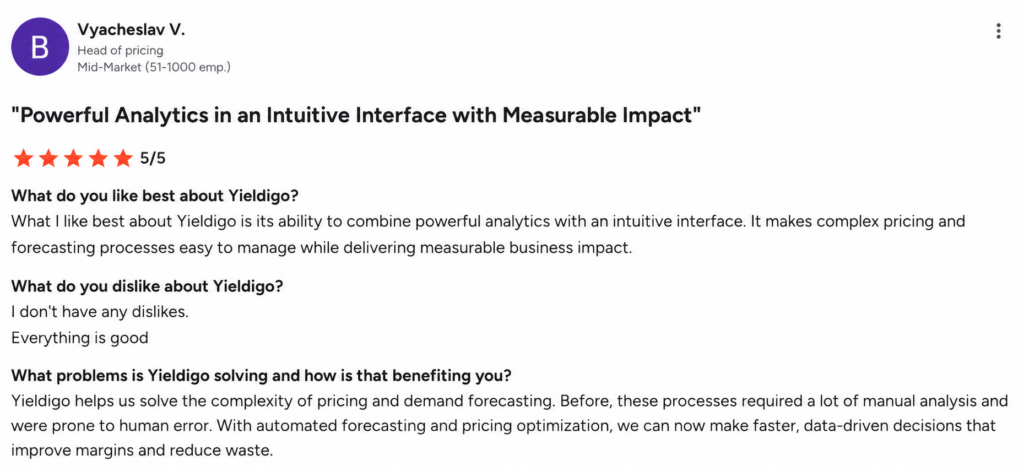
G2 Rating: As of the latest check, Yieldigo has a 4.6 / 5 rating on G2 based on 28 verified reviews.
2. PriceShape – Best Prisync Alternative for Ecommerce Competitor Monitoring and Dynamic Pricing
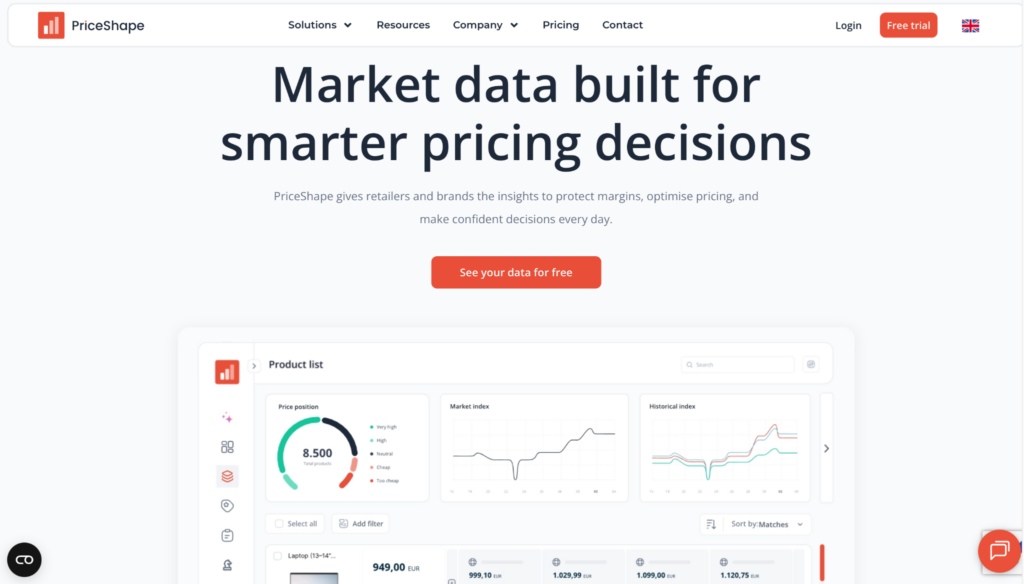
What Is PriceShape?
PriceShape is a pricing platform built primarily for ecommerce retailers, brands, and wholesalers that need continuous visibility into competitor prices and the ability to act on market changes. The platform monitors competitor prices, stock levels, assortments, delivery costs, and other market data across webshops and marketplaces, then brings that information into a centralized pricing environment.
PriceShape helps retailers by combining competitive monitoring with intelligent and dynamic pricing. Departments can easily create their own pricing strategies that will automatically respond to competitors’ actions, costs and inventory, as well as sales metrics and other factors. They can also set their own price targets to protect their profits.
Why Is PriceShape a Strong Prisync Alternative?
PriceShape is one of the closest alternatives to Prisync in this list because both platforms are strongly focused on competitor data and automated ecommerce pricing. It is particularly relevant for retailers that want competitor monitoring to feed directly into dynamic pricing rules rather than moving immediately to a broader enterprise optimization platform. Its main capabilities include:
- Competitor price and stock monitoring
- Dynamic and intelligent pricing
- Automated competitor matching
- Price history and market analysis
- Product performance insights
- Inventory-aware pricing strategies
PriceShape Pros & Cons
| Pros | Cons |
| Strong focus on competitor price monitoring and ecommerce pricing, making it a close functional alternative to Prisync | G2 reviewers mention pricing as a concern, particularly when tracking larger numbers of SKUs |
| Dynamic pricing can automatically respond to competitor prices, inventory, costs, sales performance, and predefined rules | Some reviewers report that product matching can require manual adjustments |
| Provides competitor price history, stock information, assortment data, and market insights in one platform | G2 users mention occasional inaccurate or incomplete scraped data |
| G2 reviewers frequently praise its ease of use and responsive customer support | Historical data access and some integrations/features are identified as limitations by a small number of reviewers |
PriceShape Pricing
Unlike many enterprise pricing platforms in this comparison, PriceShape publishes a starting price. Plans start at €299 per month, with the final cost depending primarily on the number of products a business wants to track and the markets in which it operates.
What Are PriceShape Customers Saying?
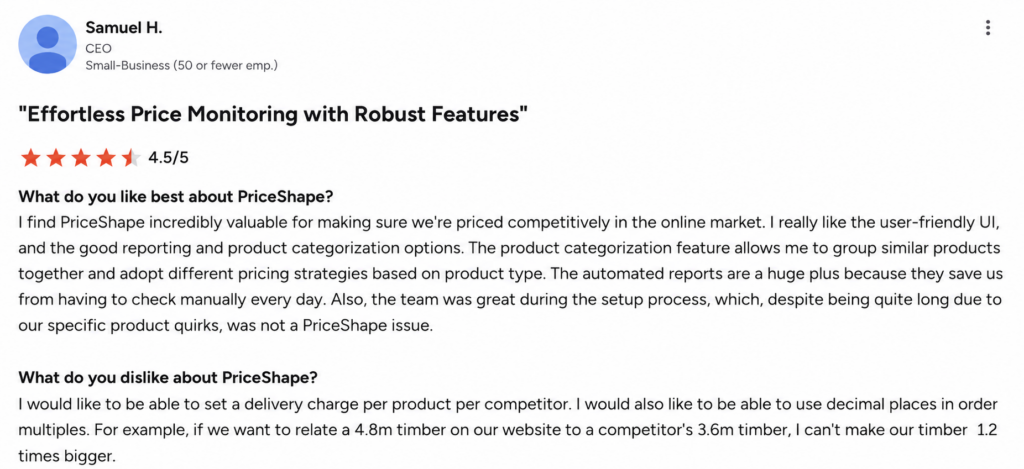
Customer sentiment on G2 is strongly positive, particularly around customer support, ease of use, pricing optimization, competitor insights, and the platform’s UI/UX. G2’s current review analysis identifies customer support as the most frequently mentioned advantage, followed by ease of use.
G2 Rating: PriceShape currently holds a 4.7 / 5 rating on G2 based on 43 reviews.
3. Omnia Retail – Best Prisync Alternative for Automated Retail and Ecommerce Pricing

What Is Omnia Retail?
Omnia Retail is a pricing platform for retailers and brands that combines competitor price monitoring, dynamic pricing, market intelligence, business rules, and AI-supported pricing workflows. It is designed to help pricing teams move from collecting competitive data to automatically applying pricing strategies across products, channels, and markets.
This platform is advantageous because it provides its services to both small businesses with just one store and larger enterprises (retail chains). Omnia, on the other hand, maintains that its pricing environment can cover anywhere from a thousand to a billion product items, and its corporate offering can support a significant number of stores and marketplaces. Its dynamic pricing tools combine a variety of internal business data with competitive information obtained from these domains, marketplaces, and various price comparison systems.
Why Is Omnia Retail a Strong Prisync Alternative?
Omnia Retail is a particularly relevant Prisync alternative for businesses that still need competitor monitoring but want to connect that data more directly with automated pricing execution. Key capabilities include:
- AI-powered competitor price monitoring
- Dynamic and automated pricing
- Business-rule-based pricing strategies
- Machine learning and AI pricing algorithms
- Pricing Strategy Tree for visual strategy configuration
- Competitor, marketplace, and comparison-shopping data
Omnia Retail Pros & Cons
| Pros | Cons |
| Combines competitor monitoring and automated dynamic pricing within the same platform | Starting price is higher than some lightweight competitor monitoring tools |
| Supports business rules alongside machine learning and AI-based pricing | Full enterprise pricing requires a custom quote |
| Pricing Strategy Tree provides a visual, no-code environment for building and adjusting strategies | Broader functionality may be unnecessary for businesses that only need basic competitor tracking |
| Provides safeguards, testing, rollback, audit logs, and explanations for automated pricing decisions | Some G2 reviewers report that scraping and product matching can occasionally require improvement |
Omnia Retail Pricing
Omnia Retail publishes separate pricing approaches for SMB and enterprise customers. Its SMB pricing starts at €399 per month and is designed for single-shop retailers and brands. The package supports up to five users and includes AI Price Monitoring, AI Dynamic Pricing, plug-and-play integrations, Omnia Agent, and online support.
What Are Omnia Retail Customers Saying?
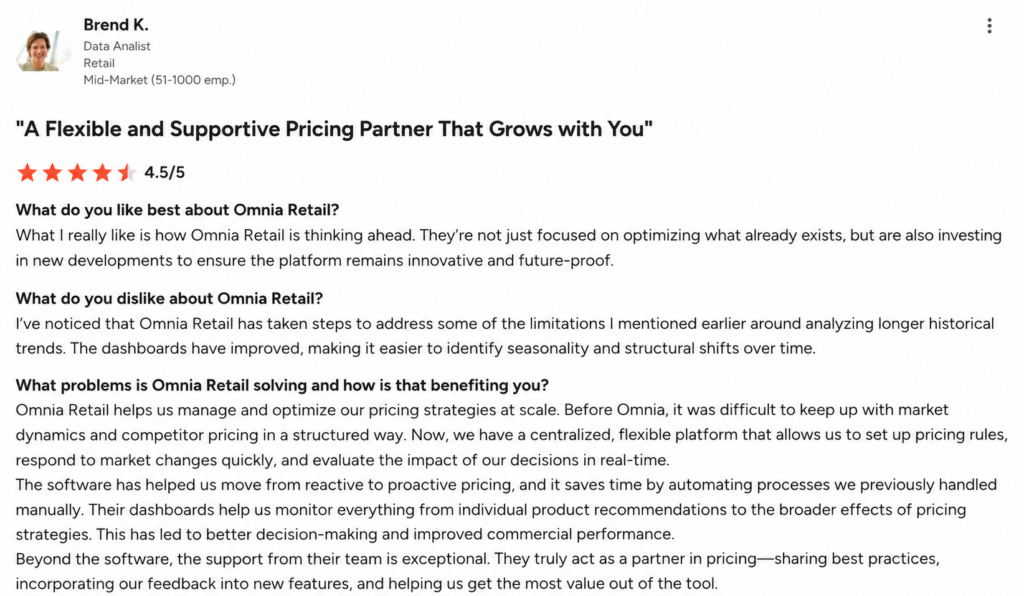
Customer feedback on G2 is generally positive. Reviewers frequently highlight the platform’s ability to turn market information into actionable pricing strategies, while recent reviews also praise its customer support and integrations.
G2 Rating: Omnia Retail currently has a 4.4 / 5 rating on G2 based on 100 product reviews.
4. Competera – Best Prisync Alternative for Enterprise Retail Price Optimization
What Is Competera?
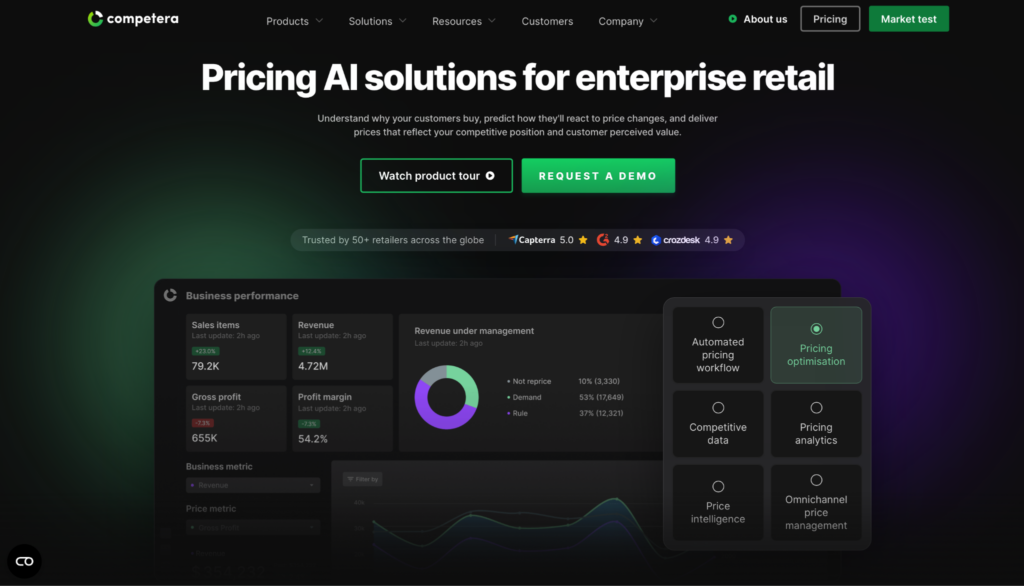
Competera is an AI-powered pricing platform built for enterprise retailers. It combines competitive data, price management, pricing analytics, automated pricing workflows, and price optimization in one environment, helping pricing teams move from monitoring market changes to predicting how different pricing decisions may affect demand and business performance.
The platform is designed for complex retail environments with large assortments, multiple stores, regions, and sales channels. Competera says its AI evaluates more than 20 pricing and non-pricing factors when generating recommendations, including competitive dynamics, costs, seasonality, demand, and product relationships. It also supports human oversight, allowing pricing teams to combine AI recommendations with their own business rules and strategic objectives.
Why Is Competera a Strong Prisync Alternative?
When a retailer needs to monitor the competitive landscape, and their workflow was focused solely on monitoring and reassessment, they typically encounter the problem that the platform, or rather its functionality, no longer meets their needs. Competera’s solution, however, not only collects information on competitive prices but also gathers essential information on promotions, product availability, assortment changes, delivery costs, and other important market signals. Competera has covered 34 markets and processed over 119 million data points collected monthly, and can confidently guarantee data delivery with a service level of 98 percent. Its key features typically include:
- Competitor price and assortment tracking
- AI-powered product matching
- Portfolio-level price optimization
- Demand and price elasticity modeling
- Cross-product relationship modeling
- AI-driven dynamic pricing
Competera Pros & Cons
| Pros | Cons |
| Combines enterprise competitor intelligence with AI-powered price optimization | Broader enterprise scope may be excessive for smaller ecommerce teams that primarily need competitor monitoring |
| Competitive Data covers prices, promotions, availability, assortment changes, and other market signals | Pricing is not publicly disclosed, making initial cost comparison with subscription-based tools more difficult |
| Models elasticity and cross-product effects rather than basing recommendations only on competitor prices | Implementation is likely to require substantially more internal retail data and integration work than a standalone monitoring tool |
| Supports what-if simulations so pricing teams can forecast potential outcomes before deploying price changes | Sophisticated optimization workflows may require greater pricing maturity and organizational readiness |
Competera Pricing
Competera does not publish standard subscription plans or a starting price. Instead, it provides custom quotes based on the retailer’s required products and scope.
Its current pricing page separates the offering into three configurations: Competitive Data, AI Pricing Platform, and a combined Competitive Data & AI Pricing Platform package.
What Are Competera Customers Saying?
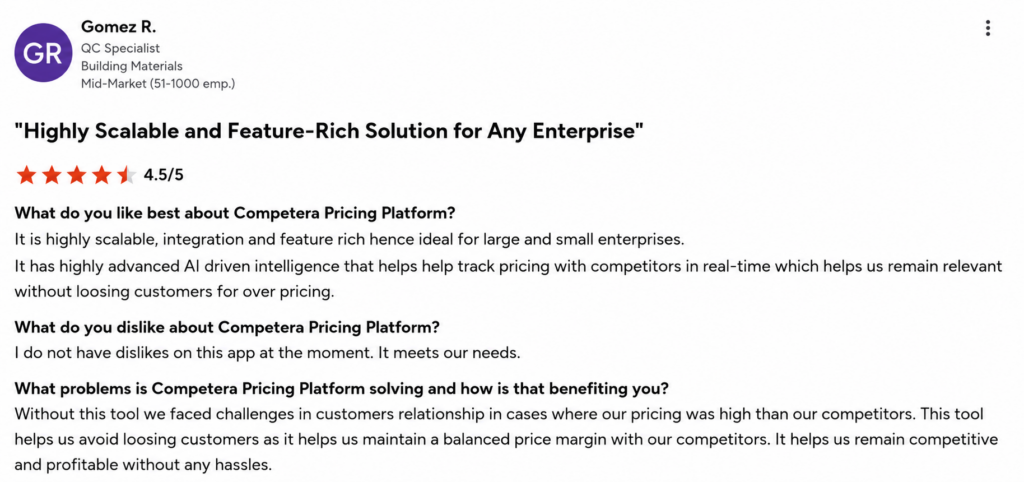
Competera receives strong feedback on G2, although its review base is considerably smaller than those of some other platforms in this comparison. Reviewers frequently highlight the quality of the platform’s pricing recommendations, competitive data, customer support, and the ability to automate pricing processes.
G2 Rating: Competera currently holds a 4.9 / 5 rating on G2 based on 14 reviews.
5. RELEX Solutions – Best Prisync Alternative for Integrated Retail Planning
What Is RELEX Solutions?
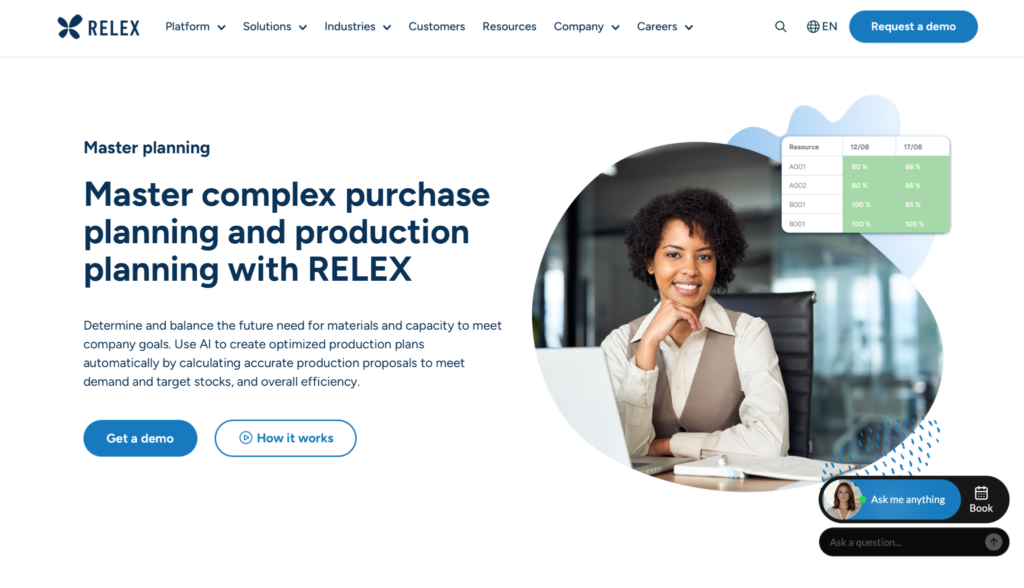
RELEX Solutions is an AI-native retail and supply chain planning platform for retailers, manufacturers, and wholesalers. Unlike platforms centered primarily on competitor price monitoring, RELEX connects pricing with a much broader set of retail decisions, including demand forecasting, inventory and replenishment, promotions, merchandising, assortment, space, supply, and production planning.
The RELEX platform in the environment of education and price promotion includes the following functions: planning promotions, optimization and price reduction, as well as discount management. It is this feature set that has helped RELEX become popular with retailers because they need the pricing decisions they make to be linked to clear forecasts, inventory management, promotion plans and other operational constraints, rather than as a stand-alone process.
Why Is RELEX a Strong Prisync Alternative?
RELEX is a strong Prisync alternative for retailers whose pricing challenges extend beyond tracking and reacting to competitors. Instead of treating pricing as an isolated ecommerce function, RELEX connects it with demand and inventory planning so teams can consider how price changes and promotions affect the wider retail operation. Key capabilities include:
- AI-powered price optimization
- Promotion planning and optimization
- Markdown and clearance optimization
- Demand forecasting
- Inventory planning and replenishment
- Assortment and merchandising planning
RELEX Solutions Pros & Cons
| Pros | Cons |
| Connects pricing and promotions with forecasting, inventory, replenishment, assortment, and other retail planning processes | Much broader and more complex than necessary for businesses that only need competitor price monitoring or ecommerce repricing |
| Offers AI-powered price optimization as part of an integrated retail planning platform | Public standard pricing is not available, so businesses need to contact RELEX directly |
| Strong promotion and markdown capabilities are particularly relevant to grocery, seasonal, and inventory-sensitive retail | Implementation scope can be substantially larger than adopting a standalone pricing tool |
| Flexible business rules allow organizations to adapt workflows to specific operational requirements | G2 reviewers note that extensive flexibility can also lead teams toward over-customization |
RELEX Solutions Pricing
RELEX does not publish standard subscription tiers or starting prices on its website. Prospective customers are directed to request a consultation or demo, meaning pricing is determined according to the retailer’s required solutions, deployment scope, and business needs.
What Are RELEX Customers Saying?
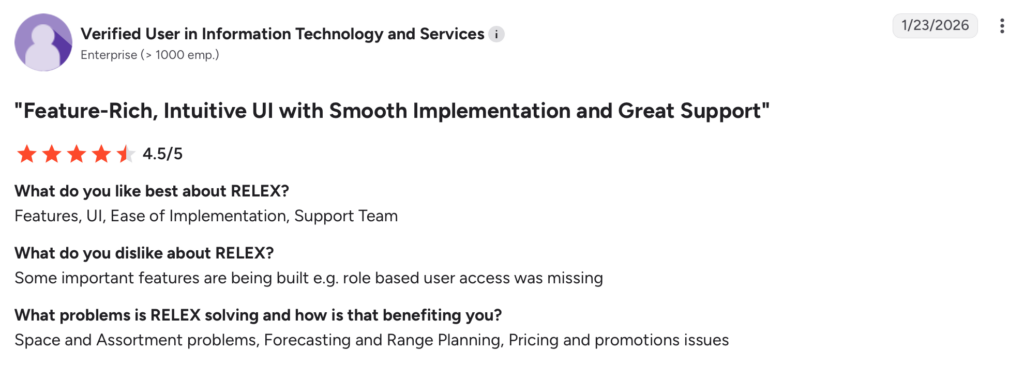
RELEX receives predominantly positive feedback on G2. Its current review summary says users consistently praise the platform’s ease of use and flexibility, particularly its ability to adapt to different business requirements and streamline complex processes. Reviewers also highlight the intuitive interface and customer support.
G2 Rating: RELEX currently holds a 4.6 / 5 rating on G2 based on 21 reviews.
6. Revionics – Best Prisync Alternative for Enterprise Grocery and Retail Pricing
What Is Revionics?
Revionics is an enterprise retail pricing platform from Aptos that uses AI and advanced analytics to support regular pricing, promotions, markdowns, and competitive pricing decisions. It is built primarily for large retailers managing complex assortments, frequent price changes, and multiple commercial objectives.
To avoid relying solely on competitive pricing, Revionics analyzes factors such as price elasticity, competitive positioning and business constraints, and product interdependencies. This enables them to generate clear pricing metrics. This approach clearly demonstrates their difference from their competitor monitoring platform, such as Prisync. While we understand that competitive intelligence can indeed help in making the right decisions, it’s important to remember that it’s still only one part of a larger process.
Why Is Revionics a Strong Prisync Alternative?
Revionics becomes a relevant Prisync alternative when a retailer needs to move beyond monitoring competitors and applying rule-based price changes toward optimizing prices across the full product lifecycle. Its main capabilities include:
- AI-powered price optimization
- Price elasticity and demand modeling
- Competitive pricing analytics
- Key Value Item and category pricing
- Business rules and pricing constraints
- Promotion optimization
Revionics Pros & Cons
| Pros | Cons |
| Designed specifically for enterprise retail price optimization | Significantly broader than necessary for small ecommerce businesses that primarily need competitor tracking |
| Combines regular price, promotion, markdown, and competitive pricing capabilities | Pricing is not publicly disclosed |
| Uses elasticity and demand modeling to support pricing decisions rather than relying only on competitor movements | Enterprise deployment can involve greater data, integration, and implementation requirements than a lightweight monitoring platform |
| Supports business rules and constraints so retailers can align optimization with commercial strategy | Very limited number of public G2 reviews makes customer sentiment harder to evaluate |
Revionics Pricing
Revionics does not publicly list standard subscription plans or starting prices. Aptos directs prospective customers toward its sales team and product demonstrations, so businesses need to request a quote based on their requirements.
What Are Revionics Customers Saying?

Public customer feedback for Revionics on G2 is currently very limited. The platform has only one G2 review, which means there is not enough verified feedback to identify meaningful recurring themes in the same way we can for Prisync, Yieldigo, PriceShape, or other platforms with larger review bases.
G2 Rating: Revionics currently has a 4.5 / 5 rating on G2 based on just one review.
7. Pricefx – Best Prisync Alternative for Configurable Enterprise Pricing

What Is Pricefx?
Pricefx is a cloud-native SaaS platform for enterprise price management, optimization, and Configure, Price, Quote (CPQ). It supports both B2B and B2C pricing processes and is designed to cover the pricing lifecycle from analyzing data and defining pricing strategies to calculating prices, managing quotes, promotions and agreements, and bringing approved prices into commercial systems.
The capabilities and functionality of this platform have long since expanded beyond simply monitoring competitive prices. Pricefx combines analytics and optimization based on machine learning, price discovery, promotions and advertising, discounts, sales channel management, and AI-powered tools into a massive modular platform. This makes it popular among large businesses that centralize a vast number of pricing processes, rather than relying on a single tool for purely competitive price analysis.
Why Is Pricefx a Strong Prisync Alternative?
Pricefx is a strong alternative for organizations that have moved beyond competitor-based repricing and need a configurable environment for managing complex pricing strategies. Key capabilities include:
- Enterprise price management
- AI and machine-learning price optimization
- Price setting and price lists
- Competitor- and market-informed pricing
- Price elasticity modeling
- Pricing simulations
Pricefx Pros & Cons
| Pros | Cons |
| Covers price management, optimization, analytics, CPQ, promotions, rebates, and other commercial pricing processes in one platform | Much broader and potentially more complex than required for businesses primarily looking for competitor monitoring |
| Highly configurable calculation and simulation logic can incorporate costs, competition, product attributes, market factors, and business rules | Public standard software pricing is not readily available, making direct cost comparison with Prisync more difficult |
| Supports AI/ML optimization, elasticity modeling, segmentation, and impact simulation | Configuration flexibility can require more internal pricing expertise than a lightweight out-of-the-box monitoring tool |
| Integrates pricing guidance with price lists, CPQ, ERP, CRM, and digital commerce workflows | Some G2 reviewers mention performance challenges when working with large datasets |
Pricefx Pricing
Pricefx does not provide conventional public subscription tiers that allow a direct monthly-price comparison with Prisync. Enterprise buyers generally need to engage Pricefx to determine the appropriate solution and commercial terms based on their use case and implementation scope.
What Are Pricefx Customers Saying?
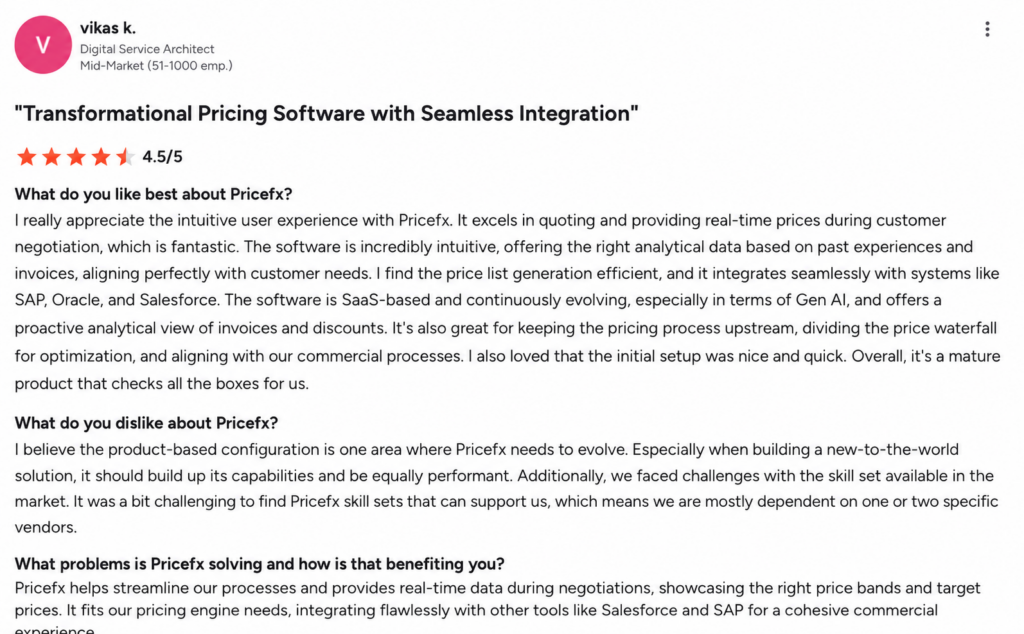
Pricefx has one of the larger G2 review bases among the enterprise pricing platforms in this comparison. Customer feedback frequently highlights the platform’s flexibility, real-time pricing capabilities, dashboards, and ability to handle complex price calculations.
G2 Rating: Pricefx currently holds a 4.4 / 5 rating on G2 based on 133 reviews, giving it a considerably larger public review base than several other enterprise pricing platforms in this comparison.
8. Zilliant – Best Prisync Alternative for B2B Price Optimization and Management
What Is Zilliant?
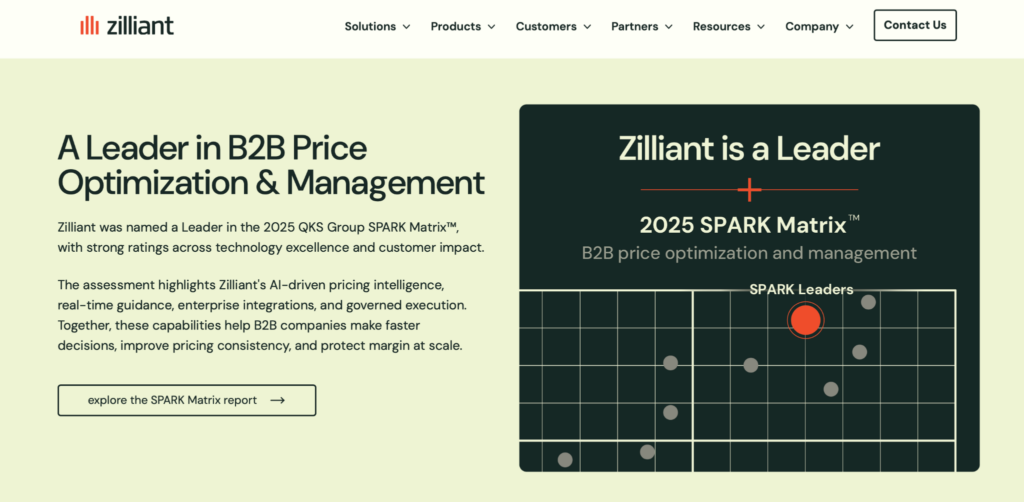
Zilliant is an enterprise pricing software provider focused primarily on complex B2B pricing. Its platform helps organizations manage, optimize, and execute pricing across products, customers, regions, sales teams, and commercial systems rather than concentrating mainly on ecommerce competitor tracking.
Its current product portfolio includes Price Manager for centralized pricing execution, Price IQ for pricing analysis and optimization, Configure, Price, Quote (CPQ), Sales Agreements, and Sales Insights and Actions. Together, these tools are designed to connect pricing strategy with day-to-day commercial execution.
Why Is Zilliant a Strong Prisync Alternative?
Zilliant’s paid optimization capabilities have added specific recommendations based on artificial intelligence to this process. This pricing optimization solution was created to take pricing decisions far beyond those previously based on cost-benefit principles or, for example, intuition, by aligning recommended prices with various business rules, revenue, and margin targets. Key capabilities of this platform include:
- Enterprise price management
- AI-driven price optimization
- Price list management
- Global, country, and regional pricing
- Customer-specific pricing
- Cost-change and cost-pass-through management
Zilliant Pros & Cons
| Pros | Cons |
| Strong focus on complex B2B price management and optimization | Less directly comparable with Prisync for ecommerce businesses primarily seeking competitor price monitoring |
| Centralizes pricing logic across products, regions, customers, and commercial systems | Broader enterprise functionality may be unnecessary for smaller businesses |
| Combines AI-powered optimization with configurable business rules and pricing governance | Standard subscription pricing is not publicly disclosed |
| Supports scenario analysis before teams publish price changes | Implementation is likely to require more pricing maturity, internal data, and integration work than a lightweight monitoring tool |
Zilliant Pricing
Zilliant does not publish conventional subscription tiers or a standard starting price for its core enterprise products. Prospective customers are directed to schedule a demo or speak with the company’s pricing specialists, meaning the final commercial model depends on the products and implementation required.
What Are Zilliant Customers Saying?
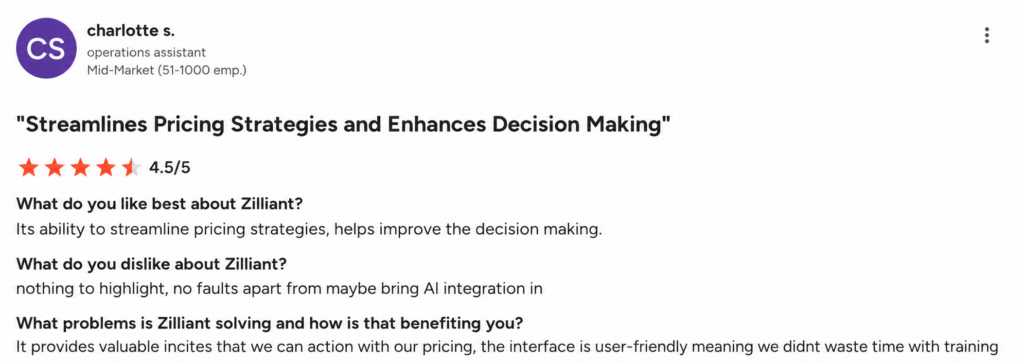
Customer feedback on G2 is generally positive, with reviewers highlighting the platform’s pricing capabilities, analytics, flexibility, and ability to support sophisticated pricing processes.
G2 Rating: Zilliant currently holds a 4.4 / 5 rating on G2 based on 61 reviews.
9. Price2Spy – Best Prisync Alternative for Competitor Price Monitoring and Repricing
What Is Price2Spy?
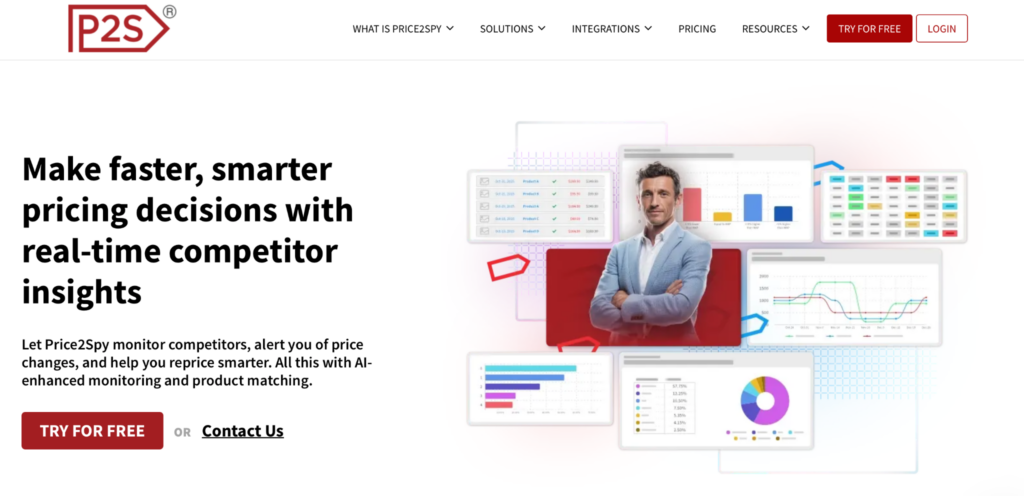
Price2Spy is a competitor price monitoring and repricing platform developed by WEBCentric. It is designed for ecommerce businesses, retailers, brands, and enterprises that need to track competitor prices at scale, analyze market changes, and automate pricing actions based on predefined strategies.
Like Prisync, Price2Spy focuses more on competitor price analysis than on optimization in retail for particularly sensitive businesses. Businesses, in turn, provide the platform with all the necessary information about the products and websites of competitors they wish to monitor, and the platform, in turn, automatically checks prices and provides alerts, reports, historical data, and other comprehensive analytics.
Why Is Price2Spy a Strong Prisync Alternative?
Price2Spy is one of the most direct Prisync alternatives in this comparison because the two platforms address many of the same core requirements: monitoring competitor prices, identifying market changes, analyzing historical pricing data, and turning competitive information into pricing actions. Its key capabilities include:
- Competitor price monitoring
- Automated repricing
- Pricing rules and custom strategies
- Price change alerts
- Historical pricing reports
- Market and competitor analysis
Price2Spy Pros & Cons
| Pros | Cons |
| One of the closest Prisync alternatives in terms of competitor monitoring and automated repricing | Some advanced functionality is restricted to higher plans or available as a separately priced module |
| Supports price alerts, historical reporting, marketplace monitoring, MAP monitoring, and product variations | G2 reviewers report occasional data-fetching or scraping issues when competitor websites change |
| Automated repricing lets businesses create their own pricing rules while protecting commercial objectives | More frequent competitor checks can increase the cost depending on the selected plan |
| Offers packages for small teams through to large enterprise ecommerce businesses | Some reviewers describe initial setup as complex for specialized industries or competitors requiring customized page reading |
Price2Spy Pricing
Price2Spy uses a tiered pricing structure with Starter, Basic, and Premium plans.
The Starter package is designed for smaller teams and businesses that need core competitor monitoring. It includes price monitoring, market analysis reports, a pricing dashboard, product-feed integration, bulk product import, Quick Match, price-change alerts, and monitoring of up to 10 competitors.
What Are Price2Spy Customers Saying?

Price2Spy receives particularly strong customer feedback on G2. Reviewers consistently praise its customer service, pricing optimization capabilities, ease of setup and use, reporting, timely alerts, and reliability of competitive pricing data.
Recent reviews illustrate those strengths.
G2 Rating: Price2Spy currently holds a 4.8 / 5 rating on G2 based on 110 reviews.
10. Quicklizard – Best Prisync Alternative for AI-Powered Multichannel Pricing
What Is Quicklizard?
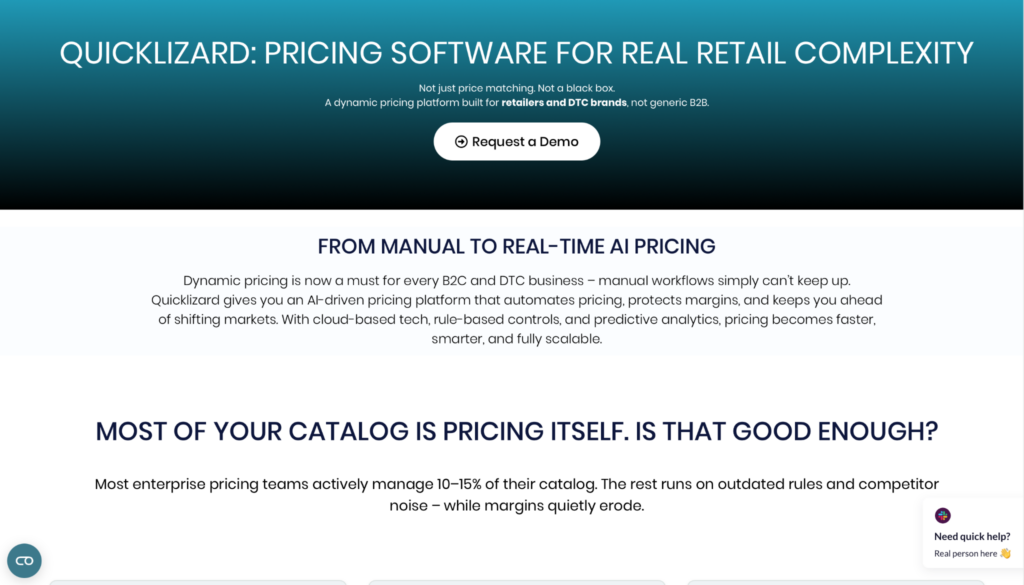
Quicklizard is an AI-powered dynamic pricing and optimization platform built for retailers and brands. It combines competitive pricing intelligence, demand forecasting, price elasticity, business rules, and automated price execution to help pricing teams manage decisions across large assortments and multiple sales channels.
Unlike platforms that focus on tracking competitor prices, Quicklizard was designed to transform internal and external data into pricing recommendations and automated actions. This platform’s primary goal is to integrate transaction data, inventory, competitive pricing, product information, promotions, and other contextual signals to support pricing decisions at the SKU, category, channel, and regional levels.
Why Is Quicklizard a Strong Prisync Alternative?
Quicklizard becomes a strong Prisync alternative when competitive pricing remains important but the retailer wants to move beyond automatically following every competitor price movement. Key capabilities include:
- AI-powered dynamic pricing
- Competitive pricing intelligence
- Competitor Sensitivity Index
- Real-time competitor and market signals
- Product matching
- SKU-level price elasticity
Quicklizard Pros & Cons
| Pros | Cons |
| Combines competitive intelligence with AI-powered dynamic pricing rather than responding to competitor prices alone | Broader functionality may be unnecessary for smaller ecommerce businesses that only need competitor monitoring |
| Models SKU-level elasticity, demand, competitor sensitivity, seasonality, and other pricing factors | Standard starting prices are not publicly disclosed |
| Supports ecommerce, marketplaces, and in-store pricing within an omnichannel environment | AI capabilities are offered as optional add-ons within the current pricing packages |
| Combines AI recommendations with configurable business rules, guardrails, approvals, and manual overrides | More sophisticated optimization requires internal transaction, inventory, competitor, and other data |
Quicklizard Pricing
Quicklizard does not publish a standard starting price. Instead, it uses custom pricing based on assortment size, pricing frequency, and execution channels. Its current packages are divided into Perform, Strategize, and Enterprise tiers.
What Are Quicklizard Customers Saying?
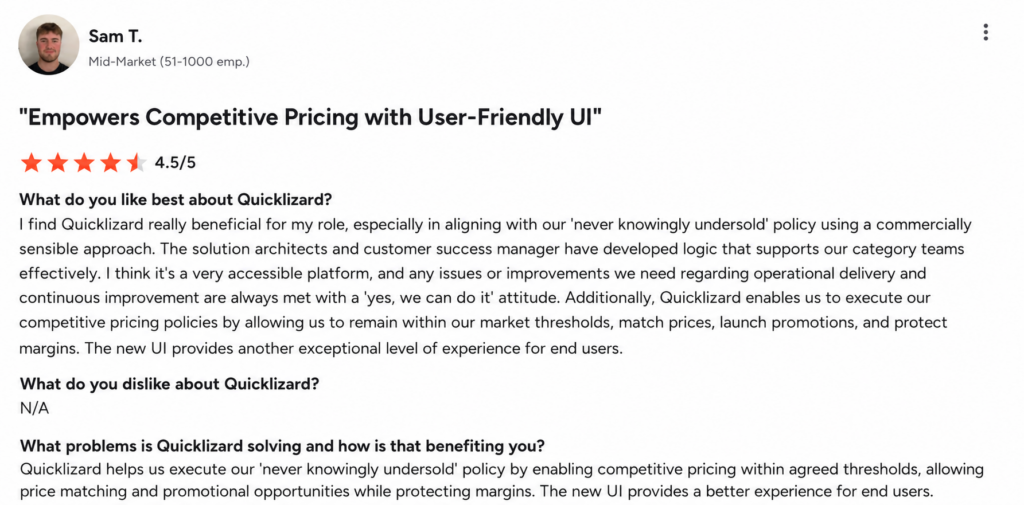
Customer sentiment on G2 is strongly positive. Recent reviewers particularly highlight customer support, usability, flexibility, pricing automation, and the ability to manage complex pricing workflows.
G2 Rating: Quicklizard currently holds a 4.7 / 5 rating on G2 based on 32 reviews.
11. Intelligence Node – Best Prisync Alternative for AI-Driven Competitive Pricing Intelligence
What Is Intelligence Node?
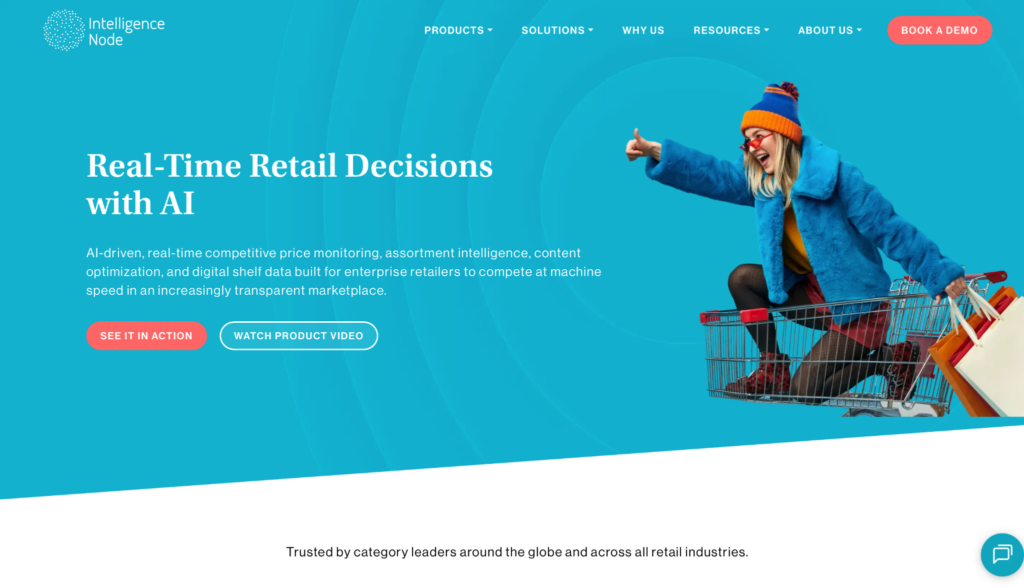
Intelligence Node is an AI-powered retail intelligence platform that helps retailers and brands monitor prices, products, competitors, and broader market activity across digital commerce. Its solutions span pricing intelligence, assortment intelligence, digital shelf analytics, product matching, MAP monitoring, and other competitive insights.
For businesses evaluating alternatives to Prisync, price analysis is a crucial part of the process. Intelligence Node collects data on competitors in the market and uses the resulting product comparison data powered by artificial intelligence to quickly help businesses compare similar products from competitors, filter out price changes, quickly identify price differences, and make clear, rapid pricing decisions.
Why Is Intelligence Node a Strong Prisync Alternative?
Intelligence Node is a strong Prisync alternative for retailers and brands that consider the quality, scale, and context of competitive data central to their pricing strategy. Its key capabilities include:
- Competitive price monitoring
- AI-powered product matching
- Pricing intelligence and benchmarking
- Dynamic pricing support
- Assortment intelligence
- Competitor assortment tracking
Intelligence Node Pros & Cons
| Pros | Cons |
| Strong focus on AI-powered competitive pricing and retail intelligence | May offer more market-intelligence functionality than smaller businesses need for straightforward competitor tracking |
| AI product matching helps compare large assortments across competitors | Standard subscription prices are not publicly disclosed |
| Combines pricing data with assortment, promotions, availability, and digital shelf insights | Broader intelligence workflows may require more setup and data integration than lightweight price trackers |
| Particularly relevant to brands and retailers that need competitive visibility across large ecommerce markets | Businesses primarily looking for advanced elasticity-based retail price optimization may find optimization-focused platforms more suitable |
Intelligence Node Pricing
Intelligence Node does not publish standard subscription tiers or a starting monthly price on its website. Businesses interested in the platform are directed toward a demo and custom commercial discussion, meaning pricing depends on the required solutions and deployment scope.
What Are Intelligence Node Customers Saying?
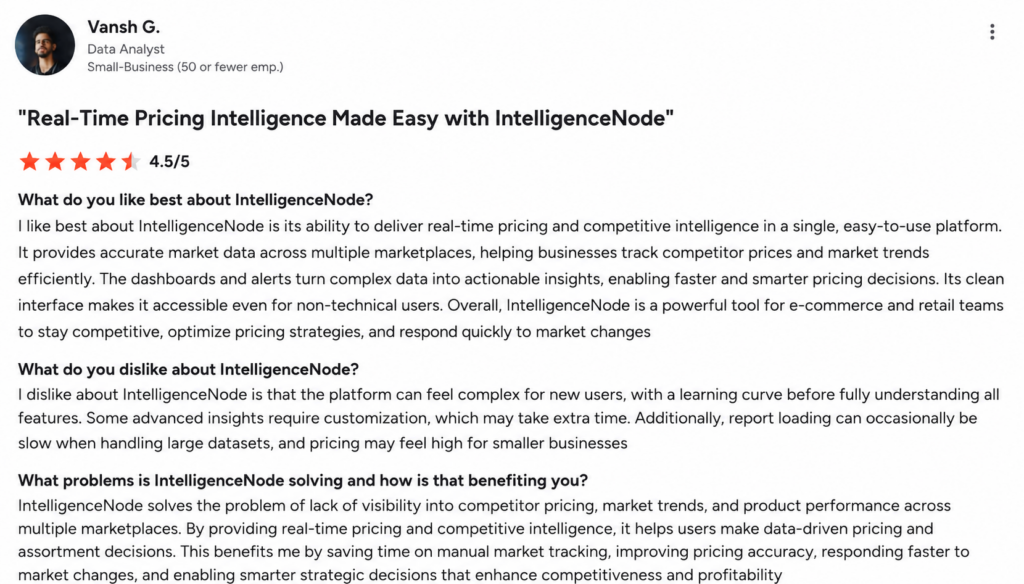
Customer feedback on G2 is generally positive. Reviewers particularly value the platform’s competitive intelligence, product and pricing data, analytics, and ability to provide visibility into large online markets.
G2 Rating: Intelligence Node currently holds a 4.5 / 5 rating on G2 based on 37 reviews.
12. Wiser Solutions – Best Prisync Alternative for Retail Price Intelligence and Market Monitoring
What Is Wiser Solutions?
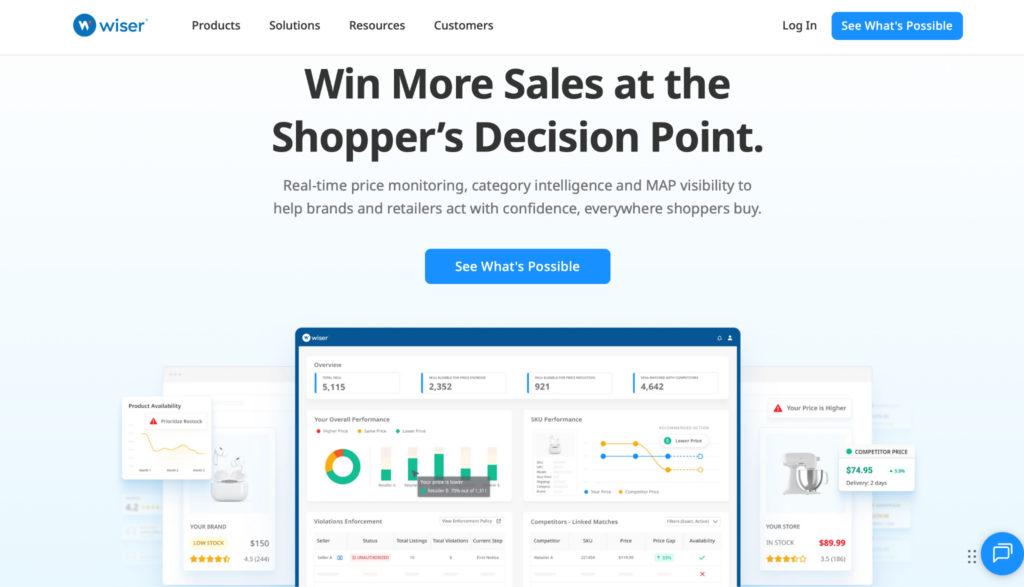
Wiser Solutions is a commerce intelligence platform for brands and retailers. Its solutions help businesses collect and analyze competitive pricing, promotions, product availability, digital shelf performance, marketplace activity, and other market signals across online and physical retail environments.
For businesses choosing a Prisync replacement, Wiser’s best features lie in its dedicated price and market analysis tools. Using this platform and its functionality, businesses can easily monitor competitor prices, monitor market changes, analyze pricing trends, and use competitor data to make quick pricing decisions.
Why Is Wiser Solutions a Strong Prisync Alternative?
Wiser Solutions is a strong alternative when competitor price monitoring is important but pricing teams also need context around promotions, assortment, availability, marketplaces, and digital shelf performance. Key capabilities include:
- Competitor price monitoring
- Competitive pricing intelligence
- Price and promotion tracking
- Historical pricing analysis
- Product matching
- MAP monitoring
Wiser Solutions Pros & Cons
| Pros | Cons |
| Combines competitor pricing intelligence with broader commerce and digital shelf insights | Broader commerce intelligence functionality may be unnecessary for businesses that only need straightforward competitor price tracking |
| Useful for brands as well as retailers that need visibility across ecommerce and marketplace channels | Standard subscription pricing is not publicly disclosed |
| Covers pricing, promotions, MAP, assortment, availability, and other competitive signals | Less focused on elasticity-based price optimization than dedicated retail optimization platforms |
| Product matching supports competitive comparisons across large and changing online assortments | Deployment requirements can be greater than those of lightweight self-service price trackers |
Wiser Solutions Pricing
Wiser Solutions does not publicly list standard monthly subscription plans or starting prices for its broader commerce intelligence offering. Prospective customers are directed to contact the company and request a demo, with the final solution tailored to their business requirements.
What Are Wiser Solutions Customers Saying?
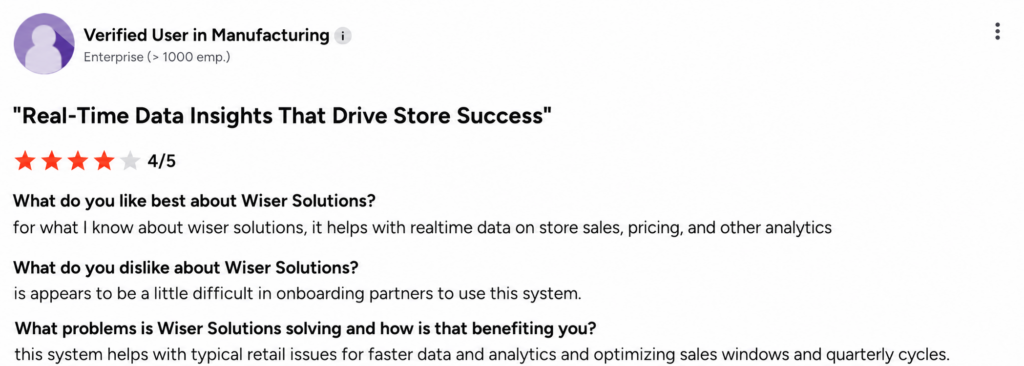
Wiser Solutions has a larger public G2 review base than several enterprise platforms in this comparison. Customer feedback commonly highlights the value of competitive market information and the ability to replace time-consuming manual data collection with more scalable monitoring.
G2 Rating: Wiser Solutions currently holds a 4.3 / 5 rating on G2 based on 63 reviews.
How to Choose the Right Prisync Alternative?
The key to choosing the best alternative to Prisync begins with defining the specific problem you need to solve and the underlying pricing issue. Monitoring competitors’ markets may be sufficient for small online platforms/stores seeking market pricing information, while a larger retailer, for example, needs to model demand elasticity, optimize, implement promotions, discounts, and, for example, perform scenario planning.
The distinction matters as retailers invest more heavily in AI: McKinsey reports that only 15% of AI investment among European retailers currently goes to the commercial domain, despite it representing the largest opportunity. Rather than choosing the platform with the longest feature list, retailers should evaluate how well each solution supports their pricing strategy, data environment, team, and scale.
Features and Solutions
Start by separating essential capabilities from features that are simply useful to have. Depending on the retailer and pricing strategy, relevant capabilities may include:
- Competitor price monitoring. Tracking competitor prices, availability, and market changes at SKU level.
- Automated repricing. Applying predefined rules or strategies when market conditions change.
- Retail price optimization. Recommending prices based on business objectives rather than competitor prices alone.
- Price elasticity and demand modeling. Estimating how changes in price may affect demand.
- Promotion optimization. Evaluating and improving promotional pricing decisions.
- Markdown optimization. Determining markdown timing and depth for seasonal, perishable, or end-of-life inventory.
- Scenario planning. Testing the potential impact of different pricing decisions before implementation.
- Business rules and constraints. Incorporating margin targets, price relationships, competitive positioning, and other commercial requirements.
- Integrations and data management. Connecting pricing workflows with ERP, ecommerce, POS, competitive intelligence, and other retail systems.
- Explainability and control. Allowing pricing teams to understand recommendations, apply business judgment, and retain appropriate control over final decisions.
Not every retailer will require all of these features. As we mentioned above, small platforms like online stores would be better off focusing on competitor filtering and price adjustments, while a grocery store or a large chain with thousands of products in stock will require a platform that prioritizes flexibility, product integration, promotions, and optimization at scale.
Pricing
Compare the total cost of using the platform rather than the advertised starting price alone. Prisync alternatives range from subscription-based competitor monitoring tools with publicly listed plans to enterprise pricing platforms sold through custom contracts.
Consider what drives the final cost, such as the number of products, competitors, markets, users, modules, or integrations, and whether implementation, onboarding, support, or additional data services are included. A lower-cost monitoring tool can be the better choice when competitive visibility is the primary requirement, while more sophisticated optimization software may justify a larger investment when pricing decisions have material effects across a large assortment.
Business Size and Pricing Complexity
The right platform should fit both the current size of the business and the complexity of its pricing decisions. Smaller ecommerce teams may value quick deployment, straightforward workflows, and the ability to monitor selected competitors without a major implementation project.
Large retailers have a different challenge. Thousands of SKUs, multiple stores or markets, frequent promotions, category relationships, business constraints, and large volumes of transaction data can require a platform built for enterprise-scale optimization. Before choosing an alternative, consider not only whether the software can support today’s assortment but also whether its data architecture, integrations, automation, and pricing capabilities can scale as the business grows.
Because these platforms serve different parts of the pricing market, we do not treat every capability as equally important for every business. A straightforward competitor monitoring tool may be the stronger choice for a small ecommerce operation, while a large retailer may need a platform capable of predictive pricing analytics and demand modeling, optimizing prices across thousands of SKUs, and supporting complex business rules. The rankings therefore reflect use-case fit as well as overall pricing capabilities.
Prisync Pricing vs. Alternatives
Pricing for alternatives to Prisync varies considerably, but only because each platform focuses on solving a different problem. Prisync, on the other hand, is one of the most straightforward options, as it publicly lists its pricing and plans (which start at $99 per month, including monitoring of approximately 100 products by their URLs, as well as a 14-day free trial that doesn’t require any personal information, especially a credit card number). Of course, there are also more expensive plans that add dynamic pricing, help tracking marketplace changes, price history, and various features. Businesses tracking more than 5,000 products can choose a custom plan.
Enterprise platforms such as Yieldigo, Competera, RELEX, Revionics, Pricefx, Zilliant, Quicklizard, Intelligence Node, and Wiser generally require businesses to request a quote. PriceShape and Omnia Retail sit between these models by publishing starting prices while offering more advanced price management capabilities. Because the scope varies substantially, starting price should be treated as one comparison point rather than a direct measure of value.
| Platform | Starting Price | Pricing Model | Free Trial / Demo | Best Fit |
| Prisync | $99/month | Tiered subscription; custom plan for 5,000+ products | 14 day free trial | Ecommerce competitor monitoring and dynamic pricing |
| Yieldigo | Not publicly listed | Custom / quote-based | Demo | Grocery and complex retail price optimization |
| PriceShape | €599/month | Subscription based on products and markets | Demo / trial | Ecommerce competitive pricing and dynamic pricing |
| Omnia Retail | €399/month | SMB subscription; custom Enterprise pricing | Demo | Automated retail and ecommerce pricing |
| Competera | Not publicly listed | Custom / quote-based | Demo | Enterprise retail price optimization |
| RELEX Solutions | Not publicly listed | Custom / quote-based | Demo / consultation | Integrated retail planning |
| Revionics | Not publicly listed | Custom / quote-based | Demo | Enterprise grocery and retail pricing |
| Pricefx | Not publicly listed | Custom / enterprise | Demo | Configurable enterprise pricing |
| Zilliant | Not publicly listed | Custom / enterprise | Demo | B2B price management and optimization |
| Price2Spy | Public tiered pricing | Subscription; Premium/custom options | 14 day free trial | Competitor monitoring and repricing |
| Quicklizard | Not publicly listed | Custom | Demo | AI-powered multichannel pricing |
| Intelligence Node | Not publicly listed | Custom | Demo | Competitive retail intelligence |
| Wiser Solutions | Not publicly listed | Custom | Demo | Retail and commerce intelligence |
Prisync Alternatives by Use Case: Which Platform Is Best for What?
The best Prisync alternative depends on why you are replacing or expanding beyond competitor price monitoring in the first place. Some retailers need deeper competitive intelligence or ecommerce repricing, while others are looking for AI-powered optimization, promotion analytics and markdown capabilities, or a platform that connects pricing with broader retail planning. The table below matches the strongest alternatives in this comparison with the use cases where their capabilities are most relevant.
AI-powered pricing is already becoming mainstream in retail. According to Deloitte’s 2026 Global Retail Industry Outlook, 48% of retail executives surveyed say their companies currently use AI for pricing and promotion optimization, making it the second-most common AI use case in retail after fraud detection and cybersecurity.
| Retail Need | Best Alternative | Why |
| Grocery price optimization | Yieldigo | Retail-focused AI optimization with elasticity modeling, product relationships, business rules, and what-if simulations |
| AI price optimization | Yieldigo | Combines ML/AI recommendations with elasticity, cross-effects, business constraints, and pricing-manager control |
| Promotion optimization | Revionics | Enterprise retail platform with dedicated promotion optimization alongside regular pricing and markdowns |
| Markdown optimization | RELEX Solutions | Connects AI-driven markdown decisions with demand forecasts, inventory, replenishment, and sell-through planning |
| Competitor price monitoring | Price2Spy | Dedicated competitive monitoring with alerts, historical analysis, product matching, MAP monitoring, and optional repricing |
| Ecommerce pricing | PriceShape | Combines ecommerce competitor monitoring with automated dynamic pricing and configurable strategies |
| Enterprise retail pricing | Competera | Combines competitive data with AI optimization, elasticity modeling, simulations, and enterprise pricing workflows |
| Integrated retail planning | RELEX Solutions | Connects pricing and promotions with forecasting, inventory, replenishment, assortment, and merchandising |
- Best Prisync Alternative for Grocery Retailers: Yieldigo. Yieldigo is our strongest fit for grocery retailers because its pricing environment is built around the complexities of professional retail rather than competitor monitoring alone. It combines AI-powered optimization with price elasticity, cross-product relationships, business rules, simulations, promotions, multibuy pricing and markdown capabilities, allowing grocery pricing teams to account for how thousands of interconnected products affect demand, margins, and overall category performance.
- Best Prisync Alternative for AI Price Optimization: Yieldigo. Yieldigo is also our pick for AI price optimization when the goal is to move beyond reactive competitor-based repricing. Its ML/AI models combine demand and elasticity with product relationships and commercial constraints, while what-if simulations let teams assess potential effects on revenue, margin, volume, and other KPIs before implementing changes. Importantly, pricing managers can retain control through rules and constraints rather than relying on completely autonomous price changes.
- Best Prisync Alternative for Promotion Optimization: Revionics. Among the alternatives to Prisync, the Revionics platform is your best bet if your goal is to optimize promotions, as optimization of this process is a specialized part of Revionics’ retail pricing solution for businesses. This platform leverages demand analysis and artificial intelligence to quickly and efficiently help retailers evaluate promotional pricing decisions, alongside regular prices, competitor market position, and other commercial constraints. This makes it particularly relevant for large enterprise retailers, where promotions are a key part of their pricing calendar.
- Best Prisync Alternative for Markdown Optimization: RELEX Solutions. RELEX Solutions stands out for markdown optimization because markdown decisions can be connected with demand forecasting, inventory, replenishment, and broader retail planning. Its markdown pricing capabilities are designed for seasonal, promotional, and end-of-life inventory, making RELEX particularly relevant when the objective is not simply to reduce a price but to coordinate markdown timing and depth with stock levels and expected demand.
- Best Prisync Alternative for Competitor Price Monitoring: Price2Spy. Price2Spy is one of the closest direct alternatives to Prisync for competitor price monitoring. It tracks competitor prices and stock, provides price-change alerts and historical reporting, supports product and marketplace monitoring, and offers MAP monitoring and optional automated repricing. This makes it a strong choice for businesses that want to remain focused on competitive intelligence rather than move to a broader enterprise optimization platform.
What Do Prisync Users Say?
Prisync receives strong overall customer feedback, with a 4.7 / 5 rating from 171 reviews on G2. Users frequently praise its customer support and ease of use. Still, G2’s review analysis identifies several recurring limitations: data management issues, missing features, software bugs, manual processes, and pricing concerns are among the disadvantages mentioned by reviewers.
Some users specifically report difficulties retrieving accurate prices from certain competitor websites or URLs, while others mention missing advanced features and manual work when correcting URLs or competitor data. These concerns do not affect every user, but they highlight why businesses with more complex data, automation, or optimization requirements may evaluate Prisync alternatives.
We’ve noticed that G2 users frequently mention Prisync, saying they save time by filtering competitors, that the platform is truly easy to use, and that it has fairly good, responsive customer support. For example, one commenter said that as a small business owner, the platform was very helpful because it eliminates the need to manually check competitor prices, thereby expanding the company’s ability to track competitors in Google Shopping search results.
Other reviewers similarly value its automated tracking and daily reporting, particularly in fast-moving ecommerce markets. Reported limitations include additional costs for API access, setup requirements, and manual product matching for products without standardized GTINs.
What Users Are Saying About Yieldigo
Customer feedback published by Yieldigo points to three recurring benefits: reducing manual pricing work, giving pricing teams greater control over complex assortments, and making it easier to understand the expected business impact of price changes. These themes appear across customers operating different retail models, from grocery ecommerce to multichannel wholesale.
One example is METRO Slovakia, where Yieldigo was introduced to manage pricing across multiple regions and three customer segments. According to the case study, METRO needed to replace complex spreadsheet-based workflows while introducing multichannel and bulk-pricing strategies. Yieldigo provided regular price management, what-if simulations, bulk pricing, and product-family management. A newer METRO case study reports that the retailer can automate up to 90% of its pricing processes, while implementation of the modules, including Bulk Pricing, took 14 weeks.
“With the support of Yieldigo, we were also able to implement a new approach to bulk pricing.” – Xavier Gardies, Chief Commercial Officer, METRO Slovakia.
METRO, in this case, is a clear example of how software can deliver rapid, accurate, and effective results. According to data from Yieldigo, after the company implemented the program, prices displayed with errors visible to customers dropped by as much as 95 percent, a remarkable result. METRO used the platform across five price regions, three customer segments, six stores, and one Canadian e-commerce site, covering 21,000 active product items.
Košík.cz provides another example, this time from online grocery. The retailer initially used Yieldigo for regular price management and later adopted markdown functionality. Its case study describes using what-if simulations to assess how different pricing strategies could affect KPIs such as sales volumes, margins, revenue and profit, while expiration-based markdown pricing helped address unsold ultra-fresh inventory.
“After a successful long-term cooperation with Yieldigo on Regular pricing, we are truly confident that they are the right partner for us on our new pricing journey” – Josef Hovořák, Head of Pricing & Category Management, Košík.cz
Yieldigo’s newer Košík.cz case study provides another measurable result: the retailer says its Bulk Pricing module allows it to manage 39% of its SKUs with a single feature. The case covers a grocery ecommerce operation spanning the Czech Republic, Slovakia and Bulgaria, with more than 16,000 active SKUs.
Yieldigo vs. Prisync: Direct Comparison
Yieldigo and Prisync both help retailers make pricing decisions using data, but they approach the problem from different directions. Prisync is primarily a competitor price tracking and dynamic pricing platform for ecommerce businesses, while Yieldigo is designed around AI-powered retail price optimization, including demand and elasticity modeling, product relationships, simulations, promotions, and markdowns.
As a result, the choice is less about which platform has more features and more about the pricing problem a retailer needs to solve. Prisync is the more direct fit when competitive pricing analysis and rules-based repricing are the priority. Yieldigo becomes more relevant when retailers need to optimize prices based on demand, elasticity, assortment relationships, business constraints, and broader financial objectives.
| Criteria | Yieldigo | Prisync |
| Primary focus | AI-powered retail price optimization | Competitor price monitoring and dynamic pricing |
| Retail specialization | Built specifically for complex retail pricing, including grocery and large assortments | Primarily ecommerce-focused, with support for retailers and brands |
| AI price optimization | Yes, optimization incorporates demand, elasticity, product relationships, constraints, and business objectives | Dynamic pricing primarily uses configurable rules and competitor data |
| Elasticity modeling | Yes | Not positioned as a core capability |
| Cross-product effects | Yes, models relationships between products when evaluating pricing decisions | Not positioned as a core capability |
| Promotion optimization | Yes | Not positioned as a dedicated promotion optimization platform |
| Markdown optimization | Yes | Not positioned as a dedicated markdown optimization platform |
| Scenario simulation | Yes, what-if simulations can evaluate potential KPI impact before implementation | Not positioned as a core capability |
| Business rules | Yes, optimization can operate within retailer-defined constraints and pricing rules | Yes, users can create dynamic pricing rules |
| Competitive data | Can be incorporated as an input into broader pricing decisions | Core use case, automated competitor price tracking |
| Automated repricing | Pricing recommendations and automation within retail pricing workflows | Yes, dynamic pricing can automatically update prices according to rules |
| Integrations | Integrates with retailer data and existing pricing/IT environments | API, Magento, Shopify, WooCommerce and other ecommerce integrations |
| Explainability & control | Pricing managers retain control through rules, constraints and simulations | Users control repricing through predefined rules |
| Best suited for | Grocery and complex retailers seeking AI-driven optimization | Ecommerce businesses focused on competitor tracking and repricing |
| Pricing | Custom / quote-based | From $99/month |
| Trial / demo | Demo | 14-day free trial |
Prisync’s strong position in tracking competitors has been clearly demonstrated using official, publicly available information on the platform’s website. Its dynamic pricing model focuses on using custom rules that bidders can adjust based on their costs and competitive position.
When Should You Choose Yieldigo?
Choose Yieldigo when pricing decisions need to account for more than competitor movements. It is particularly worth evaluating as dynamic pricing software for grocery and other complex retailers managing large assortments, product relationships, demand elasticity, promotions, markdowns, and multiple business constraints. It is also the stronger fit when pricing teams want to simulate the expected effect of changes on KPIs before implementation and retain human control over AI-generated recommendations.
When Should You Choose Prisync?
Choose Prisync when the primary requirement is competitor price monitoring and ecommerce repricing. It is especially relevant to online retailers and brands that want to track competitor prices and stock availability, receive price-change notifications, analyze historical competitor data, and automatically adjust their own prices according to configurable rules. Its public plans and 14-day free trial also make it easier for smaller and mid-sized ecommerce teams to evaluate without starting with an enterprise sales process.
Conclusion
Ultimately, choosing the right Prisync replacement requires understanding your business’s pricing challenges and how retailers need to address them. Companies focused on competitor monitoring and e-commerce pricing should choose platforms like Price2Spy or PriceShape, but retailers managing product lines, promotions, discounts, and demand models will likely benefit from a more comprehensive optimization platform. For grocery stores and complex retail environments, Yiledigo stands out in this comparison precisely because it focuses on pricing optimization using artificial intelligence, elasticity modeling, product-level effects, scenario modeling, and retailer-defined business rules.
The potential impact of moving toward more sophisticated pricing technology can be substantial. Boston Consulting Group reports that retailers that have transitioned to AI-powered pricing solutions have increased gross profit by 5% to 10%, while also achieving sustainable revenue growth and improvements in customer value perception.These results reinforce why retailers should evaluate Prisync alternatives not simply by subscription cost or the number of features available, but by how well each platform supports their pricing maturity, assortment complexity, commercial objectives, and long-term pricing strategy.
Frequently Asked Questions
What is Prisync?
Prisync is a competitor price tracking and dynamic pricing platform for ecommerce businesses, retailers, and brands. It monitors competitor prices and stock availability and provides historical data, alerts, reporting, and dynamic pricing functionality that can automatically adjust prices according to predefined rules.
How much does Prisync cost?
Prisync’s publicly listed plans currently start at $99 per month, and the company offers a 14-day free trial without requiring a credit card. Pricing varies according to the monitoring method, number of products, and additional requirements, while businesses with larger assortments can request a custom plan.
What is the best Prisync alternative?
There is no single best Prisync alternative for every business. Yieldigo is our pick for AI-powered retail price optimization, Price2Spy is particularly relevant for competitor monitoring and repricing, PriceShape for ecommerce pricing intelligence, and RELEX Solutions for organizations that want pricing within a broader retail planning environment.
Who are Prisync’s main competitors?
Prisync competitors and alternatives include Yieldigo, Price2Spy, PriceShape, Omnia Retail, Competera, RELEX Solutions, Revionics, Pricefx, Zilliant, Quicklizard, Intelligence Node, and Wiser Solutions. They cover different parts of the pricing software market, ranging from competitor monitoring and ecommerce repricing to AI-powered enterprise retail optimization.
Is Yieldigo a good alternative to Prisync?
Yes, particularly for retailers that need to move beyond competitor-driven pricing. Yieldigo combines retail price optimization with elasticity modeling, product relationships, business constraints, scenario simulations, promotion optimization, and markdown capabilities, making it more relevant to complex retail pricing environments.
How does Yieldigo compare with Prisync?
The biggest difference is scope. Prisync centers on competitor price monitoring and rules-based dynamic pricing, while Yieldigo centers on AI-powered retail price optimization using demand, elasticity, product relationships, business constraints, and simulations. Prisync is therefore closer to a competitive pricing and repricing tool, while Yieldigo addresses a broader retail optimization problem.
Which Prisync alternative is best for grocery retailers?
Yieldigo is our pick for grocery retailers among the alternatives evaluated in this article. Its retail-specific approach can account for price elasticity, relationships between products, business rules, promotions, markdowns, and broader pricing objectives, all of which become particularly important when managing large grocery assortments.
Which Prisync alternatives offer promotion optimization?
Among the platforms evaluated here, Yieldigo, Revionics, Competera, and RELEX Solutions provide capabilities relevant to promotion pricing or optimization. Retailers should compare how each platform connects promotions with demand forecasting, regular pricing, inventory, business constraints, and other parts of the commercial process rather than comparing the presence of a feature alone.
Which Prisync alternatives support markdown optimization?
Yieldigo, Revionics, Competera, and RELEX Solutions are among the alternatives in this comparison with markdown-related capabilities. RELEX is particularly relevant when markdown decisions need to connect with inventory and demand planning, while Yieldigo incorporates markdowns within a broader retail pricing optimization environment.
Are there cheaper alternatives to Prisync?
It depends on the required scope, and starting prices alone can be misleading. Prisync already has publicly listed plans starting at $99/month, while many enterprise alternatives use custom pricing; tools such as PriceShape and Omnia publish higher starting prices. A retailer should therefore compare total required functionality rather than assuming that an enterprise optimization platform and a competitor monitoring tool are interchangeable on price.
What should retailers consider when switching pricing software?
Retailers should evaluate pricing use case, assortment size, data requirements, integrations, automation level, explainability, implementation effort, scalability, and total cost of ownership. They should also test whether a platform fits their actual pricing maturity: a business that primarily needs competitor monitoring has very different requirements from a retailer trying to optimize prices, promotions, and markdowns across thousands of interconnected SKUs.